Most retailers focus their security budget on the shop floor—cameras, staff on tills, security gates. But that’s only half the threat. The other half happens where no one is looking: in stockrooms, after hours, in blind spots. Understanding where losses come from is the first step to stopping them.
The breakdown matters. Customer shoplifting is large, but staff-related shrinkage accounts for 22.1% of all shrink in UK retail—roughly £1,305 million a year. These sources drain profit in different ways and need different defences.
What the Numbers Show
Shoplifting costs £400 million a year. There are 5.45 million recorded incidents. But staff shrinkage, though less visible, is equally costly. Beyond these two sit procedural errors, waste, and unaccounted loss.
The total shrinkage in UK retail sits at 1.42% of sales—almost £5.5 billion a year. That scale matters. It adds up across seasons, regions, and product lines.
Why separate the sources? Because stopping a shoplifter needs different tools than stopping staff theft. Stopping staff theft needs different controls than fixing procedural errors. Treating all shrink the same leads to wasted security spend and leaves real losses open.
External Theft: The Visible Front
Shoplifting happens during trading hours. Thieves target high-value items in quiet moments or when staff are busy at checkouts. They use hoods, prams, and open stockroom doors to leave the store.
Traditional CCTV records what happened after the fact. But it does not stop a theft in progress. A shoplifter runs a quick risk calculation: Will I be seen? Can I escape? Is the haul worth it?
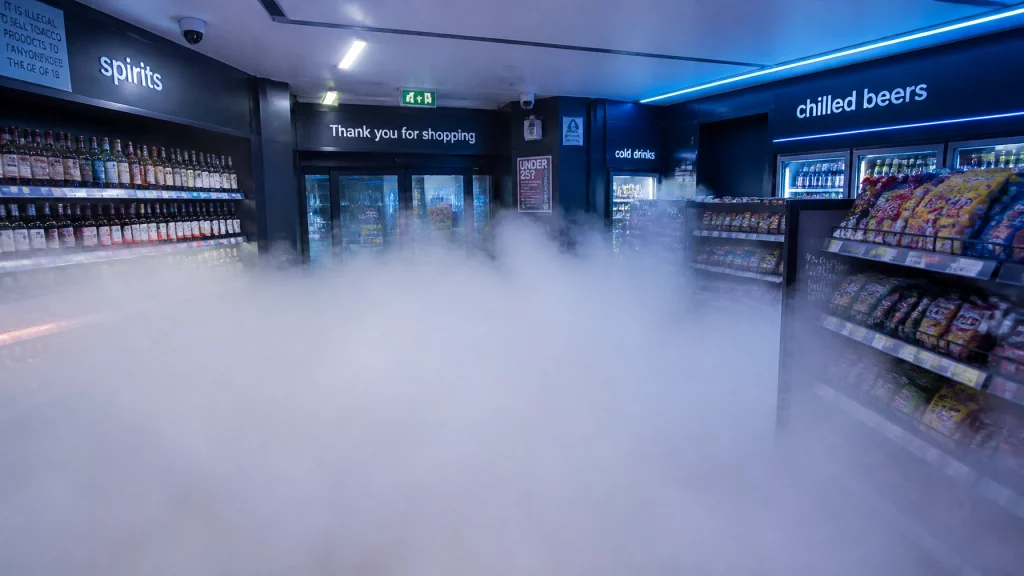
Fog removes that calculation entirely. When the alarm sounds, the shop fills with fog in seconds. Visibility dies. The thief cannot see exits. They cannot run without hitting obstacles. Getting caught moves from possible to probable. The risk is no longer worth taking.
This is why 97% of thefts are avoided with a fogging system AND an alarm, compared with 17% with an alarm only, according to Density® manufacturer figures. The fog is not just a reactive tool—it is a deterrent that works before theft happens.
Tools that work:
- Store layout and mirrors to reduce blind spots
- Staff on the floor
- Security tags on high-value items
- CCTV for after-the-fact evidence
- Real-time active deterrence
That last one is key. A system that floods the store with odourless, non-toxic fog the moment an alarm sounds stops the thief cold. Thieves will not face that risk twice.
Internal Theft: The Hidden Drain
Staff shrinkage is less obvious than shoplifting. It happens in stockrooms, during till closure, on breaks. One item per shift. A handful of voided transactions. Deliberate small discounts. It leaves no alarm, no broken glass, no evidence of urgency.
Staff have a key advantage: access and legitimacy. They know where cameras do not reach. They understand stock rotation and valuation. They may alter records instead of stealing goods outright. A void here. A discount there. A receiver who doesn’t log an item in. These add up quietly.
Tackling internal loss requires a different playbook:
- Lock stockrooms and log entries
- Audit tills daily and track variance trends
- Split duties (one person receives, another checks in)
- Use inventory systems to spot gaps
- Build a culture where theft is never accepted
Technology is useful, but culture is decisive. Retailers with clear anti-theft values, trained managers, and open reporting channels see significantly lower internal loss.
How Integrated Security Addresses Both Routes
The best retailers layer different tools to address each threat. No single measure stops everything. The framework combines detection, deterrence, and control:
- Access control: Restrict stockroom entry. Log who enters and exits and when. This blocks opportunistic staff theft and creates accountability.
- CCTV: Position cameras at tills, in stockrooms, and at entry points. Retain footage for investigation and audit trails. CCTV alone deters some, but does not stop committed theft.
- Active deterrence: Deploy fogging at entry points. When an alarm sounds, fog fills the shop in seconds. Visibility dies. Thieves cannot find exits. The risk changes from acceptable to unacceptable.
- Alarm integration: Density systems integrate with all existing alarm panels and Ajax interfaces. They offer free remote monitoring via ActiveCloud and work with video management systems and LAN APIs.
- Procedures: Implement tight stock checks, daily till reconciliation, and clear approval limits for discounts and refunds. Strong procedures cut internal loss and create an audit trail for investigation.
The benefit of layering is resilience. If a camera fails, fogging and procedures remain effective. If procedures weaken, CCTV and access control catch issues. Speed is also critical. Active deterrence only works if it responds faster than the threat. Fog filling a store in seconds is faster than a thief’s escape.
Sizing and Coverage
Fogging systems are specified by store volume, not floor area. A security survey assesses your layout, identifies high-risk zones, and recommends the right unit for your space. Convenience stores often use units covering up to 600 m³. Mid-size retail operations use units up to 1,500 m³. Large warehouses and big-box stores use units up to 14,000 m³. Coverage is focused where stock and risk cluster: the till area, main stockroom, and high-shrink merchandise zones.
The fog itself is non-toxic and certified to international standards (EN 50131-8:2019, CE, EMC, FCC). It is safe for people and animals. For food retail environments, the fog meets food-contact regulation Reg. (CE) No. 1935/2004—meaning it poses no health or safety risk in supermarkets, convenience stores, or food-contact areas. Retailers across 80+ countries use Density systems in every retail environment.
97% of thefts are avoided with a fogging system AND an alarm, compared with 17% with an alarm only – Density® manufacturer figure
Building a Loss-Prevention Strategy
You cannot stop all theft, but you can cut it sharply. Top retailers mix three things: active technology, tight procedures, and a culture where loss prevention matters to everyone.
For more on how to build this, see The Retailer’s Guide to Loss Prevention. It covers layered design, deterrence, detection, and the procedures that make technology work.
Frequently asked questions
What percentage of retail shrinkage is caused by staff theft?
Staff shrinkage is 22.1% of total loss in UK retail, roughly £1,305 million per year. The rest comes from shoplifting, errors, and waste. Both must be tackled.
How fast does fog deploy?
Fogging systems release non-toxic fog in seconds when an alarm sounds. The fog fills the space and blocks vision. It clears safely once the threat is gone. Fogging activates automatically when triggered by door breach or alarm signal.
Can I use fogging in a food store?
Yes. Density systems meet food-contact regulation Reg. (CE) No. 1935/2004. The fog is non-toxic, odourless, and leaves no residue. Safe for supermarkets and convenience stores.
Does my store need fogging?
A security survey will assess your site and recommend layers of protection. Fogging works best where external theft risk is high, stock is valuable, or entry points are vulnerable. See the Loss Prevention sector page or book a survey.
Does fogging work with my existing alarm system?
Yes. Density systems work with all alarm panels and Ajax. Free remote monitoring via ActiveCloud. Compatible with LAN and video management systems. No need to replace existing equipment.
Get a Survey
If your store is losing profit to shrinkage, a professional audit will pinpoint the leaks and recommend the most cost-effective fixes. Fogging stops external theft cold. Combined with good procedures and access control, it cuts loss across both internal and external routes.
Explore our fogging systems and book a survey. Our specialists will assess your site, identify where you’re losing money, and recommend the right protection.