Start your autumn business security review in September
As daylight hours shorten, your premises spend more time unoccupied in darkness. The period after the clocks change is associated with a measurable increase in burglary and theft risk. Business theft claims have been reported to rise by 35% in the months following the clocks going back, with November identified as a particularly high-risk month (Property Reporter).
September is the correct time to review your burglary prevention for business. Do not wait for an attempted break-in, a failed lock or a police incident. Use the seven-point checklist below to identify weaknesses and add active protection where passive measures are not sufficient.
1. Risk: Earlier darkness creates longer attack windows
A business may be empty from late afternoon until the following morning. The earlier sunset gives intruders more time to approach doors, loading bays, windows and roof access without being seen.
Research indicates that a significant proportion of burglaries occur during evening and night hours. For a commercial site, this means your out-of-hours security arrangements must work continuously, not only when a keyholder is nearby.
Fix: Audit visibility and perimeter protection
Check the following before October:
- External lighting at entrances, rear doors, yards and loading areas.
- Motion-activated lighting and timer-controlled internal lighting.
- CCTV coverage of access points, stockrooms, cash areas and perimeter routes.
- Visibility of gates, shutters, doors and vulnerable windows.
- Vegetation, storage or vehicles that provide cover.
CCTV supports identification and investigation. It does not physically prevent an intruder from reaching stock. Add an active layer that responds immediately when the alarm detects an intrusion.
2. Risk: Relying on an alarm to stop the theft
An alarm is essential, but detection does not equal prevention. A typical break-in can be completed in two or three minutes. A monitoring centre, keyholder or police response may not arrive before the intruder has reached the stock, safe or equipment.
The performance difference is clear: 97% of thefts avoided with fog vs 17% with just an alarm.
Fix: Connect a security fog system to your existing alarm
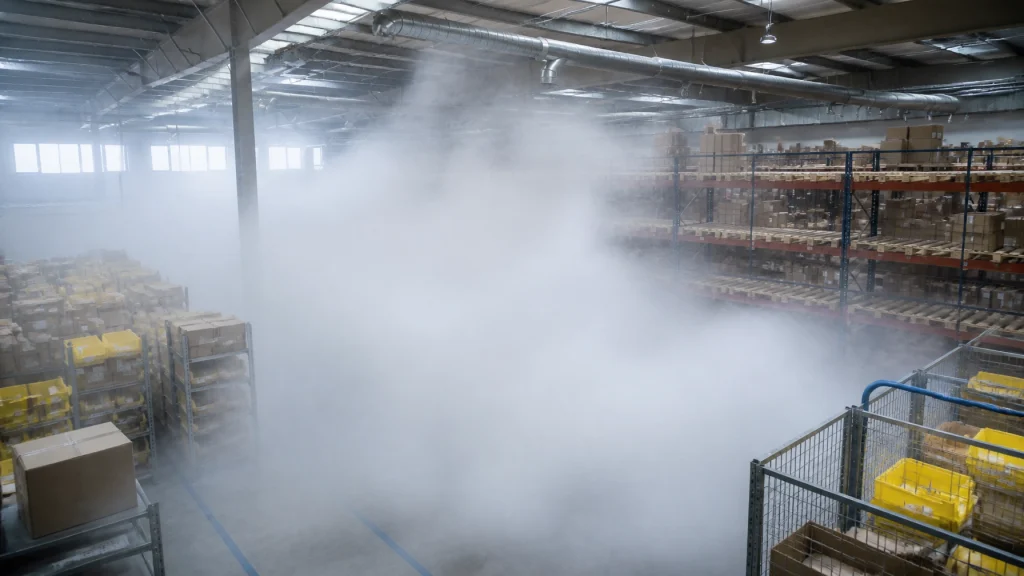
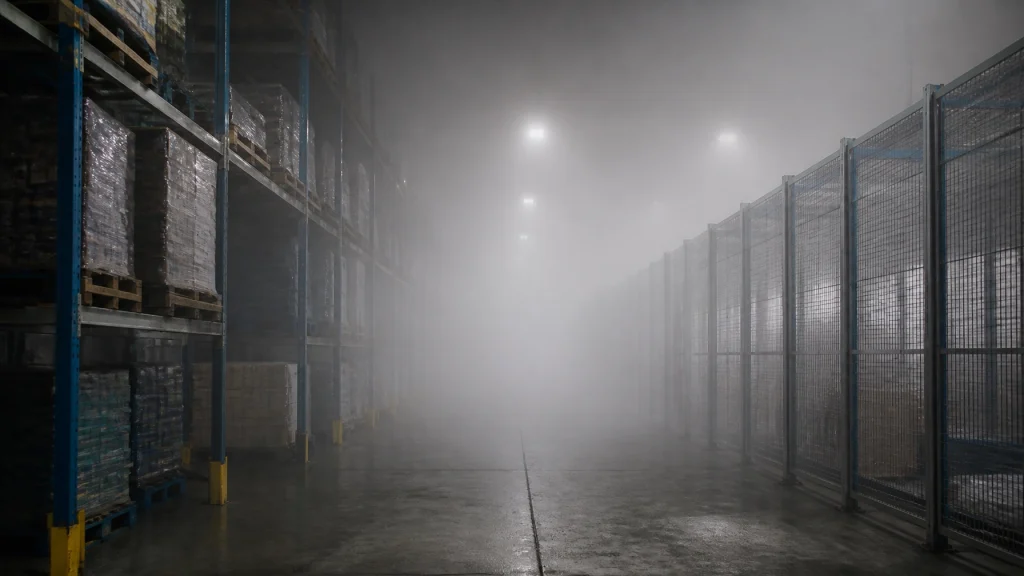
A Density® system receives the alarm signal and deploys dense, non-toxic fog in seconds. Visibility drops to less than an arm’s length, removing the intruder’s ability to locate goods, operate tools or find a safe route out.
The operating principle is simple:
Alarms detect. CCTV records. Density prevents.
Density fog is water-based, food-grade and residue-free. It is designed to protect stock, electronics, paperwork and food environments when correctly specified and installed.

3. Risk: Treating locks, shutters and glass as complete protection
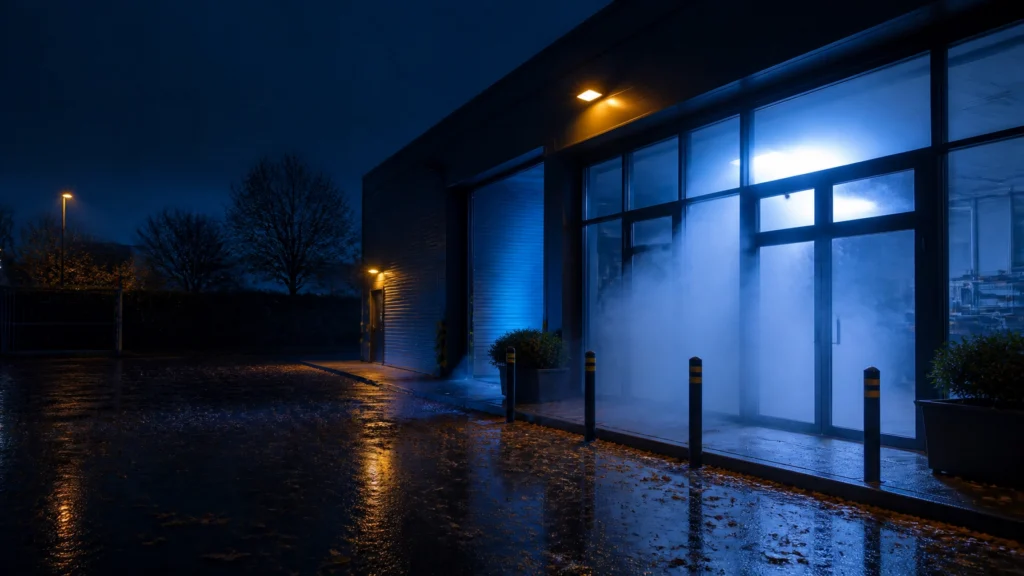
Strong doors, shutters, grilles and locks delay access. They do not guarantee that an organised group cannot force entry. Smash-and-grab attacks are designed to exploit a short period of access: break the glass, remove high-value stock and leave before a conventional response is effective.
Fix: Use physical delay and active denial together
Review each external barrier and ask:
- Can the door, shutter or window be attacked from a concealed position?
- Can stock be reached immediately after entry?
- Is the alarm triggered before the intruder reaches high-value areas?
- Does the site have a response that prevents visibility after the alarm activates?
Do not assume that a safe solves the entire problem. A safe may protect selected contents, but it can still be attacked, removed or accessed if the intruder has time. Similarly, thieves may use tools or fire extinguishers to break display cases, damage equipment or disrupt visibility.
A security fog system protects the wider zone. It can obscure display areas, counters, safes and stockrooms before the theft can be completed.
4. Risk: Protecting only the sales floor
The main retail area is not the only target. Intruders may move towards stockrooms, offices, server rooms, cash offices, loading bays or secure storage areas once inside.
Warehouses and factories present a further challenge. Large volumes, high shelving and multiple access routes make it difficult for one alarm or camera to control every area effectively.
Fix: Design protection by zone and volume
Map the premises and identify:
- Entry points.
- High-value stock locations.
- Routes from the entrance to the target.
- Areas with limited camera visibility.
- Zones where an intruder could hide or wait.
For smaller premises, the Density® Basic provides entry-level protection for homes and small shops, with coverage up to 390 m³. For compact, unmanned or mobile spaces, Density® UNIK provides instant fog generation and battery operation, with up to six months’ battery autonomy under specified conditions.
For large warehouses, logistics platforms and factories, the Density® HP line is designed for high-output protection. The range includes systems for large areas up to 1,500 m², subject to the protected volume and the installation survey.

5. Risk: Failing to plan for power loss or disabled communications
Autumn storms, accidental damage and deliberate attacks can affect mains power or communications. A security system that cannot report status or activate correctly during an interruption creates a gap at the time protection is needed most.
Fix: Confirm resilience and remote status
During your September review:
- Test alarm backup batteries.
- Check communication paths and monitoring contracts.
- Confirm that security systems report faults.
- Inspect cabling and exposed equipment.
- Verify that fog system standby and battery requirements are documented.
Density® UNIK can operate on battery power and is suitable for sites without a permanent supply. Density® Basic includes backup battery operation for approximately one hour if mains power is lost. The Density® HP line can be specified with backup power for larger industrial applications.
For connected sites, Active Cloud provides remote monitoring and management through smartphones, PCs and tablets. Use it to check system status, identify faults and manage installed systems without relying on a person being physically present.
6. Risk: Leaving staff procedures unchanged after the clocks change
A business may have secure equipment but still be vulnerable because of inconsistent closing routines. Doors can be left unsecured, alarms may not be armed correctly, and keys or access codes may remain with former employees.
Fix: Issue an autumn closing procedure
Create one written checklist and require the closing employee or manager to complete it. Include:
- Locking all external doors and accessible windows.
- Closing shutters and securing loading areas.
- Removing cash and high-value goods from displays where appropriate.
- Checking stockrooms, toilets, offices and plant areas.
- Arming the alarm and confirming the correct set mode.
- Checking that fog system status indicators show readiness.
- Confirming that Active Cloud notifications are working.
- Recording any fault for immediate action.
Review access permissions before seasonal staffing changes. Remove former employees from access-control systems and change codes where necessary. Keep a key and fob register.
7. Risk: Delaying the security upgrade until after an incident
Once autumn demand increases, installers, insurers and facilities teams may have limited availability. A late decision can leave your business exposed during the highest-risk period.
Fix: Complete a documented September survey
Use a free site survey to confirm:
- Protected volume and ceiling height.
- Required fog output and number of units.
- Alarm-panel compatibility.
- Suitable fog zones and trigger inputs.
- Backup power requirements.
- Remote monitoring requirements.
- Servicing, fluid and testing intervals.
A typical Density installation can be completed in one working day, depending on the site and existing alarm infrastructure. The system is specified to work alongside your current alarm rather than replace it.
Review the Density security fog range, including the Density® UNIK, Density® Basic and Density® HP14000 for large-volume premises.
CTA: Request a free autumn security survey
The objective is not to make your business impossible to approach. It is to ensure that an alarm activation becomes an immediate physical barrier, not simply a notification that arrives after stock has been removed.
FAQ box
Does security fog replace my intruder alarm?
No. Density systems are designed to connect to your existing alarm and add active prevention. The alarm detects the event; the fog denies visibility.Which Density® system is suitable for a small shop?
Density® Basic is designed for homes and small shops, with coverage up to 390 m³. Density® UNIK is suitable where instant trigger response, compact installation or battery operation is required.Which system protects a warehouse?
The Density® HP line is designed for large warehouses, logistics platforms and factories. Systems can protect areas up to 1,500 m², subject to protected volume and site survey.Can I monitor my system remotely?
Yes. Active Cloud enables remote monitoring and management from smartphones, PCs and tablets. Active Server provides centralised management for networked systems from one PC.Is Density fog safe around stock and food?
Density fog uses a food-grade, water-based fluid. It is designed to be non-toxic and residue-free, with food-contact testing under Regulation (EC) No 1935/2004. Site-specific installation and safety requirements must still be assessed by a qualified installer.
Prepare before the clocks change. Check passive barriers, test your alarm, review staff procedures and confirm how quickly your security system can prevent access to stock. With more than 20 years of security experience and systems tested by national and international organisations, Density provides active protection for shops, homes, warehouses, logistics platforms and factories.
CTA: Get a security fog system recommendation for your premises