The better choice for a wholesale depot
For most UK wholesale depots, a modern security fog system is the more suitable option than a pyrotechnic obscuration system.
The reason is simple: a wholesale depot needs an active response that works quickly, integrates with the alarm already in place and does not introduce avoidable contamination, heat or recovery issues around valuable stock.
A pyrotechnic obscuration system can reduce visibility, but it normally relies on a single-use charge. Depending on the system, activation may also involve heat, odour, residue and more complex post-incident procedures. Those considerations matter when the protected premises contain tobacco, spirits, pharmaceuticals, food, tools, cable, electronics or packaged goods.
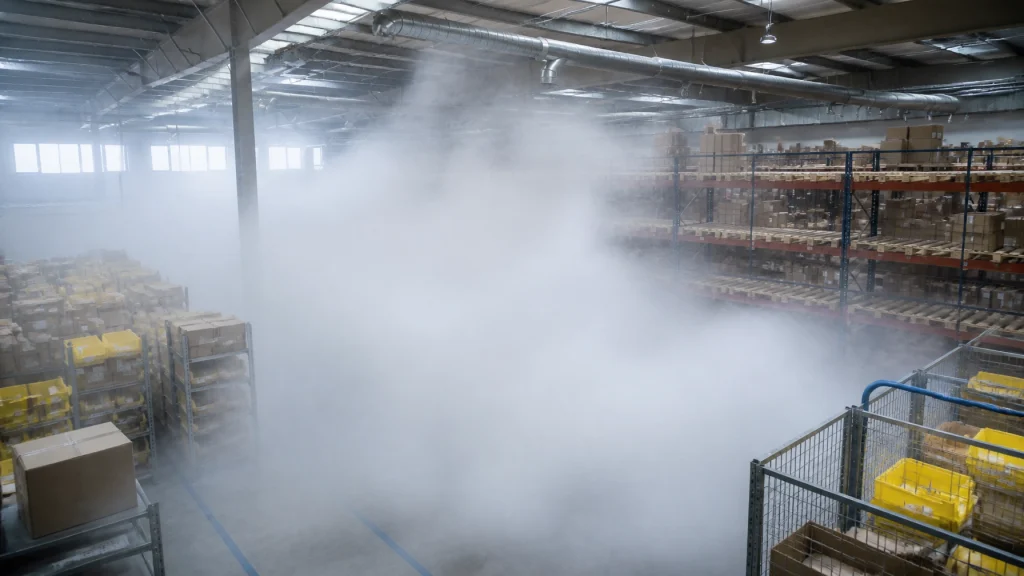
A commercial security fog system uses a non-toxic, water-based fog designed for rapid deployment. When the alarm activates, the Density system can begin deployment in approximately three seconds, creating a dense visual barrier before intruders can reach high-value stock.
That is the operational difference:
Alarms detect. CCTV records. Density prevents. Passive security fails.
Security fog is not a replacement for an alarm, CCTV, shutters, doors or physical security. It is the active layer that acts after detection and before stock can be removed.
Request a wholesale depot security assessment →
A depot is not protected simply because an alarm event has been recorded. An alarm can notify a monitoring centre, a keyholder or the police, but it does not physically obstruct an intruder inside the building. CCTV can provide valuable evidence, but it cannot stop someone moving through an aisle, forcing a cage or loading stock into a vehicle.
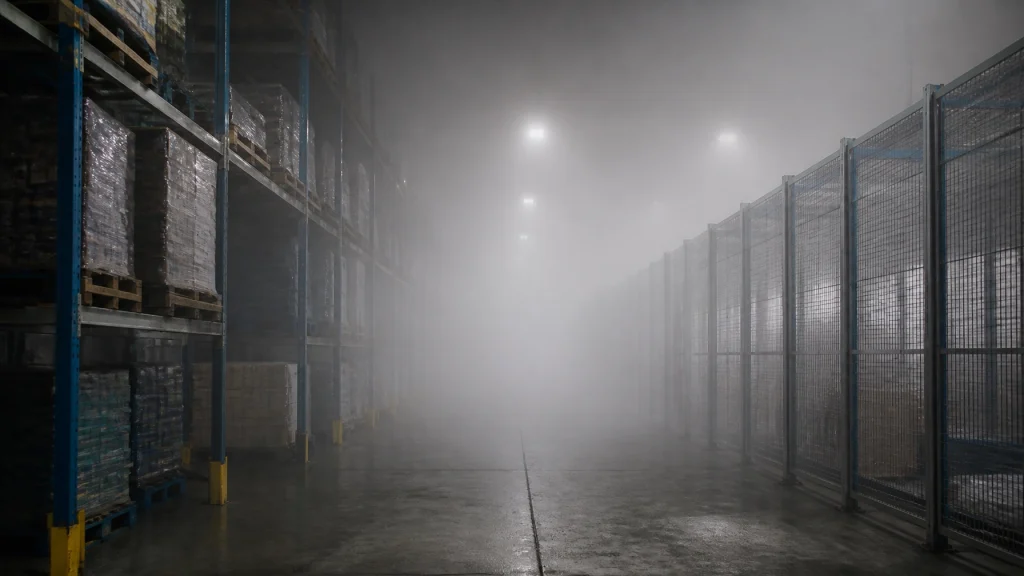
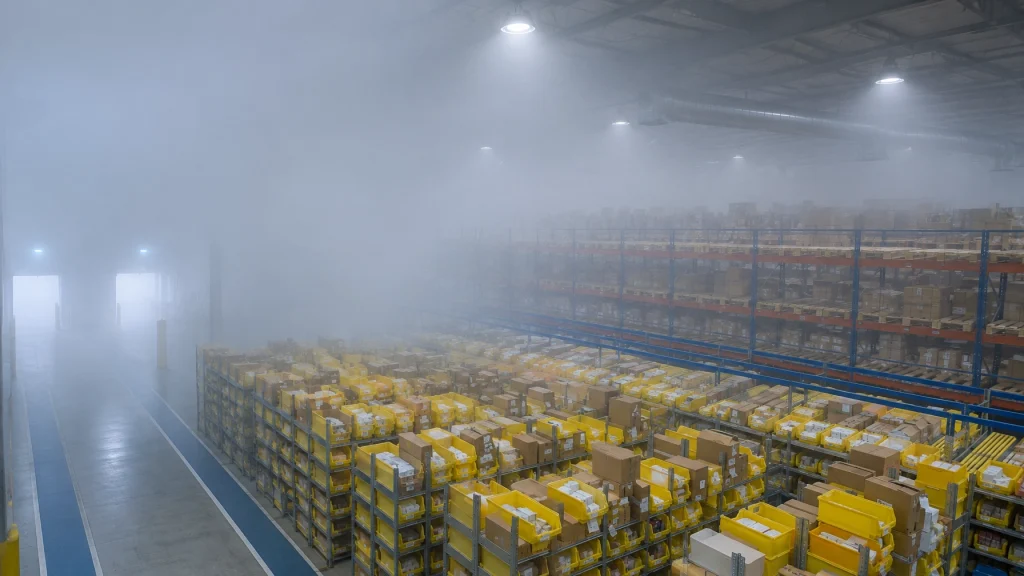
Security fog changes the conditions inside the protected zone. Visibility can fall to near-zero, making it difficult for intruders to identify stock, navigate the premises or work together. The objective is not to guarantee that every incident will be stopped. The objective is to disrupt the theft while it is in progress and create time for the response to take effect.
Security fog and pyrotechnic obscuration compared
| Consideration | Security fog system | Pyrotechnic obscuration system |
|---|---|---|
| Activation | Integrated with the existing alarm panel | May require a separate trigger or specialist integration |
| Response | Designed for rapid deployment following an alarm signal | Performance depends on the charge and system design |
| Material | Non-toxic, water-based security fog | Uses a pyrotechnic charge to create an obscuring effect |
| Reuse | Units can support multiple activations, subject to servicing and fluid capacity | Commonly requires replacement after activation |
| Stock environment | Suitable for areas containing packaged goods, food, pharmaceuticals and electronics when correctly specified | Residue, odour and heat considerations may create additional risk |
| Standard pathway | BS EN 50131-8 provides a recognised standard for security fog devices | A pyrotechnic product is not automatically an EN 50131-8 security fog device |
| Alarm compatibility | Designed to operate as part of an intruder and hold-up alarm system | Compatibility depends on the product and installer |
| Recovery | Normal operation should not require extensive cleaning | Some systems may require clean-up, ventilation or charge replacement |
| Sizing | Designed around protected volume in m³ | Coverage depends on the individual product and charge |
| Ongoing protection | Serviceable and ready for further activations | Replacement components may be needed after each event |
The standards position is important for operations managers and security directors. BS EN 50131-8 covers security fog devices and their performance, testing and use within an intruder and hold-up alarm system. The National Security Inspectorate has also published guidance on the implementation of the 2019 edition of the standard.
The BSIA security fog code of practice provides guidance on installation, commissioning and maintenance. The NSI implementation notice confirms that BS EN 50131-8:2019 superseded the earlier edition and explains its role as a product standard.
A pyrotechnic obscuration product should therefore not be described as an approved security fog system simply because it creates a visual barrier. Ask whether the product is designed, tested and documented for integration into the relevant alarm system and whether it meets the requirements specified by your insurer and security provider.

What this means for wholesale depot security
Wholesale sites often have several risk zones rather than one open room. These may include:
- A trade counter containing tills, keys or customer collection stock.
- A secure cage for tobacco, spirits or other controlled goods.
- High-value tool storage in a builders’ merchant.
- Pharmaceutical stock awaiting dispatch.
- Cable, metals or electronics stored in a rear warehouse.
- Loading areas connecting the depot to yards or vehicle access points.
- Offices containing records, keys or cash-handling equipment.
A security design should be based on the protected volume in cubic metres, not just floor area. Ceiling height, racking, partitions, doors and ventilation all affect how fog moves through the premises.
For example, the Density 2400 Lite is intended for commercial areas up to 2,400 m³, while the 2400 C-Line provides a chainable option for wider or multi-zone layouts. The HP6000 is designed for larger warehouse volumes up to 6,000 m³. The correct selection depends on the site survey, the alarm zones and the areas that need the fastest protection.
This makes security fog relevant across several wholesale applications:
- Tobacco & spirits wholesale security: protect controlled stock cages and dispatch routes.
- Builders merchant security fog: disrupt access to tools, cable and high-value materials.
- Pharmaceutical wholesale security: use a non-toxic, stock-compatible deterrent around sensitive products.
- Cash and carry depot theft deterrent: create an immediate response around high-value aisles and back-of-house zones.
- Trade counter security fog: protect staff areas, tills and stock collection points.
- Out-of-hours break-in prevention wholesale: respond during the period when a depot has fewer people on site.
For a multi-site wholesale business, consistent specification is also important. A multi-site wholesale security UK programme should document alarm compatibility, protected volume, maintenance requirements, staff procedures and insurer conditions at every location.
The Density product range covers compact secondary zones through to large wholesale and distribution environments. Every installation should be surveyed and sized for the actual volume and risk profile rather than selected from a generic floor-area estimate.
FAQ box: security fog for wholesale depots
Is a security fog system suitable for a wholesale warehouse?
Yes. A security fog system can be designed for wholesale warehouses, distribution centres, trade counters, secure cages and dispatch zones. The system must be sized according to the protected volume in m³ and integrated with the site’s alarm strategy.
What is the main difference between security fog and pyrotechnic obscuration?
Security fog systems use a controlled, non-toxic fog designed for alarm integration and repeatable operation. Pyrotechnic obscuration systems use a charge to create the obscuring effect and may involve single-use components, heat, odour or residue. The exact specification varies, so the product documentation and insurer requirements should be checked.
Will security fog damage food, tobacco or spirits?
Density security fog is non-toxic and designed to be safe around products when correctly installed and used. A site survey should confirm the protected zones, ventilation and stock requirements. Products should always be assessed against the manufacturer’s technical documentation and the business’s own risk controls.
Can a security fog system connect to our existing NSI or SSAIB alarm?
Density systems are designed to integrate with existing alarm panels through the alarm trigger, avoiding the need for a separate monitoring contract or entirely new infrastructure. Installation must be carried out by a competent security provider and documented correctly. The SSAIB Electronic Security Systems Scheme explains the role of certification for companies working on intruder alarms and related electronic security systems.
How quickly does the fog deploy?
Density units are designed to start deployment in approximately three seconds after the alarm trigger. The time required to achieve the intended obscuration depends on the unit, protected volume, ceiling height, layout and system design.
Does security fog replace an alarm or CCTV?
No. The strongest approach combines detection, verification, physical security and active intervention. Alarms detect. CCTV records. Density prevents. Passive security fails.
Are active security systems required by insurers?
Insurance requirements vary between policies and sites. However, active security systems are increasingly mandated as a prerequisite of cover for businesses holding high-value stock. Ask your broker or insurer to confirm the required standard, alarm grade, installer approval and maintenance arrangements before specifying the system.

For businesses comparing commercial security fog systems wholesalers and installers, the decision should be based on more than purchase price. Compare the system’s tested performance, coverage in m³, integration method, maintenance plan, stock compatibility and documentation for your insurer.
Consider the likely incident as well. A planned organised break-in may begin with a forced door, roof access, air-conditioning duct route or vehicle breach. Once inside, intruders can move quickly. The system needs to protect the route between the breach and the stock, not just the alarm panel or office.
Review how the proposed system would protect your actual premises:
- Identify the stock and routes most likely to be targeted.
- Confirm the volume of each protection zone in m³.
- Check compatibility with your existing NSI or SSAIB alarm system.
- Confirm whether the system meets your insurer’s requirements.
- Establish how staff, keyholders and engineers will respond after activation.
- Schedule regular servicing and confirm refill or reset procedures.
- Test the design against future changes to racking, partitions and stock layout.
You can also review real security fog case studies to see how active protection has been applied across warehouses, logistics sites, pharmacies and other commercial premises.
The principle remains clear: passive measures may delay an intruder, detect an event or provide evidence afterwards. A security fog system is designed to intervene during the incident itself.
What you can't see you can't steal.