Cameras catch theft. They don’t stop it.
Your CCTV system records shoplifters in 4K, then you hand the footage to police and watch inventory shrink. Last year, UK retailers reported 5.45 million incidents of shop theft—and most were simply filmed, not prevented. A £2.2 billion loss. The gap between seeing theft and stopping it before stock walks out the door is the entire loss prevention game.
Why Recording Alone Leaves You Exposed
CCTV serves a purpose: evidence. Evidence for police, for insurance claims, for prosecution files that gather dust. A thief knows the difference between a camera and a consequence.
Visible cameras do create a weak psychological barrier for some casual shoplifters, but they offer no intervention point. The person slipping items into a bag sees themselves on screen and steals anyway, banking on anonymity or speed. You have their face. The loss is already yours.
Retailers currently spend record sums on CCTV, AI monitoring, security tagging, and facial recognition—yet shop theft continues to rise. Why? Because these tools document. They gather intelligence. They do not physically prevent the theft from occurring in the moment it happens.
How Active Deterrence Works
Active deterrence inverts the problem. Instead of responding after the loss, it removes the conditions for theft to succeed.
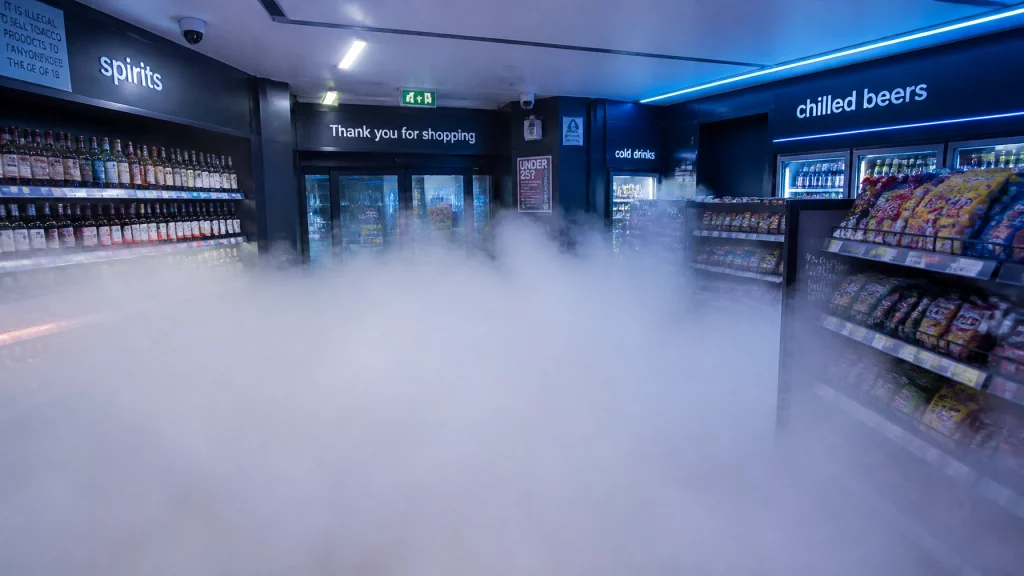
A modern security fog system activates on alarm trigger or manual command, filling the target area with a dense, non-toxic fog within seconds. Visibility drops to near-zero. Stock becomes invisible and unmarketable. The thief cannot see merchandise. They cannot load a bag. They cannot see the exit.
This is not theatre. It is a mechanical barrier—not a psychological one.
Unlike a visible camera that a thief can choose to ignore, an active fog system fundamentally breaks the conditions under which theft operates. Speed, visibility, and concealment are the three pillars of retail theft. Fog attacks all three at once.
97% of thefts are avoided with a fogging system and an alarm, compared with 17% with an alarm only. Density manufacturer figure.
That 97% figure reflects the combined power of active intervention. A fogging system does not arrest the offender. It makes theft operationally impossible during the critical seconds when goods are at risk.
Speed Matters
The window for organised retail crime is narrow. A gang hitting a store at closing time, a smash-and-grab at a high-value display, an employee filling a bag during a rush—all rely on a brief, uninterrupted sequence.
Fog fills a space in seconds. The thief cannot see. Cannot load. Cannot navigate. The heist that would take 90 seconds becomes a 10-second bet against chaos. Most abandon the attempt.
CCTV, by contrast, offers no barrier to speed. The camera films the entire crime, then you call police. By then the thief is gone, and your stock is gone.
Building the Right System
Effective active deterrence does not work in isolation. It integrates with existing alarm infrastructure—all major alarm panels, Ajax systems, and compatible VMS setups. Your installer connects the fog system to the same sensors and logic that trigger your current alarm response.
For large premises—warehouses, distribution centres, cash-and-carry sites—larger systems cover up to 14,000 cubic metres. The HP14000 fills a 14,000 m³ space with fog in under 30 seconds. For retail environments and smaller facilities, the Basic system covers 390 m³, the Density 600 covers 600 m³, and the Density 900 covers 900 m³.
All systems are certified to EN 50131-8:2019, comply with CE and EMC standards, and use non-toxic fluid certified by Eurofins. Where food is present, the system meets food-contact regulations under EU Reg. 1935/2004, leaving no residue and no risk to stock or customers.
Integration and Monitoring
Fog systems are not bolt-on gadgets. They talk to your alarm, your monitoring centre, and your security operations room. ActiveCloud, Density’s free remote monitoring platform, logs every activation, trigger point, and system status in real time.
If you run a multi-site retail operation, you can see fog activations across all locations from one dashboard. You can audit which alarm sensor triggered the response. You can correlate fog deployment with CCTV footage from the seconds before activation—combining active prevention with retrospective investigation.
This integration is why active deterrence works alongside traditional security, not against it.
Installation and Maintenance
A fogging system is installed at ceiling height or within a wall-mounted bracket. Activation is hardwired to your alarm panel or controlled via a wireless button at your monitoring centre. When a perimeter breach or internal trigger occurs, the control unit releases the fog charge.
Residual fluid evaporates naturally. The system resets and rearms. Maintenance is annual: a new cartridge and a function check. Systems have been deployed in 80+ countries and operate reliably in retail, hospitality, jewellery, cash handling, and warehouse environments.
The Difference Active Deterrence Makes
Cameras and alarms remain essential. But they are reactive. Active deterrence is preventive. It does not wait for crime to occur and then document it. It stops the crime before it begins by removing the operational space—the time, visibility, and conditions—that theft requires.
Retailers that invest in layered loss prevention, including active deterrence, reduce theft not by prosecuting more offenders, but by making theft logistically impossible during the moments of highest risk.
Frequently asked questions
Does fog damage stock or equipment?
No. The fog is non-toxic, certified by Eurofins for safety to humans and animals, and tested to EN ISO 16000-1:2006. In food environments, it is certified to Reg. (CE) No. 1935/2004 and leaves no residue. It clears naturally within minutes once ventilation resumes.
Can a fog system activate by accident?
No. Activation requires either a genuine alarm trigger from your connected sensors or a manual command from an authorised user. False alarms are extremely rare, and if they do occur, the fog disperses naturally without damaging stock or premises.
Is it visible to customers during normal operation?
No. The fog system is dormant during normal trading. It is only released on alarm trigger. A customer in the store during normal hours will not see or be affected by the system.
How does it integrate with my existing security setup?
Fog systems are fully compatible with all major alarm panels and control interfaces. Your installer connects the fog control unit to the same circuit or wireless protocol as your existing alarms, so activation is seamless with your current security infrastructure.
What happens after the fog is released?
Once activated, the fog fills the target space and disperses naturally. Your security team can then investigate, assess any incident, and retrieve CCTV footage from the seconds before activation. The system resets and is ready to rearm within minutes.
Next Steps
If your retail operation is losing inventory to theft despite cameras, alarms, and monitoring, active deterrence fills the gap where cameras can only record. Get a quote or book a survey to discuss how a fogging system integrates with your existing security infrastructure and site layout. Your installer will confirm coverage, integration points, and deployment schedule.
For a comprehensive look at building layered loss prevention, visit The Retailer’s Guide to Loss Prevention. To explore product options and specifications, see our products page and loss prevention sector page.