UK retail crime cost £4.2 billion last year in direct losses and prevention spending, according to the British Retail Consortium. Over 20 million theft incidents occurred in 2024–25. Violence and abuse surged 50%. For any retailer, loss prevention is no longer optional.
Loss prevention is every step you take to protect stock, staff, and premises. It is the core of business resilience.
What Shrinkage Really Costs
Shrinkage is the gap between what you record and what you actually have. It comes from three sources: shoplifting, internal theft, and admin error. Each needs a different fix.
The BRC also noted more confrontational theft, where shoplifters resist or turn violent. Retailers now balance loss control with staff safety more carefully. Confrontation alone is risky and ineffective.
Technology, staff training, and store design cut losses—but only together. Isolated measures fail. CCTV alone catches criminals after theft. An alarm alone is just noise. Staff with no tools are only watchers.
The Layers That Work
Effective loss prevention strategies stack multiple barriers:
- Visible deterrence—CCTV, uniformed staff, prominent security signage—stops many potential offenders before they act.
- Access control—controlled storerooms, staff-only zones, time-locked safes—limits exposure of high-value stock.
- Staff vigilance—attentive service, behavioural training, clear reporting protocols—turns your team into active guardians.
- Electronic article surveillance—tagged goods and gate systems—adds friction to theft attempts.
- Alarm integration—systems that detect intrusion, trigger response, and record evidence—creates accountability.
- Active deterrents—tools that stop theft in motion, not after the fact—raise the cost and risk of crime in real time.
Each layer works because the others support it. Lose one, and the whole strategy breaks.
Where Active Deterrents Fit
Traditional security reacts after crime. CCTV records it. Alarms alert teams. Both matter, but the threat has already entered.
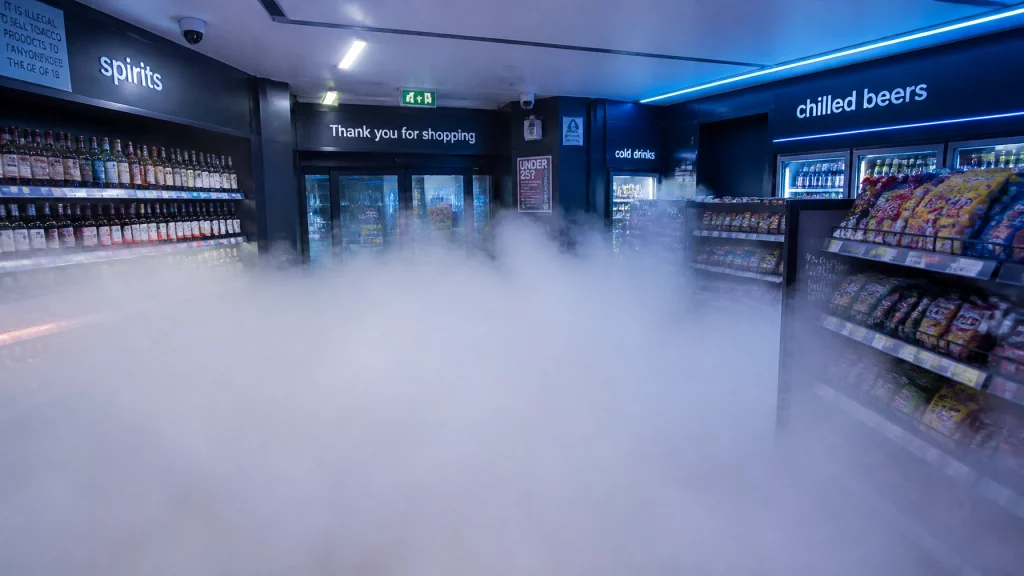
Active deterrents stop theft in real time. They make theft harder or impossible as it happens. When an offender or organised gang targets your store, a visible deterrent and an active response stop them before stock leaves.
97% of thefts are avoided with a fogging system and an alarm, compared with 17% with an alarm only, according to Density manufacturer figures. Fog changes the calculation for a thief: CCTV footage is worthless; stock cannot be grabbed or identified; exit is blocked or slowed; identity is hidden—reducing resale value and raising capture risk.
When integrated with your alarm, a fogging system transforms your premises into a defended space. In 80+ countries, such systems are embedded into loss-prevention protocols at airports, banks, retail chains, and warehouses because they stop theft in motion.
Choosing the Right Scale
A small shop needs different protection than a warehouse. Fogging systems scale from 390 cubic metres up to 14,000 cubic metres. All are certified to EN 50131-8:2019 and work with existing alarm panels. When your alarm is breached, the system triggers automatically and floods the zone in seconds.
No structural work needed. Fog disperses in minutes with no residue, so it is safe in food areas and customer spaces. It is non-toxic and certified by Eurofins to food-contact regulations.
Building Your Loss-Prevention Plan
Start by auditing weak spots. Which areas are hard to see? Where are high-value items? When do staffing levels drop? Are alarms monitored? Do staff know how to report suspected theft?
Next, map your layers. Do you have visible deterrence? Electronic article surveillance? A trained response? An active countermeasure for after-hours or peak theft times?
Finally, test it. A fogging system is only effective if offenders believe it works. Clear signage, staff training, and occasional testing build credibility.
Frequently asked questions
Will a fogging system harm my customers or staff?
No. The fog is non-toxic and certified by Eurofins for human safety. In food retail environments, it meets CE food-contact regulations. It disperses in minutes and leaves no residue or staining on merchandise.
Can a fogging system integrate with my existing alarm?
Yes. Fogging systems are fully compatible with all existing alarm panels and work with Ajax systems, LAN networks, and video management systems through APIs. Remote monitoring is available via cloud integration.
What size of premises does a fogging system protect?
Systems are rated by volume in cubic metres, not floor area. A small shop might need 390 m³ coverage, a mid-size store 900 m³, and a warehouse up to 14,000 m³. A survey will establish the right fit for your layout.
How often does a fogging system need servicing?
Systems are simple and require minimal maintenance. Battery autonomy can reach six months depending on the model, and recharge cycles are straightforward. Your installer will provide a maintenance schedule.
Is a fogging system a replacement for CCTV and alarms?
No. It complements them. Fogging stops theft in motion; alarms trigger response; CCTV records evidence. All three together create the layered defence that delivers the 97% theft-prevention figure.
Related Loss Prevention security guides
- Internal vs External Theft: Where Retail Losses Come From—understand which theft sources pose the biggest risk to your specific sector.
- Building a Layered Loss-Prevention Strategy—detailed guidance on stacking multiple security controls for maximum effect.
- Stopping Retail Theft After Closing Time—protect your premises when staff have left and conventional deterrence is lowest.
- How Active Deterrents Cut Loss Where Cameras Can’t—explore the specific role of real-time countermeasures in your loss-prevention mix.
Loss prevention pays. A layered approach cuts shrinkage and protects staff. If your system has gaps or relies on one tool alone, a brief audit can identify improvements that fit your budget and space. Get a quote today to see how active deterrence can stop theft at your location.