Q4 creates the conditions organised gangs look for
For UK wholesalers, October to December brings a predictable rise in exposure. Depots hold more spirits, tobacco, pharmaceuticals, tools, cable and seasonal goods. Darkness arrives earlier, staff numbers fall after closing and organised gangs have longer after-hours windows to breach shutters, reach stock cages and load vehicles. This combination makes Q4 a peak planning period for wholesale depot security fog systems, not because every depot will be attacked, but because the potential value and opportunity of each attack increase.
The Federation of Wholesale Distributors has reported that violent and organised crime against the wholesale sector has risen by around 30% over three years. Its evidence also highlights cash & carry depots, vehicles and high-value goods as increasingly attractive targets. The sector reporting from The Grocer describes thefts ranging from regular losses of thousands of pounds to individual incidents involving much larger sums.
Planning Q4 protection? Request a site-specific wholesale security assessment before festive stock reaches its highest value.
There is no single official UK dataset that publishes monthly theft figures specifically for wholesale depots. However, the wider indicators are clear. ONS data shows a substantial increase in recorded robbery of business property in the year ending March 2026, while also warning that changes to recording rules account for much of the rise. Earlier analysis of UK crime patterns has repeatedly identified winter and darkness as important risk factors. This is a reason to treat Q4 as a risk multiplier on top of an already serious baseline, not as proof that every depot experiences the same seasonal increase.

Why stock values rise in Q4. Wholesale businesses often build inventory ahead of Christmas demand. Premium spirits, tobacco products, pharmaceutical lines, electrical goods, cable and power tools can all be valuable, portable and easy to resell. A gang does not need to clear an entire depot to cause a major loss. A targeted visit to one spirits cage, tobacco bay or high-value storage zone may be enough.
This is particularly relevant to tobacco & spirits wholesale security. These goods have a high value-to-volume ratio and established resale channels. The same principle applies to builders merchant security fog, where compact, high-value tools and cable may be stored near loading areas or accessible trade counters.
Why darkness matters. A depot that closes at 17:00 can be unoccupied for many hours before daylight returns. Earlier darkness provides concealment during the approach, breach and removal stages. Industrial estates can also be quiet overnight, reducing the chance that a suspicious vehicle or forced entry is noticed quickly.
The ONS crime statistics should be read carefully: recorded business robbery trends have been affected by counting-rule changes. Even so, they reinforce the need for a layered response to commercial crime. The National Business Crime Centre’s commercial burglary guidance recommends strong access control, lighting, alarms, CCTV and secure stock procedures. Those measures remain essential, but they do not all perform the same function.
Passive security has a time gap. CCTV records an attack. An alarm detects an attack and alerts a monitoring centre. Neither necessarily prevents an intruder from moving through the building during the period before a police or keyholder response.
That gap is the issue in out-of-hours break-in prevention wholesale. A ram-raid team may only need several minutes to breach a trade counter, reach a cage and remove selected goods. Even when the alarm works exactly as intended, detection is not the same as disruption.
The message spine is simple:
Alarms detect. CCTV records. Density prevents. Passive security fails.
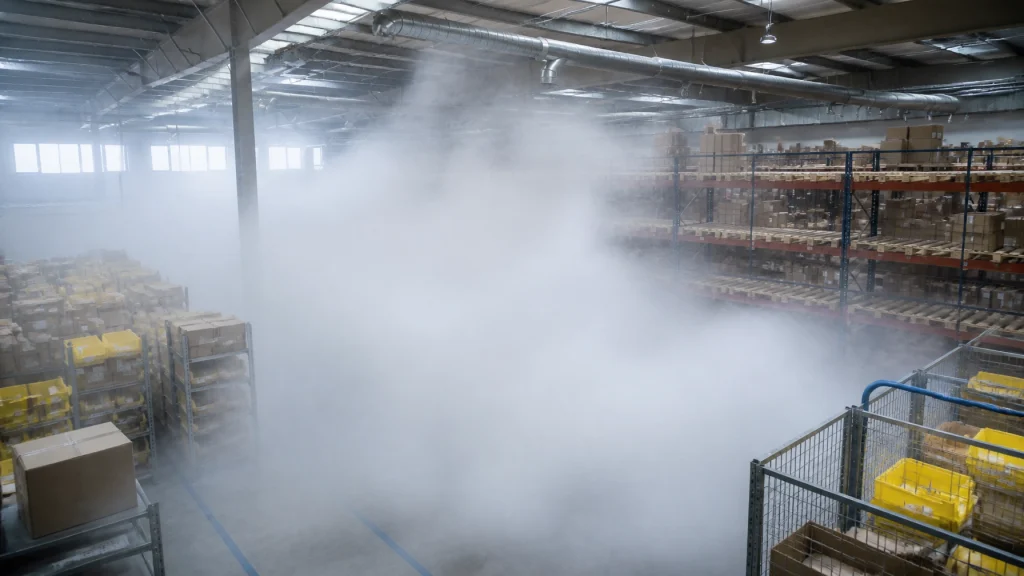
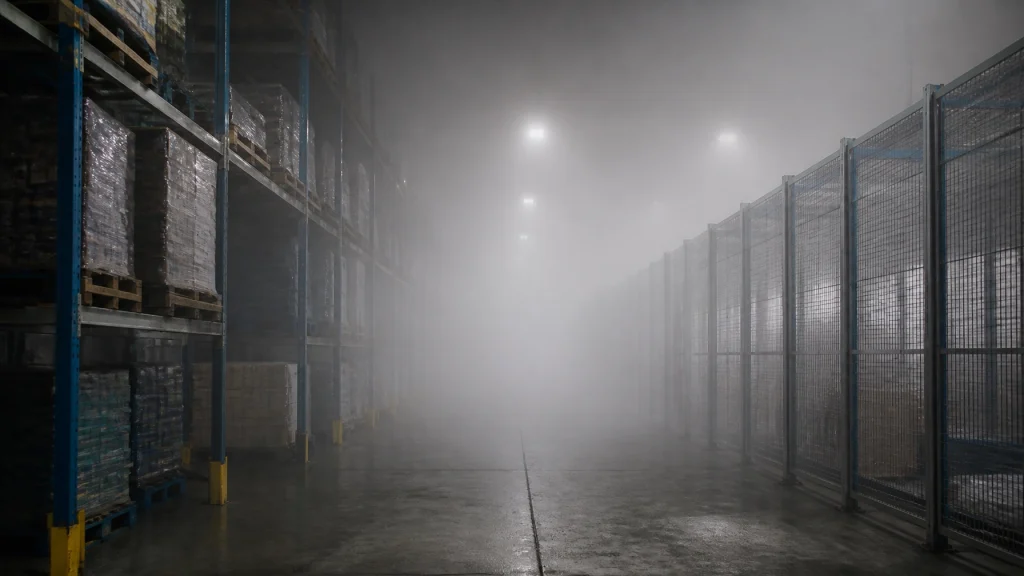
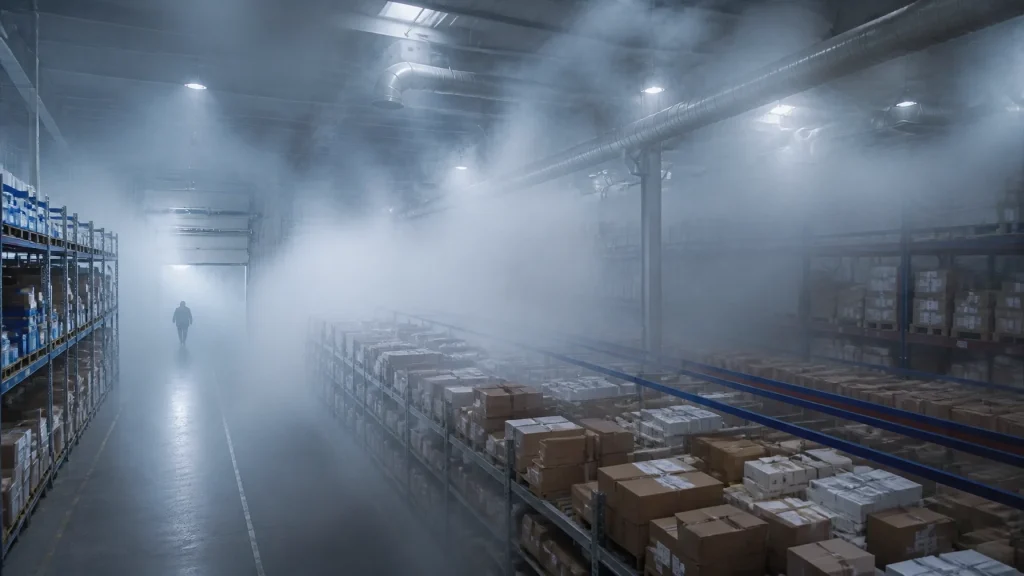
Active fog adds a physical response to the alarm event. When correctly integrated with the existing system, Density begins deploying dense, non-toxic fog in around three seconds. Visibility can be reduced to near-zero in the protected zone, disorienting intruders and making it difficult to locate, select and carry stock. The aim is to interrupt the theft while it is happening, before goods leave the building.
What you can't see you can't steal.

Designed for wholesale volumes. Density systems are specified in cubic metres (m³), because a depot’s ceiling height, racking and internal layout all affect the volume that must be protected. The right configuration should be confirmed through a site survey rather than estimated from floor dimensions alone.
For larger depots, the Density HP 6000 provides high-power protection for areas up to 6,000 m³. It is suited to substantial warehouse zones containing bulk pharmaceutical stock, spirits, tobacco or other high-value inventory.
For mid-size sites and divided layouts, the Density 2400 C-Line provides chainable coverage of up to 2,400 m³ per unit. Multiple units can be configured to protect separate zones, including a trade counter, spirits cage, cable storage area or loading-bay approach.
The Density 2400 Lite is a compact option for secondary zones, satellite locations and branch depots. It can form part of a broader multi-site wholesale security UK programme, where the main warehouse, trade counter and secondary storage areas each require a proportionate design.
Compare the Density range and coverage options.
Integration without a new security platform. Density is designed to work with existing NSI and SSAIB alarm systems. The system receives the alarm trigger through the existing infrastructure, allowing wholesalers to add an active layer without replacing their entire security arrangement. This makes it relevant to businesses looking for NSI compatible wholesale security systems and commercial security fog systems wholesalers can deploy alongside established alarm partners.
Activation can be configured for appropriate operating conditions, including after-hours protection. The alarm, monitoring and fog system should be designed and commissioned by competent professionals, with the final arrangement agreed with the alarm company and insurer.
Safe around wholesale stock. Density security fog is non-toxic and designed for use around packaged goods, electronics, pharmaceuticals, food-service packaging, tobacco and spirits. The fog is intended to clear without a clean-up operation, subject to the specific system design and site conditions. It should still be included in the depot’s emergency procedures, with staff training and clear re-entry controls.
This matters for pharmaceutical wholesale security, where concerns about contamination and stock handling are understandably high. It also matters for food, drink, electrical and builders merchant operations that cannot afford avoidable damage during an incident.
Insurance requirements are changing. For high-value stock, active security systems are increasingly mandated as a prerequisite of cover. That does not mean every insurer applies identical conditions, and it does not mean security fog guarantees a claim outcome. Wholesalers should review their policy schedule, risk survey and renewal requirements with their broker.
For businesses researching insurance-approved security fog wholesale, the practical questions are whether the system is suitable for the risk, integrated with the alarm, installed correctly, maintained and supported by the required documentation. Density systems are approved for use with NSI and SSAIB security systems, with security fog designed around BS EN 50131-8 requirements.
Q4 checklist for depot operators:
- Review stock values by zone before October.
- Identify spirits, tobacco, pharmaceutical, tool and cable storage areas.
- Check roller shutters, loading bays, side doors and roof access.
- Confirm CCTV and alarm coverage at every likely approach route.
- Verify that monitoring and keyholder details are current.
- Ask your insurer whether active security is a condition of cover.
- Size any security fog solution by protected volume in m³.
- Test the response plan with staff and your alarm provider.
- Review secondary depots and satellite storage, not only the main site.
- Complete a survey before peak festive stock arrives.
A layered system still matters. Perimeter controls, lighting, shutters, cages, access procedures, monitored alarms and CCTV all reduce risk. Security fog addresses the remaining question: what happens between detection and response?
FAQ box: wholesale depot security fog systems
How quickly does Density security fog deploy?
When triggered by the connected alarm system, Density begins deploying fog in around three seconds. Deployment speed and the time required to cover a complete protected volume depend on the model, layout and m³ specified.Can security fog protect a large wholesale warehouse?
Yes. The HP 6000 is designed for large warehouse zones up to 6,000 m³. Larger or divided premises can use multiple appropriately positioned units, with the final configuration confirmed during a site survey.Will it work with our existing alarm?
Density systems are approved for use with NSI and SSAIB alarm systems and can integrate with an existing alarm panel. Your alarm company should confirm compatibility, configuration and commissioning requirements.Is security fog suitable for pharmaceutical, food or tobacco stock?
Density fog is non-toxic and designed for use around packaged wholesale goods, including pharmaceuticals, food-service packaging, tobacco, spirits and electrical equipment. The site’s risk assessment and insurer requirements should always be considered.Does security fog replace CCTV, alarms or physical security?
No. It adds an active response to a layered security plan. CCTV records, alarms detect and security fog disrupts visibility during the incident. No security measure can promise to prevent every loss.Is security fog required by insurers?
Requirements vary by policy and risk. However, active security systems are increasingly mandated as a prerequisite of cover for high-value stock. Speak to your broker and obtain the relevant system documentation before renewal.
Q4 security planning should begin before the depot reaches peak stock levels. Review the building, the contents, the likely attack routes and the response time available after an alarm. Then assess whether passive measures alone leave a gap that an active system should address. A properly designed solution will not promise certainty, but it can make a fast, organised theft substantially harder to complete.
See how Density has been used on real commercial premises in the case studies, then request a free wholesale site assessment before Q4 exposure increases.