A wholesale depot’s most vulnerable route may not be the one an intruder uses to get in. Loading bays, dispatch doors, fire exits and secondary gates are often the real target because they provide a fast route from high-value stock to a waiting vehicle.
Organised thieves can assess these routes before a break-in. They look for the shortest path from storage cages, trade counters or secure rooms to a roller shutter, yard gate or dispatch door. Once inside, every second matters.
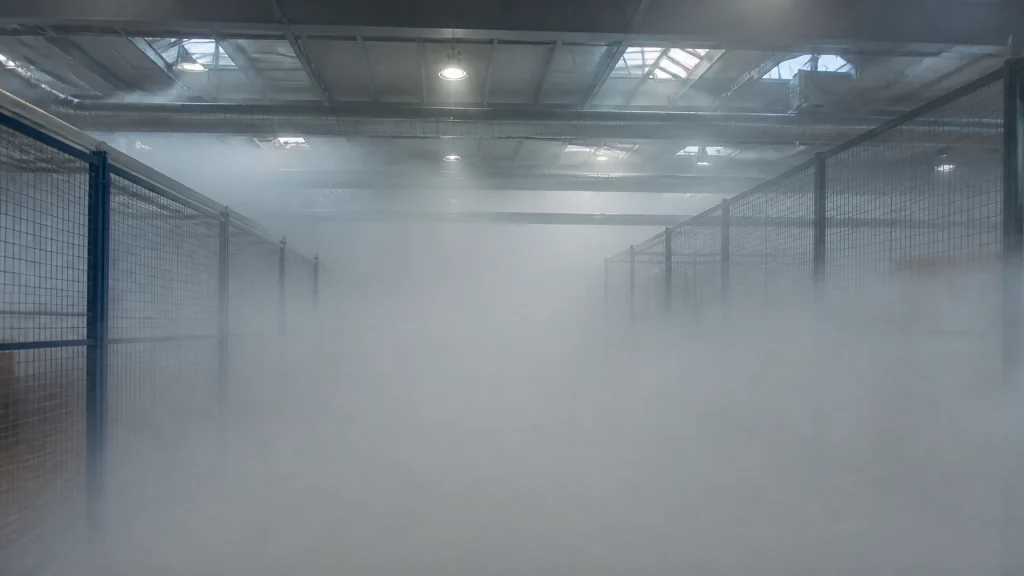
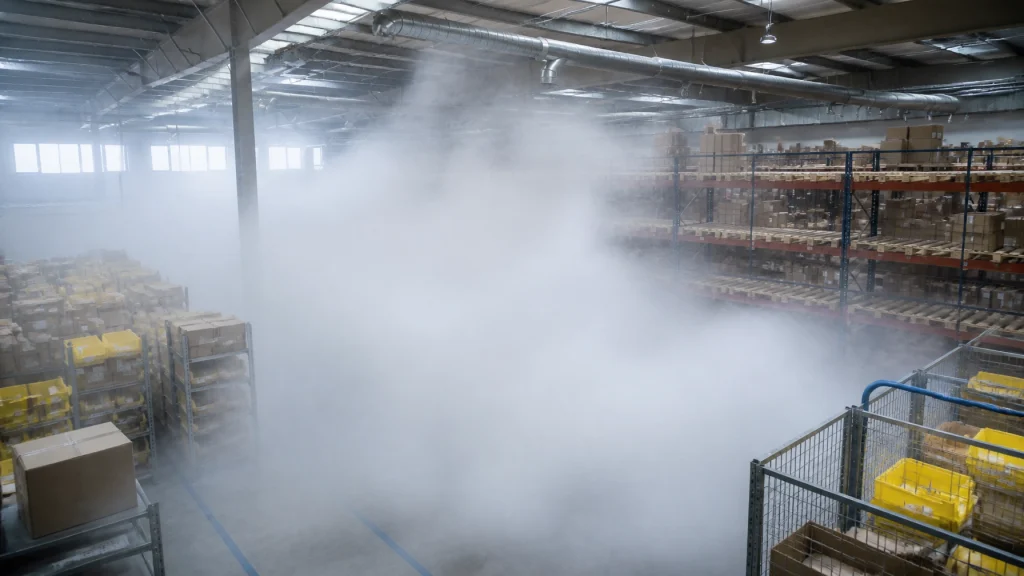
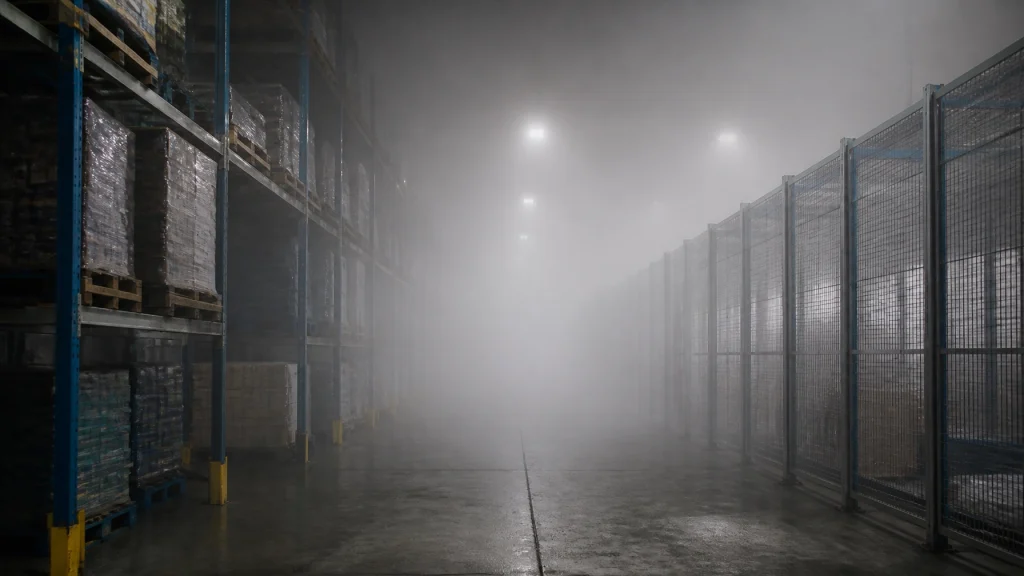
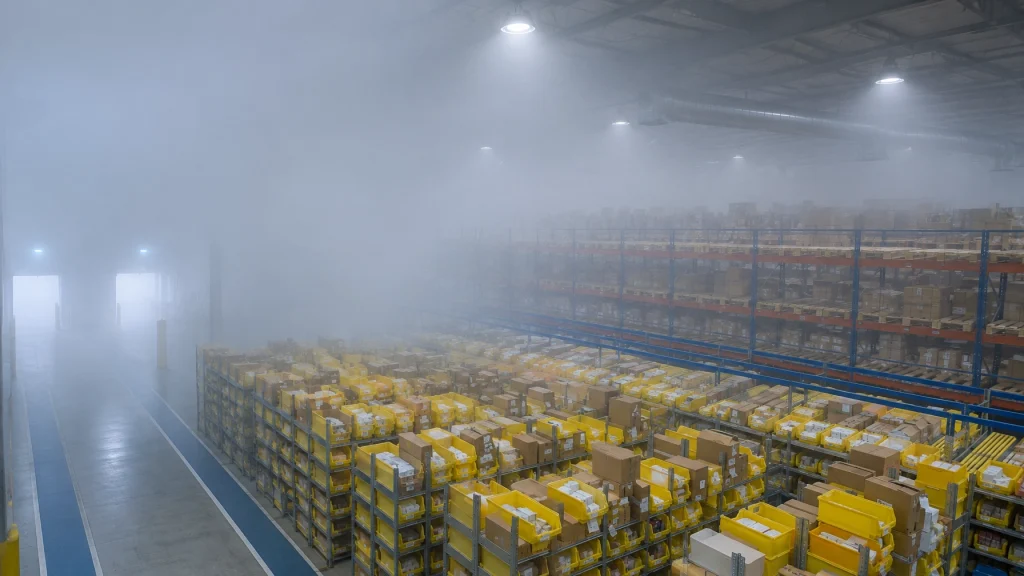
That is why wholesale depot security fog systems should be planned around movement through the building, not just protection at the perimeter. When an alarm triggers, security fog deploys in around three seconds, reducing visibility to near-zero and disrupting navigation before stock can be moved out.
The exit route is the route to protect

A monitored alarm can identify that a break-in is taking place. CCTV can record the route taken and support a police response. Neither necessarily stops an intruder moving through the depot during the response window.
The highest-risk route usually includes:
- A stock cage or high-value storage area
- An internal aisle or dispatch corridor
- A loading bay or roller shutter
- A vehicle access point, yard gate or secondary exit
This route should be assessed as a single chain rather than as separate doors and rooms. If an intruder can still see the stock, identify the exit and navigate directly between the two, passive security measures may not be enough.
Alarms detect. CCTV records. Density prevents. Passive security fails.
Security fog provides an active layer inside the building. It does not replace locks, shutters, access control, CCTV or a monitored alarm. Instead, it is designed to act when those systems identify an intrusion, making it difficult for an intruder to see stock, find the correct exit or coordinate the removal of goods.
Police.uk guidance recommends securing business doors, windows, loading areas and other potential access points. That remains the starting point for out-of-hours break-in prevention wholesale. The next question is what happens if those measures are defeated.
Protect the route, not just the door. A site survey should map the complete path from each high-value zone to every loading bay, dispatch door, fire exit and secondary gate. Security fog can then be positioned and sized to protect the relevant volume in cubic metres (m³), taking account of walls, racking, cages, ceiling height and ventilation.
Request a wholesale depot security survey

Why three seconds matters
A break-in can move quickly from forced entry to stock removal. If the intruder already knows the internal layout, they may reach a stock cage or dispatch area before a keyholder or police patrol arrives.
Security fog is designed to change that sequence. Once the existing alarm confirms an intrusion, the system deploys in around three seconds. The resulting fog removes the visual information an intruder needs to make decisions:
- Where the stock is stored
- Which aisle leads to the loading bay
- Whether a door or gate is open
- Where other people are positioned
- How to carry goods safely and quickly
The objective is not to guarantee that every incident will be stopped. The objective is to interrupt the critical seconds in which stock could otherwise leave the building.
This is particularly relevant to wholesale warehouse theft prevention where goods are stored in large, open volumes. It also applies to smaller, high-risk areas. For a trade counter, trade counter security fog can protect the route between tills, secure storage and the customer-facing entrance. In a cash and carry environment, it can provide a cash & carry depot theft deterrent across the areas most likely to be used for rapid removal.
Build security around the stock profile
Different wholesale businesses have different exit-route risks.
For tobacco & spirits wholesale security, the priority may be a locked cage or bonded storage area leading to a rear loading door. For pharmaceutical wholesale security, the focus may be controlled medication storage, dispatch corridors and temperature-controlled areas. A builders’ merchant may need builders merchant security fog around tool cages, internal stock aisles and yard-facing doors.
The deployment should reflect the value, portability and location of the goods. High-value items should not be protected only at the external door. If an intruder can reach them before the fog fills the relevant zone, the system has been specified around the wrong part of the building.
Density’s product range allows systems to be selected by protected volume:
- The 2400 C-Line can be used for mid-size spaces and multi-zone layouts, with units that can be chained across connected areas.
- The HP 6000 is designed for larger open volumes, including substantial warehouse and loading-bay environments, with coverage up to 6,000 m³.
- The 2400 Lite provides a compact option for secondary zones, smaller stock areas or supporting protection away from the main depot floor.
The final specification should be confirmed through a survey. Coverage is measured in m³, not simply by floor area, because racking, partitions and ceiling height all affect how fog moves through a building.
Work with the alarm system already in place
A major advantage of modern wholesale depot security fog systems UK businesses can deploy is integration with existing security infrastructure.
Density systems can connect to existing NSI and SSAIB alarm systems through the alarm panel. This means the depot does not necessarily need new monitoring infrastructure or a separate alarm arrangement. The existing system identifies the event; the security fog provides an active response inside the protected area.
This makes the technology suitable for NSI compatible wholesale security systems, provided the design, installation and configuration are completed correctly. Activation can also be configured around the depot’s operating hours, helping to ensure the system responds appropriately when the building is closed.
For businesses operating several locations, multi-site wholesale security UK planning should use the same principles across every depot while allowing for differences in volume, stock profile and layout. A consistent specification can simplify training, maintenance and documentation without assuming that every site requires the same generator.
Consider insurance requirements early
Security requirements increasingly form part of conversations between wholesale operators, brokers and insurers. In some cases, active security systems are increasingly mandated as a prerequisite of cover for premises holding high-value or attractive stock.
That does not mean every depot will have the same requirement, and security fog should not be presented as a guarantee of cover or a route to lower premiums. Operators should ask their broker or insurer what evidence is required and whether the proposed system meets the relevant policy conditions.
Documentation, alarm compatibility, servicing and installation standards should all be considered when reviewing insurance-approved security fog wholesale options.
Make the loading bay part of the protected volume

Loading bays are often treated as external security points. In practice, they are also internal working areas where stock can be staged, moved and loaded quickly.
The security review should therefore consider:
- Whether fog reaches the space between stock storage and the loading door
- Whether internal dispatch doors create a clear alternative route
- Whether a roller shutter provides enough protection once an intruder is inside
- Whether a secondary gate creates a second path out of the site
- Whether CCTV still supports incident review after visibility is reduced
- Whether staff, keyholders and emergency responders have clear procedures
A loading bay does not need to be the point where the system is triggered. It does need to be included in the protection plan if it forms part of the likely exit route.
FAQ: wholesale depot security fog systems
Will security fog protect every exit route in a depot?
It can be designed to protect the relevant routes and zones, but coverage depends on the building’s volume, layout, ventilation and the location of the units. A site survey is required to confirm the specification.Can security fog integrate with an existing NSI or SSAIB alarm?
Yes. Density systems are designed to integrate with existing NSI and SSAIB alarm systems through the alarm panel, without requiring a completely new monitoring infrastructure.Which Density system is suitable for a wholesale depot?
The 2400 C-Line is suited to mid-size and multi-zone areas, the HP 6000 is intended for larger spaces up to 6,000 m³, and the 2400 Lite can support compact secondary zones. The correct choice depends on the protected volume and layout.Is the fog safe around wholesale stock?
Density uses non-toxic, residue-free fog designed for use around commercial stock, including food, pharmaceuticals and other products. The installation should still be specified and maintained by a competent professional.Does security fog guarantee that a break-in will be stopped?
No security measure can provide an absolute guarantee. Security fog is designed to disrupt visibility and navigation rapidly, reducing the opportunity for intruders to reach, organise and remove stock.Can security fog help meet an insurer’s requirements?
It may support a risk-management or insurance specification, but requirements vary. Active security systems are increasingly mandated as a prerequisite of cover, so the proposed installation should be discussed with the insurer or broker before work begins.
The central principle is simple: protect the movement of goods, not just the building’s entry points. A depot may have strong perimeter doors, cameras and alarms, yet still lose stock if an intruder can see a clear route from storage to dispatch.
What you can't see you can't steal.
A properly specified system gives alarms, monitoring teams and responders more time by making the route out difficult to see and navigate. It is an active layer for wholesale depots handling spirits, tobacco, tools, cable, pharmaceuticals and other high-value stock.
Density’s products hub provides the available system range, while the case studies show how security fog is being used across commercial and logistics premises.