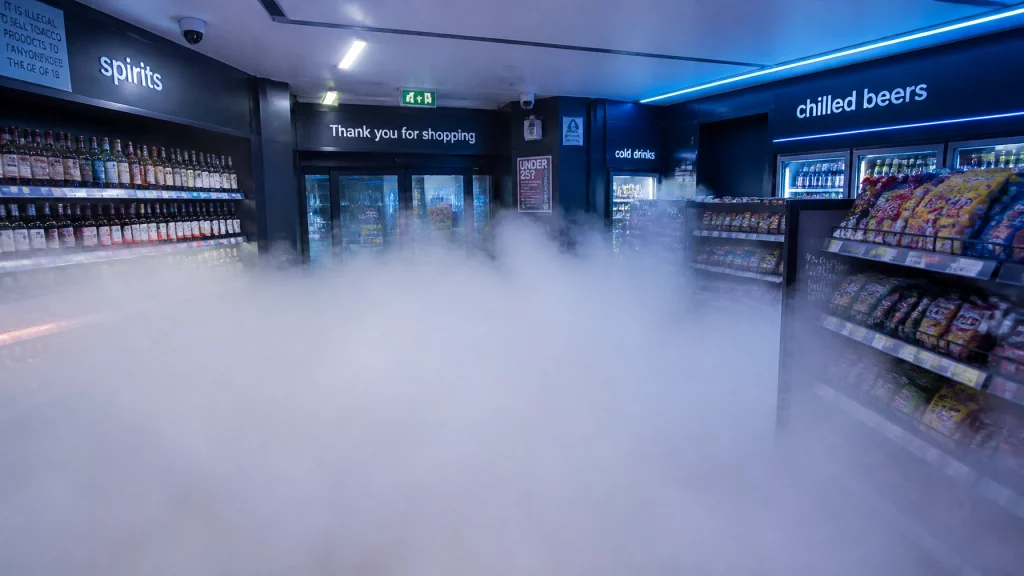
Security fog is an intruder-deterrent system that fills a room with dense, harmless fog the moment a break-in is detected. The intruder can no longer see what they came to steal, or where the exit is, so most leave within seconds. It is fitted alongside an intruder alarm, not instead of one.
You will also see it called security smoke, a fog cannon or a security fog device. In almost every case those names describe the same thing, and the reason there are so many tells you something about how the technology changed.
How security fog works
A fog generator holds a fluid made from glycol and purified water. When the system is triggered, that fluid is pushed through a heated block and vaporised. As the vapour hits cooler room air it condenses into a cloud of suspended droplets averaging roughly 0.2 to 2.0 micrometres across.
Droplets that small do not fall. They hang in the air and scatter light, which is what destroys visibility rather than any staining or coating of the room.
The trigger comes from the alarm. A detector picks up the intrusion, the panel calls for fog, and the unit discharges. Density systems deploy in under a second from that trigger, and can also be fired remotely or from a panic button. How long the space then takes to fill depends on the unit and the volume being protected.
In an enclosed space the fog holds for up to an hour, sometimes longer. Ventilated or open areas clear faster.
Security fog or security smoke — which is the right term?
Both, depending on which decade you learned the phrase in.
The first systems appeared in the UK in the 1970s, built to protect bullion stores. They burned a pyrotechnic cartridge, which produced real smoke: a smell, an oily residue on stock and surfaces, and one activation per cartridge. Calling it security smoke was accurate.
Modern systems do not burn anything. Vaporised glycol and water is fog in the meteorological sense — the same physics as a cloud — and it leaves no residue and no smell.
The European standard settled the vocabulary. EN 50131-8:2019 is titled Security fog devices, and that is the term the industry, insurers and certification bodies use.
The older word has proved stubborn, though. Wikipedia still files the category under “security smoke”, and several manufacturers kept it in brand names formed decades ago. So if someone offers you a security smoke system today, they are almost certainly describing a fog system — worth confirming, but the pyrotechnic generation has effectively gone.
What the standard actually requires
Most explanations skip this part, and it is the only one that lets you compare systems on anything firmer than adjectives.
EN 50131-8:2019 sets out how a security fog device connected to an intruder and hold-up alarm system must perform, and how it should be designed, installed and maintained. Its central obscuration test is specific: the device must reduce visibility to one metre within 60 seconds, across a minimum volume of 150 m³.
That sentence is the most useful definition of security fog there is. A system that meets it will blind a room fast enough to matter. A system that does not is a fog machine.
The standard also draws a line worth knowing about. Fog must never be deployed in a way that traps someone — electrically held locks on escape routes, combined with fog, risk exactly that, and the standard treats it as a design fault. Security fog is meant to drive an intruder out, not hold them in.
There is a further UK layer: the BSIA publishes a Security Fogging Code of Practice, and insurance surveyors have their own fogging guidelines. Asking which of these an installer works to is a fair question when you are being quoted.
Density systems are certified to EN 50131-8:2019, alongside CE, EMC and FCC. An attestation can be requested. They are also approved for use with NSI and SSAIB security systems.
Is security fog safe?
It is the first thing people ask — the instinct when a room fills with white cloud is that something is on fire.
The fluid in Density systems is certified non-toxic to humans and animals by Eurofins, with toxicological evaluation carried out to EN ISO 16000-1:2006. The fog itself is certified to the Food Contact regulation, Reg. (CE) No. 1935/2004, meaning it can contact food without altering its composition or its taste and smell. That is why it is permitted in grocers, supermarkets, bars, restaurants, delicatessens and food warehouses.
There is no residue to clean up and no smell afterwards. Stock, textiles, electronics and machinery are unaffected, which matters as much for a server room or a garment store as it does for a kitchen.
What the fog does is remove sight. It stops an intruder for the same reason it is harmless to a staff member: it does not touch them, it just takes away the ability to see.
What security fog is for
An alarm tells someone a crime is happening. A camera records it. Neither stops it. The gap between a panel activating and a response arriving is measured in minutes, and a smash-and-grab raid is over well inside that window.
Fog closes that gap by making the premises useless to steal from while the raid is still in progress. A fogging system combined with an alarm avoided 97% of thefts, against 17% for an alarm alone — a Density® manufacturer figure, and one that describes the two working together rather than fog on its own.
Typical uses are premises with concentrated, portable, resaleable value: jewellers, pharmacies, electronics retailers, vape and off-licence stock, bike showrooms, cash offices, and warehouse and logistics sites. It also works for daytime hold-up protection, where a short burst puts a fog curtain between staff and an attacker.
Frequently asked questions
Is security fog the same as security smoke?
In practice, yes. “Security smoke” is the older name, from an era when systems burned a pyrotechnic cartridge. Modern equipment vaporises a glycol and water fluid to make fog, and EN 50131-8:2019 calls these security fog devices. The terms are used interchangeably for the same category of product.
Is security fog safe to breathe?
The fluid used in Density systems is certified non-toxic to humans and animals by Eurofins, with toxicological evaluation to EN ISO 16000-1:2006, and the fog is certified to Food Contact regulation Reg. (CE) No. 1935/2004. It obscures vision rather than affecting breathing. Anyone caught in it should still leave calmly, because they cannot see where they are going.
Does security fog leave residue or damage stock?
No. The droplets are small enough to stay suspended and then disperse, leaving no residue and no smell. This is the practical difference from the pyrotechnic smoke systems of the 1970s and 1980s, which did leave an oily film.
How long does security fog last?
In an enclosed space, up to an hour or longer. Ventilated or open areas clear more quickly, and opening doors will disperse it faster still.
Will security fog set off the fire alarm?
It depends on the detector type, and it is a question to settle at design stage rather than assume either way. We have covered the interaction between fog and fire detection in more detail in a separate guide.
Is security fog legal in the UK?
Yes, and it has a European standard written for it, EN 50131-8:2019, plus a BSIA code of practice. The main consideration is designing the installation so it never obstructs an escape route or traps anyone inside, which the standard explicitly addresses.
Working out what you would need
Sizing a system is a question of volume, not floor area, because fog fills a space to the ceiling — including the space above high racking that floor-based measures ignore. Coverage is quoted in cubic metres for that reason, and units can be linked together where a site is larger or an awkward shape.
The security fog systems buyer’s guide works through how to compare units, the security fog overview covers the technology in more depth, and the certifications page lists the standards in full.
Book a survey and we will size the right system for your premises.