How to integrate intruder alarm fog into an NSI-approved wholesale depot
For many wholesale depots, the alarm system is already in place. It detects unauthorised entry, signals the event and may connect to an Alarm Receiving Centre (ARC). CCTV records what happens. What it does not do is physically obstruct an intruder who is already inside the building.
That is where intruder alarm fog adds an active layer of protection. When the existing alarm confirms an intrusion, a correctly specified fog system can deploy in around three seconds, reducing visibility across the protected zone before an intruder can reach high-value stock.
The integration does not normally require a new monitoring contract or a separate security infrastructure. A compliant system is connected to the existing alarm panel and configured by a suitably approved installer.

1. Confirm your alarm, insurer and site requirements
Start with a review of the current security system. Record the alarm manufacturer, system grade, protected zones, available outputs and ARC arrangements. Your alarm company should confirm how the panel handles confirmed alarm events and whether the existing system is NSI or SSAIB approved.
Next, check your insurance conditions. For premises holding tobacco, spirits, pharmaceuticals, tools, cable or other high-value goods, active security systems are increasingly mandated as a prerequisite of cover. The wording of your policy may specify alarm grading, monitoring arrangements, confirmation methods or additional active deterrents.
Do not assume that a standard alarm output is configured correctly for every application. Ask your NSI or SSAIB-approved alarm company and insurer to agree the intended operating sequence before installation begins.
This first review is essential for NSI compatible wholesale security systems. It ensures that the proposed fog system supports the alarm installation rather than creating an undocumented alteration.
2. Survey the protected volume in cubic metres
Security fog must be sized according to the volume it needs to protect, measured in cubic metres (m³). Floor area alone is not enough. Ceiling height, racking, partitions, cages, mezzanines and open connections between zones all affect the volume and the way fog will spread.
Map the areas where an intruder is most likely to reach valuable stock, including:
- Tobacco and spirits cages
- Pharmaceutical storage areas
- Trade counters and secure offices
- High-value stock rooms
- Loading bays and dispatch zones
- Builders’ merchant tool and equipment stores
- Cash and carry stock areas
The objective is not necessarily to fog every part of the building. A properly designed wholesale depot security fog system focuses on the routes and zones where stock could leave the premises.
Density’s wholesale depot security fog systems range covers applications from smaller commercial zones to large distribution spaces. Depending on the protected volume and layout, a Density 2400 Lite, Density 2400 C-Line or Density HP 6000 may be considered. Final specification should follow a site survey and the manufacturer’s certified coverage data.
A survey also identifies obstructions. Tall racking, fire doors, ducting and separated stock cages may require more than one unit or a chained configuration. This is particularly relevant for multi-site wholesale security UK programmes, where each depot may have a different layout despite holding similar stock.
3. Define the trigger logic with your alarm company
Security fog should work from the alarm event that meets your agreed confirmation requirements. In an unattended wholesale depot, this will commonly involve a confirmed intrusion rather than a single unconfirmed detector activation.
The exact sequence depends on the alarm design, site risk, insurer requirements and ARC procedures. Your approved installer should determine:
- Which alarm zones can activate the fog system
- Whether two independent detections are required
- Whether the system operates differently during staffed and unstaffed hours
- How the ARC receives and verifies the event
- Whether authorised personnel have a controlled hold-off or reset procedure
- How the fog system reports faults or low consumables
The fog system acts as a supplementary deterrent. It does not replace perimeter protection, access control, detection, CCTV, lighting or police and ARC procedures.
The operating principle is simple:
Alarms detect. CCTV records. Density prevents. Passive security fails.
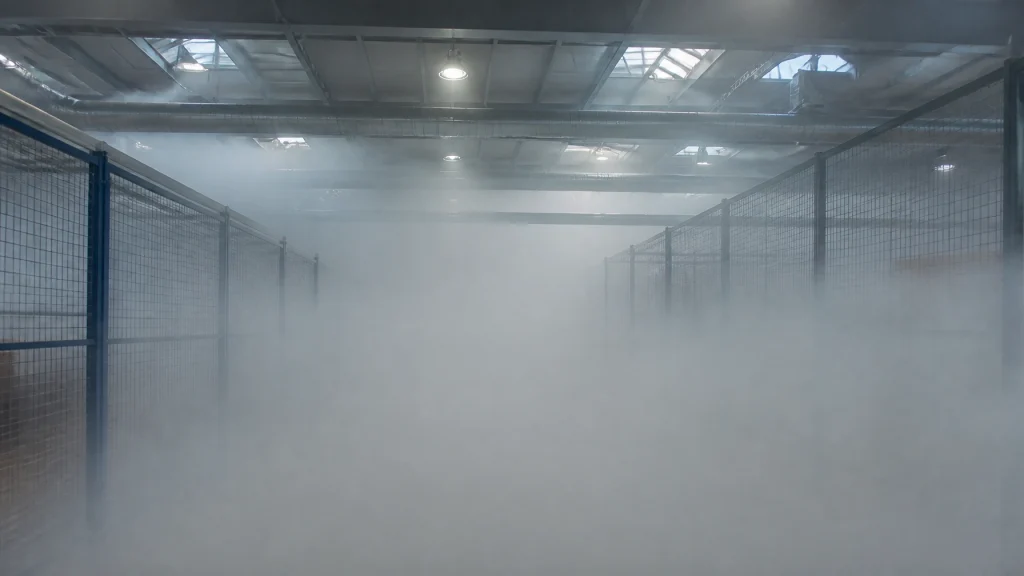
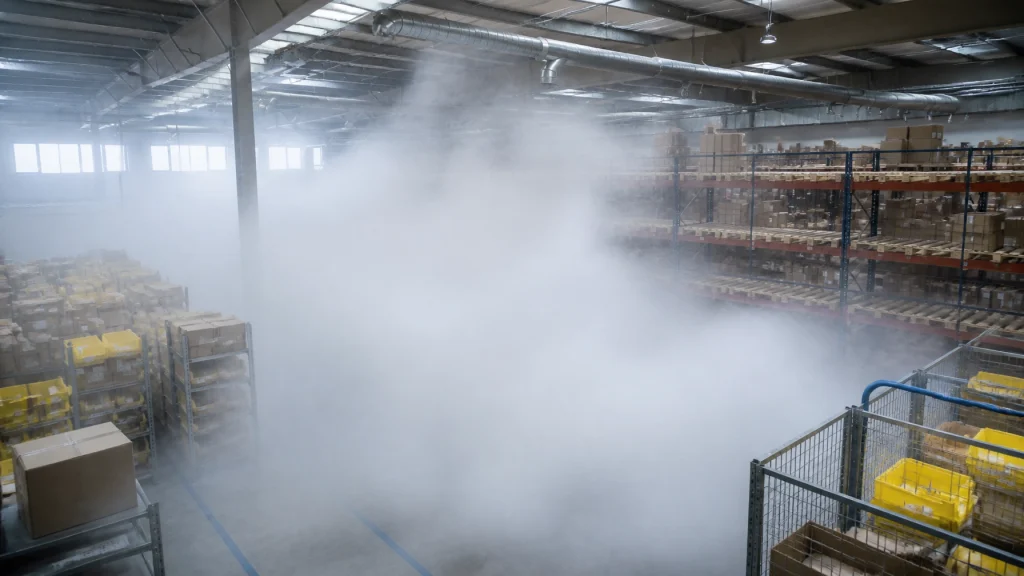
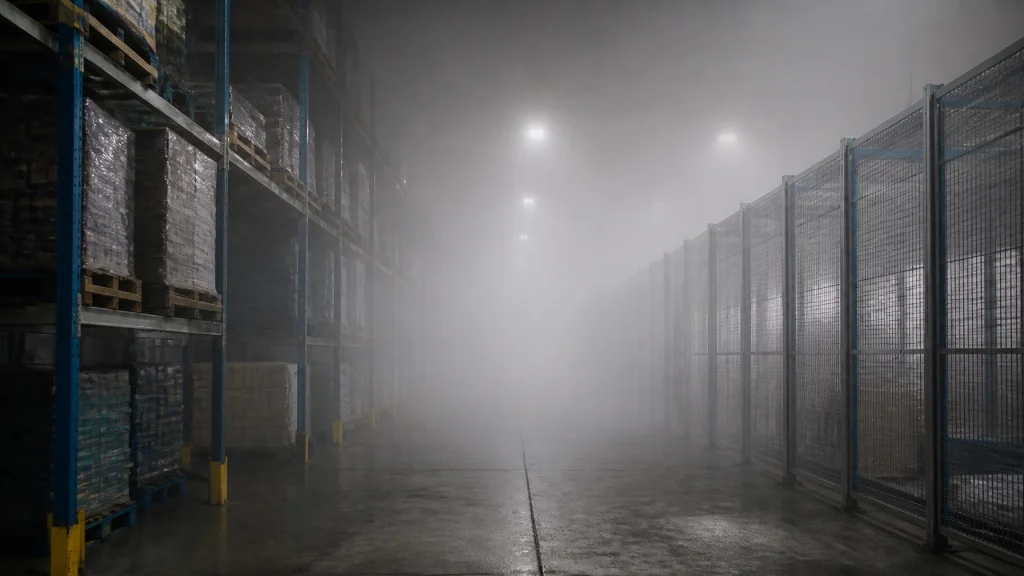
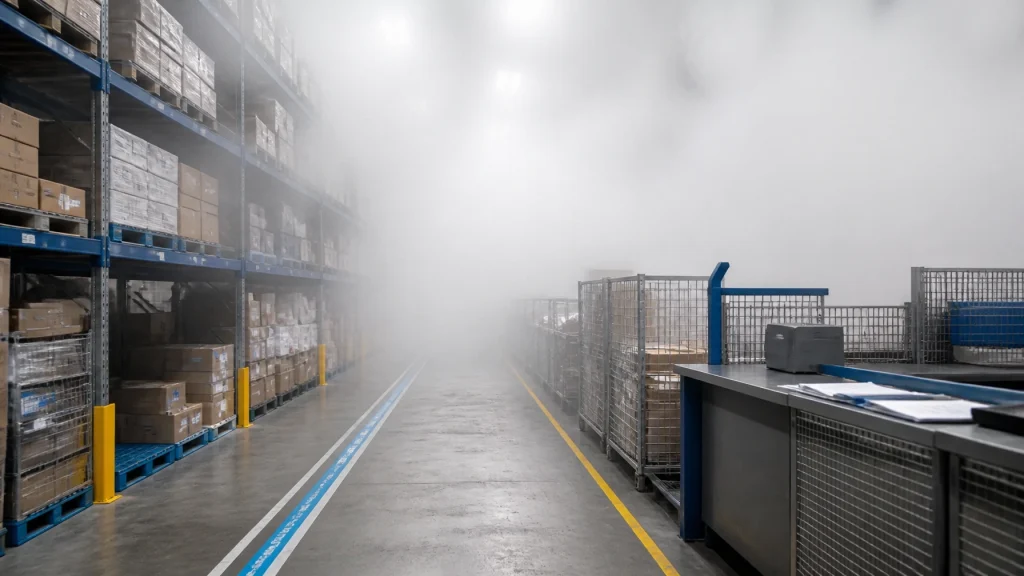
A confirmed alarm triggers the fog. The fog then creates a near-zero-visibility environment in the protected zone, making it harder for intruders to locate stock, identify routes or work safely. This supports wholesale warehouse theft prevention by intervening while the break-in is still in progress.

4. Connect the fog system to the existing panel
In most installations, the fog system is connected through a relay or programmable output on the existing alarm panel. This allows the alarm to control the fog without requiring a new standalone control infrastructure.
The connection must be completed by the appropriate alarm and security fog professionals. For an NSI-approved installation, the NSI-approved company should remain involved when the fog system is connected to the intruder and hold-up alarm system. The system should then be included in the relevant records and handover documentation.
The commissioning process should confirm:
- Correct relay and output configuration
- Correct activation from the agreed alarm zones
- Correct delay and confirmation logic
- Fault monitoring and power resilience
- ARC signalling and escalation procedures
- Interaction with access control and staff controls
- Clear reset and recovery procedures
The NSI implementation note for BS EN 50131-8:2019 explains that the standard applies to security fog devices used within intrusion and hold-up alarm systems. Your installer should confirm the relevant compliance position for the equipment and the complete installation.
For a trade counter, this may mean a compact unit protecting the counter and adjoining stock zone. For a large depot, several units may be connected so that the alarm can activate the required zones in a controlled sequence. This makes trade counter security fog and large-scale commercial security fog systems wholesalers practical extensions of an existing alarm design.
5. Coordinate fire safety, training and maintenance
Before commissioning, coordinate the security fog installation with the fire alarm provider. Dense fog can affect optical fire detection equipment, so the two systems must be assessed together. The installation team should agree any necessary interlocks, hold-off arrangements, event procedures and re-entry controls.
Depot staff also need clear instructions. Training should cover:
- What happens when the alarm and fog activate
- How the ARC and keyholders are contacted
- When staff must not enter the affected zone
- How the building is ventilated after an event
- How the system is reset
- How faults are reported
- What records must be retained
The fog is designed to be non-toxic, residue-free and suitable for use around many types of packaged stock, including food and pharmaceuticals. Nevertheless, re-entry must follow the site’s risk assessment and the agreed manufacturer, alarm and fire safety procedures.
Add the fog system to the existing maintenance schedule. Keep service records, activation logs, fault reports and training records available for your alarm company, insurer and any future audit. A system that is installed but not maintained may not satisfy the conditions attached to an insurance policy.
This is also the point to review coverage. Changes to racking, partitions, stock cages or warehouse use can alter the protected volume. A new loading area or pharmaceutical store may require a revised design rather than relying on the original installation.
Plan your integration with Density
Speak to our team about an on-site survey for your depot. We can review the protected volume, key stock zones, existing alarm arrangements and the appropriate fog system configuration.
Integrating security fog should be treated as a managed security project, not simply an equipment connection. The alarm company, fog installer, ARC, fire alarm provider and insurer should all understand the operating sequence and documentation.
The result is a more active approach to out-of-hours break-in prevention wholesale businesses can apply to their highest-risk zones. An alarm can alert responders after entry. CCTV can provide evidence afterwards. Security fog acts immediately, helping to deny visibility before stock can be selected, moved and removed.
That matters in tobacco & spirits wholesale security, pharmaceutical wholesale security, builders merchant security fog and other environments where a small number of minutes can represent substantial losses.
What you can't see you can't steal.
FAQ box: integrating security fog with an NSI alarm
Can security fog be added to an existing NSI alarm system?
Yes, a compliant fog system can generally be integrated with an existing NSI alarm through a suitable relay or programmable output. The work must be designed, installed and documented by the relevant approved security professionals.Will adding fog invalidate NSI or SSAIB approval?
Correct integration should not invalidate the alarm approval. The fog system and its connection must meet the applicable requirements, be included in the as-fitted documentation and be commissioned through the approved alarm company.Does the fog system need its own monitoring contract?
Usually, no. The system can operate from the existing alarm panel and ARC arrangements. The precise configuration depends on the alarm panel, confirmation logic and insurer requirements.How is the correct fog system selected for a depot?
Selection is based on protected volume in m³, ceiling height, racking, partitions, access routes and the value and type of stock. A site survey should confirm whether one unit, multiple units or a chained arrangement is appropriate.Is security fog suitable for food and pharmaceutical stock?
Density security fog is non-toxic and designed to be safe around a wide range of commercial stock. The installer should still review the site, stock types, ventilation and re-entry procedures before commissioning.Can fog be used in a trade counter or cash and carry depot?
Yes. A correctly designed system can protect trade counters, stock cages, high-value rooms and other priority zones. The activation sequence should reflect whether the site is staffed, partially occupied or fully unattended.What does insurance-approved security fog wholesale mean?
It means the insurer recognises the need for an active security measure as part of its risk requirements. Active security systems are increasingly mandated as a prerequisite of cover. Always confirm the exact conditions with your broker or insurer.
A properly integrated system gives depot managers an active response without discarding the alarm infrastructure already protecting the site. It can be scaled across individual zones or multiple locations, provided every installation is surveyed, commissioned and maintained correctly.
Read our case studies to see how security fog has been applied across commercial and logistics premises, or speak to Density about your own site.
Protect the stock that matters most
Tell us your depot’s protected volume, alarm arrangements and highest-risk areas. We will recommend a practical next step for your wholesale operation.