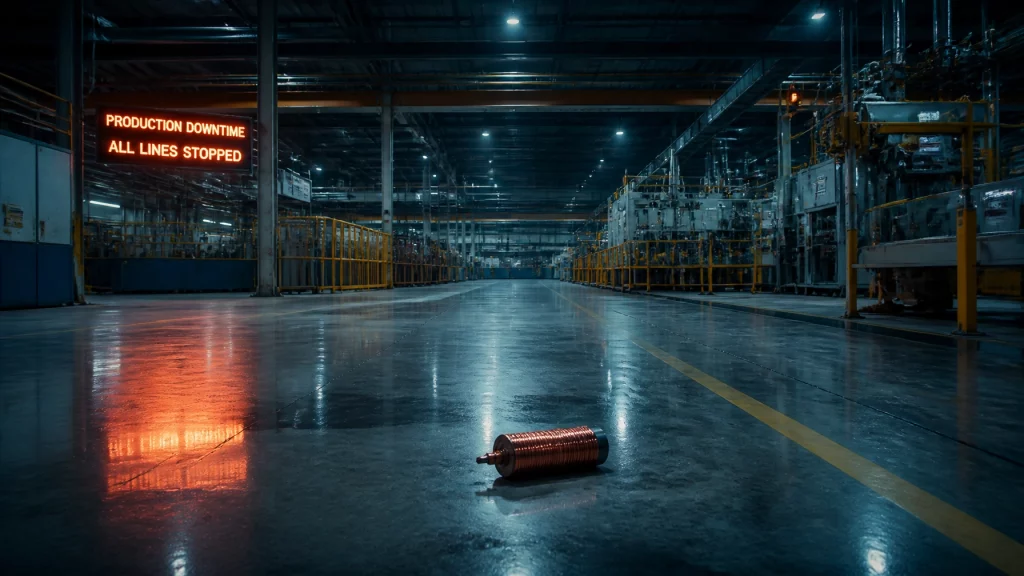
For a UK factory manager, the sound of a middle-of-the-night alarm is a dreaded occurrence. But the true anxiety doesn’t stem from the price of the copper stolen or the power tools missing from the maintenance store. The real fear is the silence that follows.
When a thief targets a manufacturing site, they aren’t just stealing inventory; they are stealing time. In the modern "Just-In-Time" manufacturing landscape, a theft that lasts sixty seconds can cause a production line to sit idle for sixty hours.
While many businesses invest in warehouse security systems to document crime, they often overlook the "active" side of protection. In this article, we’ll break down why the cost of production downtime is the single most important metric in your security ROI and why preventing the theft mid-raid is the only way to protect your bottom line.
The Invisible Price Tag of Theft
When calculating the impact of a break-in, it’s easy to look at the replacement cost. A pallet of semiconductors, a drum of copper cabling, or a specialized hydraulic press tool might have a clear market value. However, research into the UK manufacturing sector suggests that the secondary costs are far more devastating.
According to recent industry data, the average cost of unscheduled downtime for a UK manufacturer is approximately £5,121 to £5,471 per hour. For larger facilities or those in high-value sectors like automotive and pharmaceuticals, that figure can skyrocket to over £10,000 per hour, with some automotive plants losing upwards of £1.6 million for every hour the line is stationary.
The Stolen Value vs. The Downtime Value
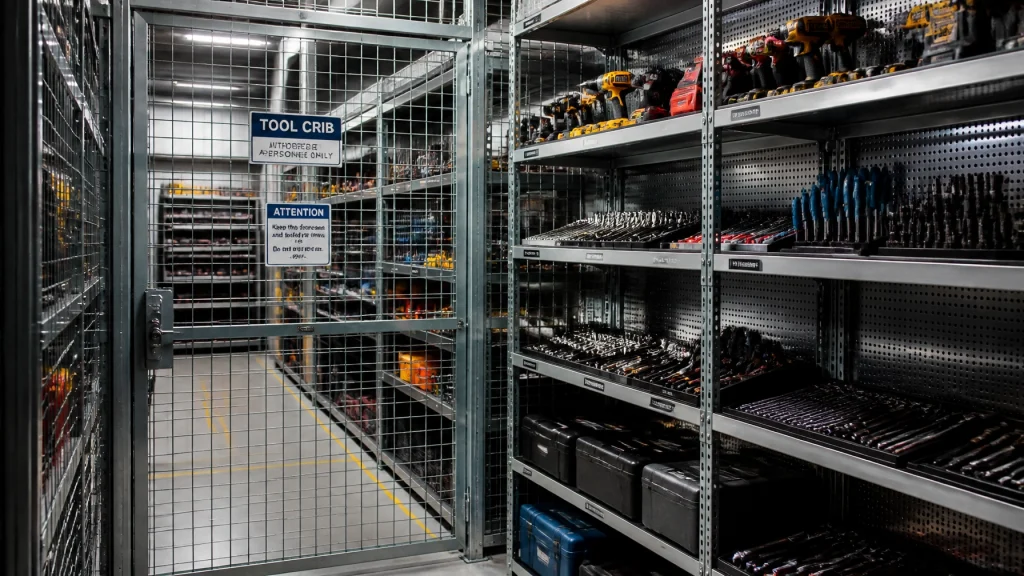
Imagine a thief breaks into your tool crib and steals a precision calibration tool worth £800.
- Direct Cost: £800 (plus the cost of a smashed door).
- Downtime Cost: If that tool is critical for the morning shift and takes 48 hours to source and replace, you are looking at two days of reduced or halted throughput.
At a standard rate of £5,000/hour, that "minor" £800 theft has just cost your business £80,000 in lost production.

Beyond the Hour: The Ripple Effect of a Stalled Line
To truly prevent warehouse theft in the UK, you have to understand the "Hidden Costs" that don't appear on an insurance claim:
- Contractual Penalties: Many Tier 1 and Tier 2 suppliers operate under strict Service Level Agreements (SLAs). If a theft halts your production, missing a delivery window to an OEM can trigger massive financial penalties.
- Labour Wastage: Your highly-skilled workforce is still on the clock. If the line is down because a critical component or raw material was stolen overnight, you are paying for hundreds of man-hours with zero output.
- Reputational Damage: In a competitive global market, reliability is your greatest asset. If a theft-related stoppage causes you to fail a major customer, they may look for a more "resilient" partner for the next contract.
- Re-Planning and Overtime: Once the stolen items are replaced, the factory often has to run at 110% capacity, including weekend shifts and overtime, just to catch up. This places immense stress on both your machinery and your staff.
Why Traditional Warehouse Security Systems Often Fail Manufacturers
The UK has seen a record rise in warehouse and cargo theft, with warehouses now accounting for roughly 41% of all recorded cargo crime incidents. Despite this, many facilities rely on passive security measures.
The CCTV Paradox
CCTV is excellent for gathering evidence, but it is fundamentally a post-incident tool. If a thief enters your facility, they can clear out a tool crib or a copper store in less than 90 seconds. By the time your security team views the footage or the police arrive, the damage is done. The line has already stopped.
To protect production, you don't just need to see the thief; you need to stop them from reaching the assets in the first place.
Active Deterrence: Preventing the Stoppage Before It Starts
This is where Density security fog changes the equation. Unlike traditional alarms that simply make noise, our systems provide an active, physical barrier that stops theft mid-raid.

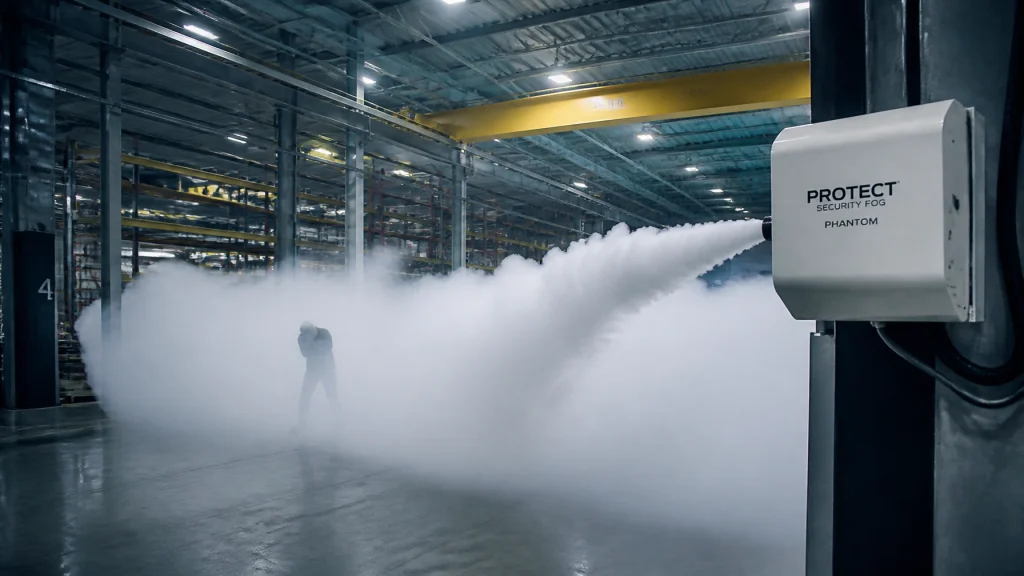
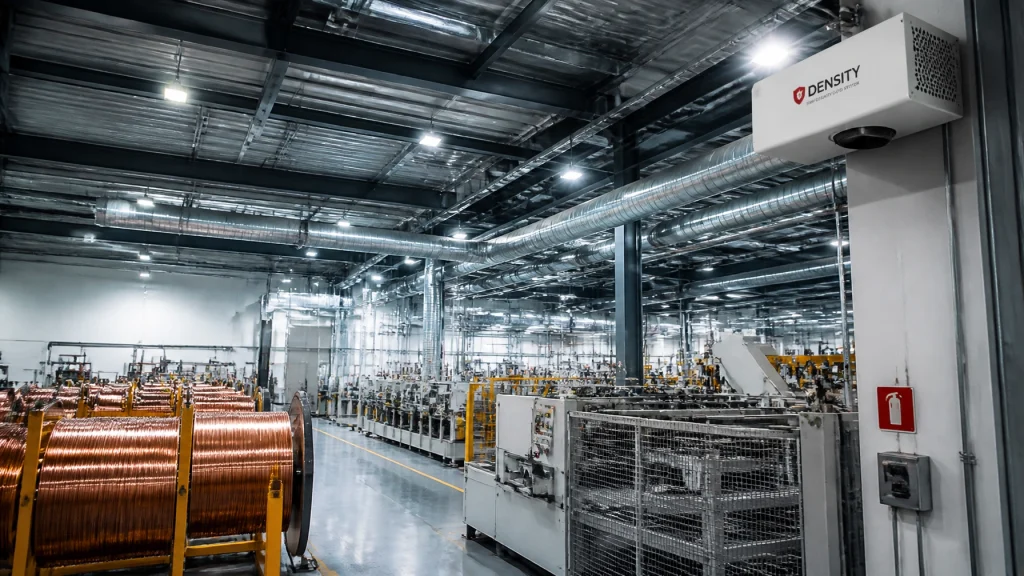
When an intruder triggers your existing NSI or SSAIB-approved alarm system, the Density HP6000 (designed for high-bay production halls) or the Density 2400 series deploys in less than a single second and can create over 70 cubic metres of fog per second.
Within moments, the visibility in your tool crib, material store, or production bay is reduced to near-zero. The intruder is instantly disoriented. They cannot see the high-value stock, they cannot find the exit, and most importantly, they cannot steal what they cannot see.
Safe for Your Environment
A common concern for facility managers is whether security fog will damage sensitive equipment. Density fog is:
- Non-toxic and water-based: Safe for staff and lone workers.
- Electronics-safe: It leaves no residue, making it ideal for semiconductor manufacturing or electronics assembly.
- Food & Pharma approved: We provide full compliance documentation for sensitive manufacturing environments.
- Fast-dissipating: The fog remains for up to an hour but can be cleared quickly once the site is secured, meaning you can get back to work almost immediately.
Calculating Your Security ROI
When evaluating the cost of a Density security fog system, don't compare it to the cost of a new camera. Compare it to the cost of one hour of downtime.

For most UK manufacturing sites, a single prevented theft pays for the entire security system many times over. By investing in an active deterrent, you aren't just buying hardware; you are buying an insurance policy for your production schedule.
If you are protecting:
- Raw Materials: Copper, semiconductors, or precious metals.
- Tool Cribs: High-value maintenance and precision instruments.
- Finished Goods: Stock waiting for dispatch.
Then you cannot afford to wait for the police to arrive. You need a system that acts the moment the perimeter is breached.
Protect Your Production, Not Just Your Stock
The landscape of UK industrial theft is evolving. Criminals are faster, more organized, and specifically targeting the raw materials that keep your lines moving.
At Density, we specialize in helping UK manufacturers eliminate the "real cost" of theft. Our systems integrate seamlessly with your existing infrastructure, ensuring that even if a thief gets through your doors, they never get to your assets.

Don’t let a 90-second theft lead to a 90-hour stoppage.
Ready to safeguard your production line?
- Explore our High-Output Protection for Production Halls.
- Learn about Point Protection for Tool Cribs and Maintenance Stores.
- Get a bespoke site survey and ROI calculation.
📞 Call our Derby HQ: 0330 133 8990
📧 Email: Sales@densitysecurityfog.co.uk