There isn’t a published price list for security fog systems in the UK — not from Density, and not from anyone else in the category. That’s not evasiveness. It’s because the honest answer to “what does this cost?” is “it depends on your building,” and every vendor who tells you otherwise is guessing before they’ve measured anything.
What you can get today, without a phone call, is an instant online estimate based on the actual volume you need to protect.
Why security fog is quoted, not priced off a shelf
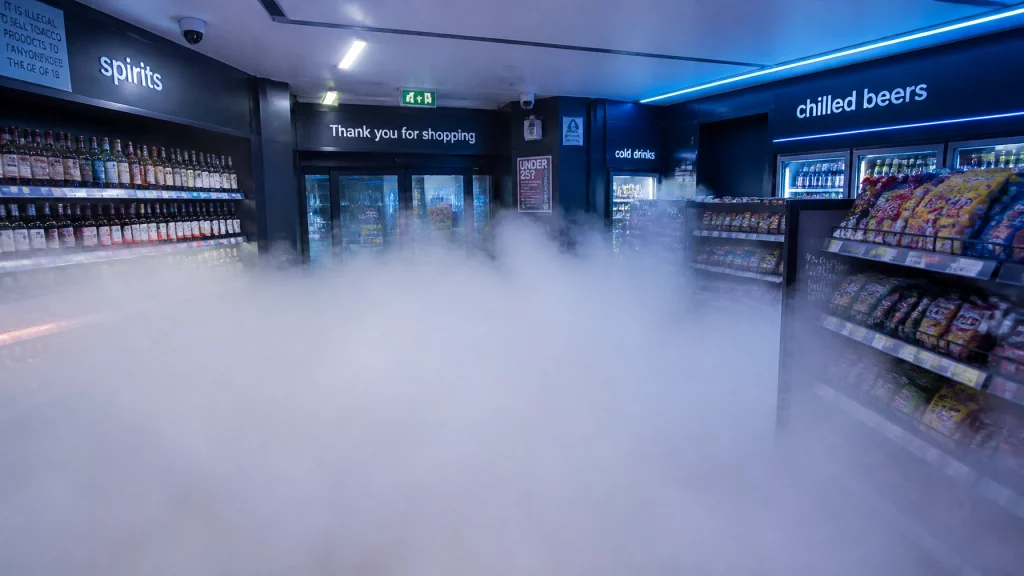
A fog system is sized to the space it has to fill, not to a generic “small, medium, large” tier. Two shops of identical floor area can need completely different systems if one has a 2.4 m ceiling and the other has open racking up to 6 m. Coverage is measured in cubic metres — protected volume — because fog fills a room from floor to ceiling, not just across the carpet.
That single variable is why every security fog provider in the UK, Density included, quotes on a site-by-site basis rather than publishing a price list. It isn’t a sales tactic. It’s the same reason a glazier quotes per window rather than per shop front. A sound loss-prevention strategy works the same way. The right level of protection depends on what you’re actually protecting, not a generic package.
What actually drives the cost
- Protected volume (m³). The biggest single factor. A single stockroom and a full warehouse floor sit at opposite ends of the same product range, sized by volume rather than floor area.
- Number of units and zones. A single till point needs one generator. A multi-room premises, or a site with several independent risk areas, needs more than one — and they’re typically priced with a volume discount once you’re beyond a single unit.
- Alarm integration. Density is compatible with all existing alarm panels, including Ajax-based systems, so this step is usually straightforward. Bespoke or older panels can occasionally add survey time.
- Site access and install conditions. Ceiling height, cable routes, and whether it’s a retrofit into a trading premises or a first-fix on a new build all affect labour, not the unit itself.
- Running cost. This is the one line that’s genuinely small rather than “it depends” — there’s no continuous consumable draw, and the ongoing cost of having a system in place is low by design.
Get a number without waiting for a callback
Most vendors in this category ask you to book a site visit before you see any figure at all. Density’s self-survey tool skips that first step. You measure your own space — room by room, either by entering dimensions directly or uploading a photo or sketch for anything awkward — and the tool calculates your total protected volume and matches it to a system size in real time.
Multi-room sites are totalled automatically, so a shop with a sales floor, a stockroom and an office gets one combined estimate rather than three separate guesses. Two situations are deliberately routed to a human survey instead of an instant number: very large sites, and anywhere a photo or sketch has been used rather than a direct measurement. That’s not a limitation being hidden — it’s the point at which an estimate stops being reliable enough to stand behind, and a proper measurement matters more than a fast one.
Either way, you get further in five minutes online than most competitors get you after a first phone call.
Is there a lower-cost option for a single small room?
Yes. The product range starts with compact, single-room systems built for exactly this — a stockroom, a small shop, a cash office — and scales up through mid-size retail units to full warehouse-scale protection at the top end. You’re never buying more capacity than your space needs, because the estimate is built from your actual volume, not a one-size default.
What happens after the estimate
An instant estimate isn’t the end of the process — it’s a starting number that replaces the guesswork of a first phone call. From there, the usual path is a short conversation to confirm the detail an online tool can’t see: exact alarm panel model, any unusual access, and install scheduling. Nothing about that step commits you to anything. It’s there to turn an estimate into a firm figure, not to reopen the question of price from scratch.
For a lot of premises, that’s a five-minute form and a follow-up call — not a diary-booked site visit before anyone will even talk numbers.
Frequently asked questions
Why won’t security fog companies just tell me the price?
Because the price depends on protected volume, unit count, and site conditions — all of which vary too much between buildings to publish a single figure that would be honest for everyone. Every provider in this category quotes on a site-by-site basis for the same reason.
What’s the single biggest factor in the cost?
Protected volume, measured in cubic metres. It’s the reason two premises with the same floor area can need very different systems once ceiling height and layout are accounted for.
Can I get a price without a sales visit?
Yes — Density’s online self-survey tool produces a real-time estimate from your own room measurements, without needing a site visit first. Very large sites or estimates built from a photo/sketch upload are routed to a human survey for accuracy.
Does a security fog system cost more to run once it’s installed?
No. There’s no continuous consumable draw, and running costs are low by design — the main cost is the initial system and installation, not ongoing use.
Is a multi-room site priced as separate quotes?
No. Multiple rooms or zones on the same site are totalled into one combined volume and one estimate, with a volume discount typically applying once you’re beyond a single unit.
Ready to see where your own premises lands? Get your instant estimate — no sales call required to get a starting number.