Chain of custody needs physical protection
Police evidence stores and property stores hold assets that may be central to an investigation, a prosecution or the return of property to its lawful owner. Their value is not only financial. Asset integrity, accurate records and controlled access support the credibility of police work and public trust.
Home Office guidance describes the chain of evidence as an audit trail covering the handling of material from seizure through to its eventual use, return or disposal. Property must be correctly recorded, packaged, transferred and stored. The Home Office guidance on evidence in criminal investigations and its property control and storage guidance provide the basis for these controls.
Physical security is one part of that wider process. Access permissions, locks, entry records, tamper-evident packaging and property management systems all help create accountability. However, an alarm or CCTV system does not physically prevent an intruder from moving through a store during the response window. When a facility is unattended overnight, at weekends or during public holidays, that gap can expose evidence, property and operational continuity to avoidable risk.
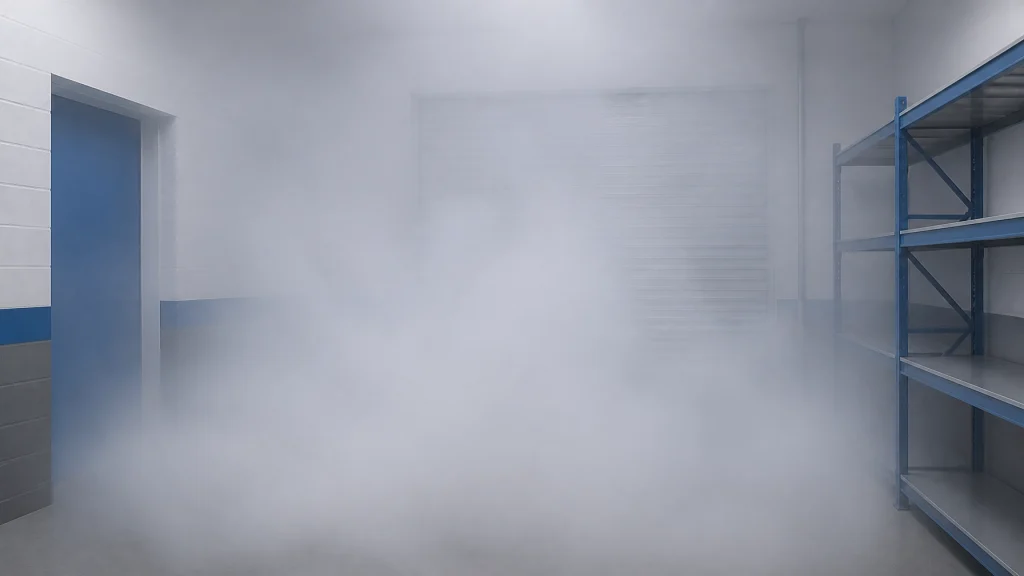
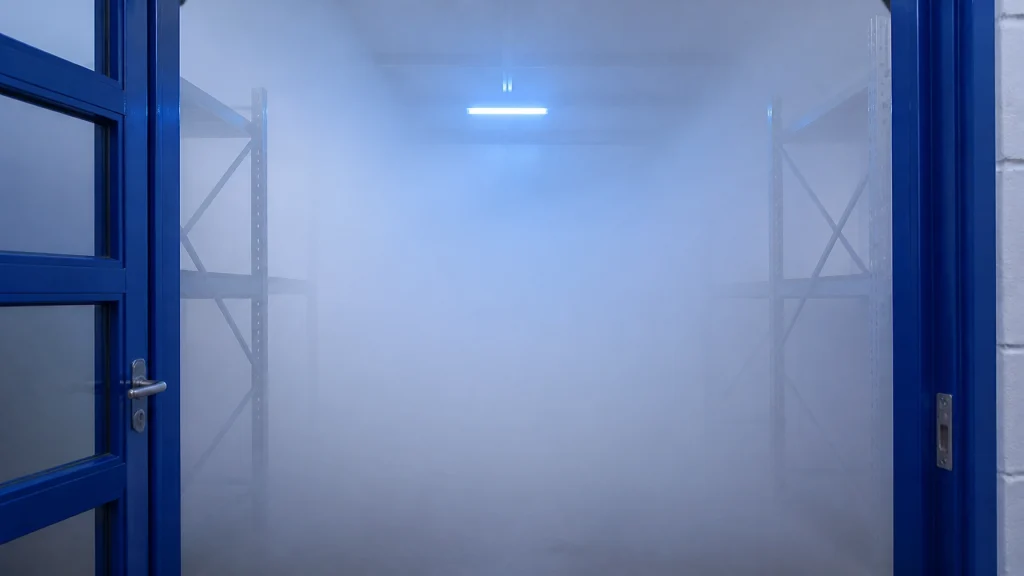
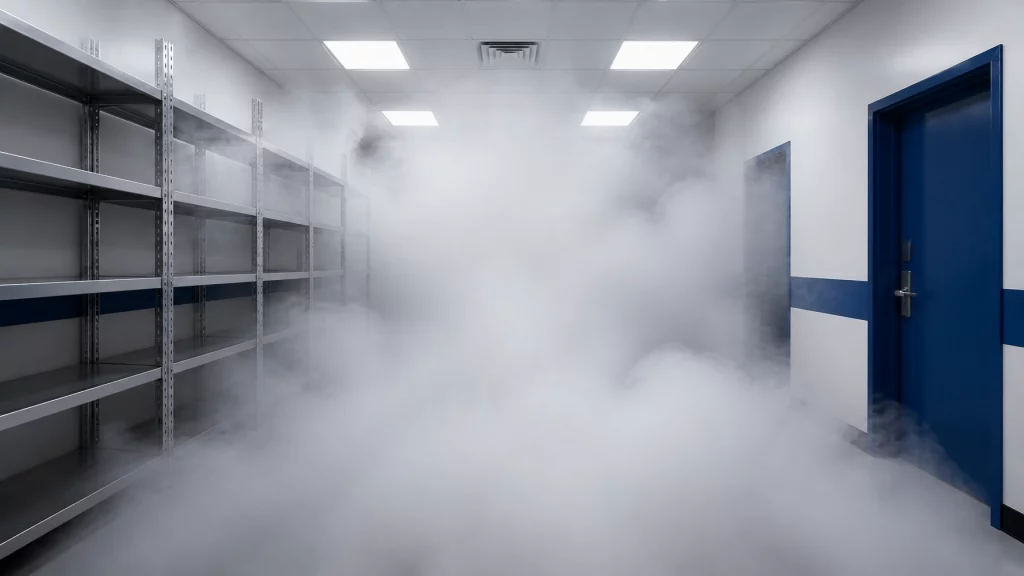
For forces reviewing public-sector security fog systems UK, security fog adds an active layer to the existing alarm and access-control arrangement. When triggered, security fog deploys in well under a single second to create zero visibility. It is designed to stop an intruder reaching, handling or removing stored property before police or security personnel arrive.
Review active security options for police and public-sector sites
Security fog should complement, not replace, the procedures that protect chain of custody. It cannot substitute for correct packaging, accurate logging or authorised access. Its role is to protect the room during an attempted intrusion, helping to preserve the conditions in which those controls operate.
Alarms detect. CCTV records. Density prevents. Passive security fails.

The practical risk is straightforward. An intruder entering an evidence store may not need much time to identify a target, open a cabinet or move a container towards an exit. CCTV may record the activity, while an alarm may notify a monitoring centre, but neither creates a physical barrier between the intruder and the stored assets.
Security fog changes the immediate environment. It removes visibility and makes navigation, selection and removal of property substantially more difficult. The objective is active deterrence during the incident, rather than evidence of an incident after the event.
97% of thefts avoided with security fog vs 17% with an alarm/CCTV alone.
This comparison should be treated as a reported performance statistic, not a guarantee for every site or incident. A properly designed system depends on the protected volume, room layout, alarm configuration, access controls, operating procedures and installation quality.
Protecting the store, not disrupting the evidence process. Density fog is non-toxic, non-corrosive and designed to leave no residue. That makes it suitable for consideration in secure rooms containing sensitive equipment, packaged property and records, subject to the force’s own estates, facilities and risk-assessment processes. Any deployment should be planned with the relevant property, forensic, information-security and estates teams.
The system can connect to an existing alarm infrastructure through a suitable relay output. Density is approved for use with NSI and SSAIB security systems. This means the technology can be considered as part of a properly specified security design without requiring a completely new alarm platform. The installer and responsible security team should confirm compatibility, activation logic, zoning, reset procedures and maintenance requirements before implementation.
Selecting the protected volume. Product selection should be based on the cubic volume of the secure area, not simply the number of cabinets or the floor plan. Density Basic provides coverage of up to 390 m³ per shot and may suit a smaller, self-contained store. Density 900 Lite provides an intermediate option, while Density 2400 Lite covers up to 2,400 m³ per shot for larger secure zones or connected areas. The final specification should be confirmed through a site survey.
The Density product range provides the available coverage options. Detailed information is also available for the Density Basic and Density Lite fog systems.

A niche option for a single high-value point. Density UNIK is a battery-powered security fog system intended for a single high-value point only. In a police setting, that may mean one particularly sensitive cabinet, a compact secure room or an isolated location where a mains-powered installation is difficult. It should not be treated as the default solution for a whole evidence department or a large property store.
The Density UNIK system provides up to 600 m³ of commercial coverage per cartridge, subject to the product specification and site design. Its battery capability may be relevant to isolated or difficult-to-power points, but the force should assess battery management, testing, access, alarm integration and replacement arrangements as part of its operating procedure.
Integrating active deterrence with governance. A security fog installation should sit within the site’s existing security management framework. Before procurement, responsible teams should consider:
- Which rooms or zones require protection
- The cubic volume of each protected area
- How the alarm signal will trigger the security fog
- Whether activation is limited to confirmed intrusion conditions
- How staff will be warned and trained
- How post-activation entry, ventilation and reset will be managed
- How testing and maintenance will be recorded
- How the system supports, rather than replaces, property tracking and access logs
- What evidence the insurer or risk protection arrangement requires
- Whether the specification aligns with the force’s procurement route
Procurement frameworks differ across England, Scotland, Wales and Northern Ireland. A security team should therefore confirm the appropriate route with its procurement and estates functions rather than assume that one framework or contract applies across the UK.
Security fog is also increasingly relevant to insurance discussions. Active security systems such as Density security fog are increasingly mandated as a prerequisite of cover. This does not remove the need to check the specific terms of a policy or risk protection arrangement. The requirement should be documented alongside alarm standards, monitoring, access control and maintenance responsibilities.
The wider case for police evidence store security is operational as well as financial. A break-in can require an investigation, stock reconciliation, system review, reporting and possible disruption to property handling. If a store is unavailable, exhibits may need to be redirected, staff time may be diverted and confidence in the facility may be affected. An active deterrent can help protect continuity by intervening at the point when the intrusion is taking place.
What you can't see you can't steal.
FAQ Box
Can security fog protect a police evidence store?
Security fog can be specified to protect a secure evidence or property store, subject to a site survey and the force’s own risk assessment. It is designed to create zero visibility during an intrusion, making it harder for an intruder to locate, handle or remove property.Does security fog replace access control, property logs or CCTV?
No. Those controls remain important for chain of custody and accountability. Security fog provides an active physical response, while access control restricts entry, property systems record movements and CCTV supports investigation and review.Will Density work with an existing police alarm system?
Density systems are approved for use with NSI and SSAIB security systems and can integrate with suitable existing alarm infrastructure. The installer must confirm the panel, relay output, activation logic, zoning and reset arrangements.Which Density system is suitable for an evidence store?
The answer depends on the protected cubic volume and layout. Density Basic covers up to 390 m³ per shot. Density 900 Lite provides a mid-range option, while Density 2400 Lite covers up to 2,400 m³ per shot. A site survey should confirm the final specification.When should Density UNIK be considered?
UNIK is a niche, battery-powered option for a single high-value point. It is not intended to be the flagship choice for a large evidence department or a whole property-store complex.Is the fog safe around stored property and equipment?
Density fog is non-toxic, non-corrosive and leaves no residue. The responsible force should still review the proposed installation with its estates, facilities and property teams, particularly where specialist equipment or controlled environments are involved.Does security fog guarantee that evidence will be protected?
No security measure can guarantee an outcome in every incident. Security fog is an active deterrent intended to help avoid theft during an intrusion. Its performance depends on correct design, installation, alarm integration, maintenance and local procedures.
Protecting chain of custody begins with disciplined handling and accountable storage. It also requires a realistic response to the out-of-hours period when a secure room may be unattended and an intruder may have only minutes to act. Security fog gives police forces an additional layer that operates at the point of attack, helping to protect asset integrity and maintain confidence in the evidence-management process.
For related implementation examples, visit the Density case studies. To discuss a police evidence store, property store or other public-sector facility, contact Density about public-sector security fog systems UK.