Roll out by risk, not geography
A council estate is rarely one estate in practical security terms. It may include vehicle depots, waste and recycling sites, fleet compounds, civic offices, workshops, plant rooms, archives and remote facilities. Each location has a different layout, operating pattern, asset profile and response-time risk. A successful programme for public-sector security fog systems UK therefore starts with a structured risk map rather than a standard system applied everywhere.
The first task is to create a single register of sites and protected assets. Record what is held at each location, when the building is occupied, how quickly an intruder could reach high-value items and how long a response is likely to take. Include metals, copper cable, plant, tools, vehicles, fuel-related equipment, IT assets and operational supplies. This provides the basis for council depot security fog, council metals theft deterrence and municipal depot break-in prevention.
Prioritise sites where three conditions overlap: high-value or operationally important assets, limited out-of-hours occupancy and a response window long enough for an intruder to enter, locate goods and leave. Council depots, fleet compounds and waste facilities will often sit near the top of this list. Remote pump stations, storage buildings and unmanned civic facilities may also require early attention because detection alone does not create a physical barrier between an intruder and the asset.
A risk map should also identify internal zones. A large depot may need separate protection for a workshop, parts store, plant room and secure office. A civic building may require protection around a records store, cash-handling area or IT room. Volume must be measured in cubic metres, including ceiling height, partitions, mezzanine areas and connected spaces. A professional site survey can then determine where security fog should deploy and whether one protected zone or several zones are appropriate.
[Find out more about public-sector security fog systems UK]
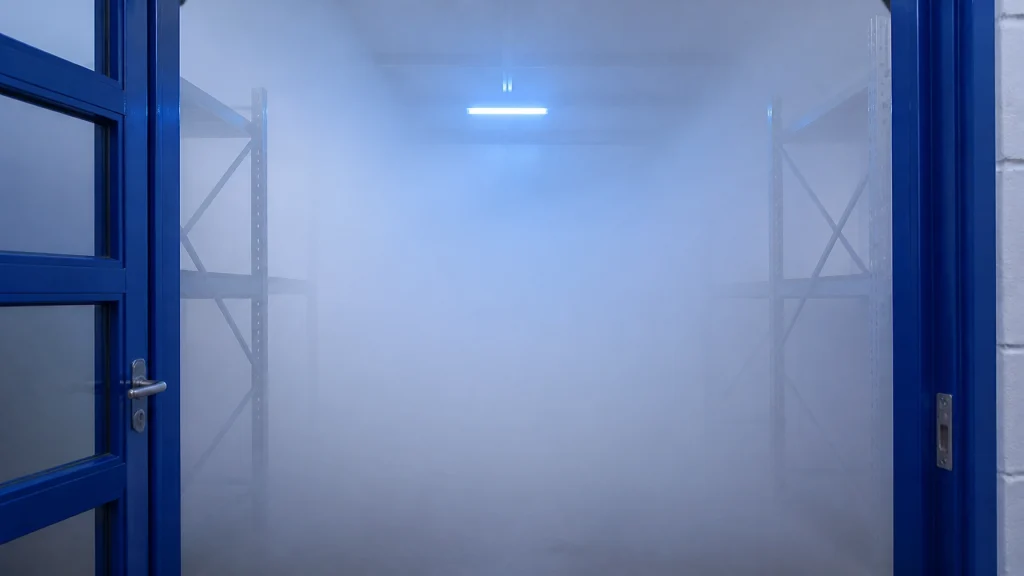
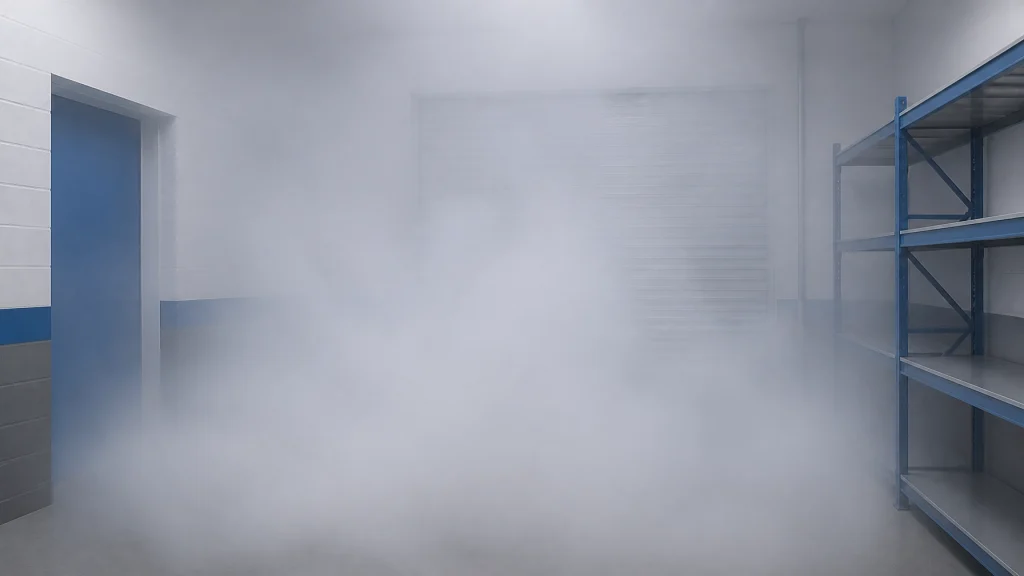
The message spine is straightforward: Alarms detect. CCTV records. Density prevents. Passive security fails. Security fog works as the active layer within an existing security design. When the alarm or a connected sensor identifies an intrusion, the system deploys in well under a single second to create zero visibility. This removes the intruder’s ability to identify, carry and navigate towards council assets while the alarm signal is being assessed.
97% of thefts avoided with security fog vs 17% with an alarm/CCTV alone.

A phased rollout allows a council to address the highest-risk locations first, prove the installation and establish a repeatable standard before extending the programme. Phase one should normally cover priority depots, fleet compounds, waste and recycling sites and civic buildings with significant out-of-hours exposure. Phase two can extend protection to remote facilities, smaller workshops, school and academy storage areas, NHS facility stores and other sites identified through the risk register. Police evidence store security and NHS pharmacy security fog require additional consultation with the relevant estates, facilities and operational teams before specification.
The objective is not to install the same product at every location. The Density product range is sized by protected volume. Density Basic covers 390 m³ and may suit a smaller store or plant room. Density UNIK covers 600 m³ and is a niche, battery-powered option for a single high-value point where mains power or installation space is limited. It should not be treated as the primary solution for a whole building or large depot.
For larger areas, Density 600C Line covers 600 m³, Density 900 covers 900 m³, and Density 2400 or 2400C Line provide 2,400 m³ of coverage for a larger secure zone. HP6000 covers 6,000 m³, and HP14000 covers up to 14,000 m³ per generator where the protected volume and layout require a higher-capacity design. Final selection should follow the survey, not a floor-area estimate. See the Basic fog system and UNIK fog system pages for product information.
Integration should be specified from the beginning. Density works with existing alarm infrastructure through a relay signal, so a council does not normally need to replace its NSI or SSAIB alarm system to add active deterrence. The installer should confirm the alarm panel, detection zones, access-control arrangements, monitoring path and any relevant fire or building-management interfaces. The specification should define what event triggers the fog, which areas are protected, how staff are notified and how the system is isolated safely for maintenance.
Density systems are approved for use with NSI and SSAIB security systems. Buyers should verify the installer’s scope, commissioning process and documentation requirements with their security provider, monitoring centre and insurer. NSI provides information for buyers and security-system providers through its security systems certification guidance, while SSAIB provides a searchable supplier directory. These organisations should not be presented as endorsing Density or any council deployment.
Site surveys should be documented consistently across the estate. Capture protected volume, doors and openings, alarm zones, sensor locations, access routes, ventilation arrangements, staff procedures, safe reset requirements and the location of sensitive equipment. The survey should also identify whether spaces are connected by corridors, shutters or internal doors that could affect fog distribution. The final design should be reviewed with facilities, security, health and safety, IT where systems are networked, and the team responsible for business continuity.
Maintenance is part of the rollout, not a later decision. Include planned servicing, battery checks, fluid replacement, alarm-signal testing, system-fault reporting and post-activation inspection. Each site should have a clear process covering who receives an alert, who attends, how the area is ventilated and how the system is returned to service. Staff should understand that fog is an active security response and that they must not enter a deployed area until it has been assessed and declared safe by the council’s procedure.
Procurement teams should create an outcome-based specification that can be applied across multiple lots or phases. It should state the required protected volume in m³, the alarm integration method, installation and commissioning requirements, training, documentation, maintenance, response arrangements and reporting. A single corporate standard can support consistency while allowing the system size and installation method to vary by site.
For England, opportunities and contract information may be published through Contracts Finder, while public-sector buying routes and agreements should be checked against current Government Commercial Agency guidance. Scotland, Wales and Northern Ireland operate different procurement frameworks and public-sector buying arrangements. Councils should confirm the appropriate route for their jurisdiction and internal standing orders rather than assuming that an England-based framework applies across the UK.
The business case should compare the cost of a phased active-security programme with the operational consequences of repeated theft. Consider vehicle downtime, replacement plant, lost working hours, damaged doors, disrupted waste collections, unavailable civic services and the staff time required to manage incidents. Insurance requirements should also be reviewed. Active security systems such as Density security fog are increasingly mandated as a prerequisite of cover, so procurement should involve the broker, insurer or RPA contact early without implying endorsement by the RPA or any other public body.
FAQ Box
How should a council decide which sites come first?
Rank each site by asset value, operational impact, occupancy, physical vulnerability and expected response time. Depots, fleet compounds, waste and recycling sites and remote stores with high-value assets will often require early review.Does a council need a new alarm system?
Not usually. Density is designed to work with existing alarm infrastructure, including systems approved for use with NSI and SSAIB security systems. The installer must confirm panel compatibility, relay outputs, detection zones and monitoring arrangements.Which Density system is suitable for a council depot?
It depends on the protected volume and internal layout. Options range from Density Basic at 390 m³ and Density 600C Line at 600 m³ to Density 900 at 900 m³, Density 2400 or 2400C Line at 2,400 m³, HP6000 at 6,000 m³ and HP14000 up to 14,000 m³ per generator. A site survey should confirm the specification.Is Density UNIK suitable for an entire council estate?
No. UNIK is a niche, battery-powered option for one high-value point up to 600 m³, such as a compact cabinet or isolated room. It is not a substitute for a properly designed multi-zone or large-volume installation.What should be included in the maintenance plan?
Include scheduled servicing, battery and fluid checks, alarm integration tests, fault reporting, staff instructions, post-activation procedures and commissioning records. Requirements should be agreed before procurement.Can security fog be used around documents and equipment?
Density fog is non-toxic, non-corrosive and leaves no residue when used as specified. Councils should still consult their estates, facilities and health and safety teams before installation in areas containing sensitive equipment, archives or specialist materials.
A council-wide rollout is most effective when it is treated as a managed security standard rather than a collection of unrelated installations. Map the estate, prioritise the sites where passive detection leaves the greatest exposure, specify protection by volume, integrate with existing alarm systems and build maintenance into the procurement from day one.
The principle remains simple: What you can't see you can't steal. Active security gives councils a practical way to close the gap between detection and response while supporting duty of care and operational continuity.
For examples of how security fog has been deployed on real premises, review the Density case studies, then discuss your estate with a specialist.
[Plan a council-wide rollout with public-sector security fog systems UK]