Organised crime groups view UK fleet yards as low-risk targets where standard perimeter fencing offers zero physical resistance to a timed trailer hook-up. In this post, I break down why perimeter walls fail against professional gangs and how active defence changes the outcome.
TL;DR
- The Core Flaw: Standard fencing and passive CCTV only record thefts; they do not physically stop criminals from hooking up pre-loaded trailers in minutes.
- The Scale of Threat: NaVCIS processed thousands of freight crime notifications representing millions in lost cargo across UK depots and transport hubs.
- The Active Solution: Integrating approved security fog systems stops intruders instantly by eliminating visibility before cargo can be moved.
The Illusion of Safety in UK Fleet Yards
Walk around most industrial estates in the UK, and you will see the same perimeter setup: 2.4-metre wire mesh fencing, razor wire, a swinging steel gate, and a few bullet cameras mounted on lighting columns. Operations managers assume this physical barrier protects their assets overnight.
According to NaVCIS freight crime statistics, organised crime gangs (OCGs) treat these fences as mere speed bumps. When criminals target a freight yard, they do not scale walls or pick locks; they simply breach the gate or ram the perimeter, hook up a pre-loaded trailer, and drive away in under four minutes.
Passive security measures give a false sense of security. Cameras record the registration plate of a cloned tractor unit disappearing into the night, but the cargo is gone. To protect freight depots effectively, we must move beyond passive barriers and adopt active deterrence strategies.
Why Trailer Hook-Up Thefts Defeat Traditional Alarms
The standard response to an intruder alert involves a security firm calling the police or dispatching a mobile guard. In rural or out-of-town industrial parks, police response times often exceed twenty minutes.
Organised gangs know this window intimately. They target yards during weekends and low-staffed shift changes when trailers sit fully loaded and ready for Monday dispatch. Traditional intruder alarms trigger sirens, but sirens rarely deter professional thieves who wear balaclavas and operate with military precision.
When evaluating yard protection, our freight depot security fog systems bridge the gap between detection and police arrival. Instead of waiting for a guard to respond, an active system reacts instantly.
The Power of Active Defence: Stopping Intruders in Seconds
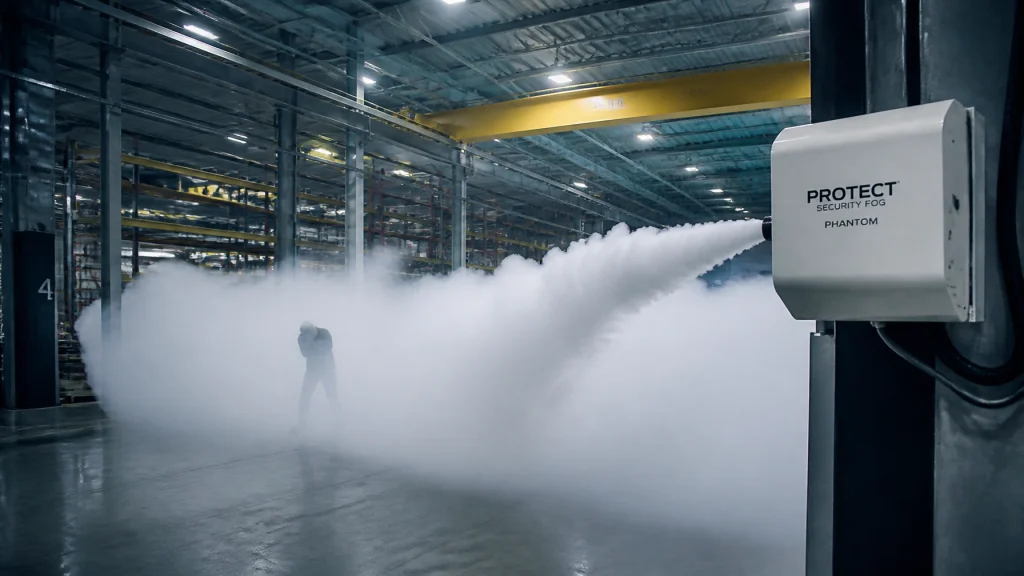
When an intruder enters a restricted yard zone, traditional CCTV leaves the criminals free to ransack high-value cargo. Security fog changes the physics of the break-in.
Our units, including the basic fog system for mid-size cross-dock zones and high-capacity units for large yards, deploy within three seconds of an alarm trigger. Within thirty seconds, the protected zone fills with a dense, dry, non-toxic fog that reduces visibility to zero.
[Perimeter Breach Detected] ──> [Instant Alarm Trigger] ──> [Fog Deployment (3 Secs)] ──> [Zero Visibility (30 Secs)] ──> [Theft Prevented]
Intruders cannot steal what they cannot see. Depriving criminals of sight neutralises their ability to locate high-value pallets, identify carton contents, or manoeuvre a tractor unit onto a trailer pin.

Protecting Loading Bays and High-Value Cargo Zones
While perimeter fencing secures the outer boundary, specific operational zones inside the facility require targeted protection. Loading bays, dispatch lanes, and internal transit sheds are prime vulnerability points during shift handovers.
For expansive loading bay doors and roller shutter thresholds, deploying our lite fog systems ensures that any breach at the loading dock creates an impenetrable visual barrier.
Furthermore, high-value electronics, bonded goods, and pharmaceuticals require compartmentalised defence. We protect these internal assets using the unik fog system, which secures bonded cages and pharma lanes against opportunistic tampering and internal collusion.
This layered approach guarantees that even if a perimeter fence is compromised, internal zones remain completely inaccessible. For operations managing broader distribution hubs, our work across warehousing sectors demonstrates how scalable fog deployment safeguards massive commercial footprints.
Insurance Compliance and Approved Security Standards
Logistics operators face mounting pressure from cargo insurers. Underwriters demand robust security credentials before underwriting high-value transit fleets and depot storage risks.
Our systems are fully Approved for use with NSI and SSAIB security systems, satisfying the rigorous demands of commercial insurers and industry compliance frameworks. Furthermore, remote ARC (Alarm Receiving Centre) integration allows monitoring stations to verify threats via visual feeds and trigger fog deployment remotely without requiring on-site staff intervention.
The empirical data supporting active defence is definitive. Industry studies and operational deployments demonstrate that there is a 97% of thefts avoided with security fog vs 17% with alarm/CCTV alone.

Key Takeaways
- Perimeter Fencing Is Not Enough: OCGs routinely bypass fences and standard gates to execute trailer hook-up thefts in minutes.
- Passive Security Fails: Alarms and CCTV record crimes after the fact, whereas active fog prevents the theft entirely.
- Proven Effectiveness: Achieving a 97% success rate against theft transforms fleet yard security from reactive to impenetrable.
- Insurance Approved: Systems are approved for use with NSI and SSAIB security systems to satisfy underwriter requirements.
Secure Your Fleet Yard Today
Relying on perimeter fencing alone leaves your high-value cargo exposed to organised crime gangs. It is time to upgrade from passive monitoring to active deterrence.
Explore our dedicated freight depot security fog systems or use our interactive Sector Quote Tool to calculate your exact depot protection requirements today.