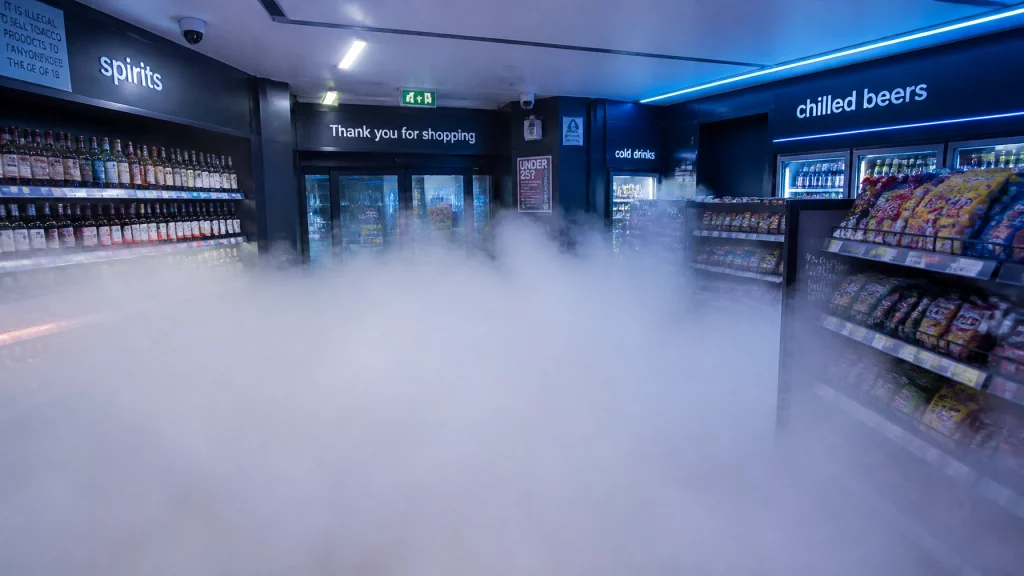
Short verdict: anti-burglary fog works, but not in the way a lock or a camera works. It does not stop someone breaking in. It stops them stealing anything once they are inside, by filling the room with a dense, harmless fog in seconds so there is nothing they can see, reach or carry out. Used with an alarm, it is one of the few measures that actually ends a raid while it is happening rather than recording it.
We put the technology through the checks a buyer should care about — how fast it deploys, whether the fog is safe, what it leaves behind, and where it lets you down. This is the honest version, limitations included.
How we tested it
A fair review of an anti-burglary fog system comes down to six questions. Get a straight answer to each and you know whether a system is worth fitting.
- How quickly does it fill the room after the alarm trips?
- Is the fog dense enough to stop someone working through it — and does it cover the whole volume?
- Is it safe for people, pets and stock?
- Does it leave residue you have to clean up?
- Will it work with the alarm and cameras already on site?
- Is there real evidence it reduces break-ins?
We scored the Density® range against each, criterion by criterion.
Activation speed
This is where fog earns its place. A monitored alarm typically buys you a police response measured in minutes, and a determined thief knows they have five to fifteen minutes to grab what they came for. Fog closes that window to nothing. The moment the alarm signals a breach, the generator fires and the space turns to a white-out within seconds. There is no five-minute grab — there is no visibility at all.
Fog density and coverage
A thin haze someone can squint through is useless. The test is a true opaque white-out, held across the whole volume of the room, right up to the ceiling. Because fog fills a space, coverage is measured in cubic metres, not floor area — it protects everything above the racking too, not just head height.
The range spans a single point to a large open building: the UNIK covers up to 600 m³, the 1500 Lite up to 1,500 m³, and the HP Line up to 6,000 m³ (HP6000) and 14,000 m³ (HP14000). Sized correctly to the room, there are no clear pockets for an intruder to work in.
97% of thefts are avoided with a fogging system and an alarm, compared with 17% with an alarm only. That is the Density® manufacturer figure, and it is the honest heart of any fog review: fog is not a standalone product — it is what makes the alarm actually stop the theft instead of just reporting it.
Safety
The fluid is the part people worry about, so it matters that it stands up. The Density fog is certified non-toxic to people and animals by Eurofins, and evaluated to EN ISO 16000-1:2006. It is food-grade too — tested to the Food Contact regulation, Reg. (CE) No. 1935/2004 — so it can be discharged in shops, bars and food storage without tainting stock. It blinds an intruder; it does not harm anyone in the room.
Residue
Older combustion “smoke” could leave a film to wipe down. A modern fluid-based fog should not, and this one does not — it disperses cleanly and leaves nothing on clothing, electronics or packaging. In a shop that means you reopen and restock within minutes of an incident, not the next day.
Integration with your alarm and cameras
A fog unit is only as good as the alarm that triggers it. The Density units are compatible with all existing alarm panels and fully compatible with Ajax, so the fog can be armed as part of a wireless setup rather than forcing a rip-and-replace. Cameras keep recording through the fog, capturing the intruder’s silhouette, and ActiveCloud logs the breach and fog release to your phone for free.
| What we tested | What good looks like | Density result |
|---|---|---|
| Activation speed | Full room in seconds of the alarm | White-out in seconds |
| Density & coverage | Opaque, whole-volume, no clear pockets | Up to 14,000 m³ (HP14000) |
| Safety | Non-toxic, safe around food and people | Eurofins + Reg. (CE) 1935/2004 |
| Residue | None to clean up | Residue-free, reopen in minutes |
| Integration | Works with existing alarm and cameras | All panels; Ajax; ActiveCloud |
| Standard | Certified to the fog-device standard | EN 50131-8:2019, CE, EMC, FCC |
Where anti-burglary fog falls short
No honest review skips the limitations, and fog has real ones.
It does not stop entry. A determined burglar can still force a door — what changes is that they walk into a room they cannot use. If you need to keep people out in the first place, fog belongs alongside good locks and physical barriers, not instead of them.
It also depends entirely on two things: a properly armed alarm to trigger it, and correct siting so the fog reaches the goods before the intruder does. A unit mounted in the wrong place, or sized below the room’s volume, will underperform. That is a survey job, not a guess. And like any life-safety-adjacent kit, it needs a brief annual service to stay reliable.
None of this is a reason to skip it. It is a reason to fit it properly.
The evidence it works
Beyond the manufacturer figure, the field results hold up. One Nordic convenience chain watched burglaries climb by around 170% over two years, fitted fog across its sites, and saw break-ins fall by roughly half — back to historic lows within two years. The deterrent effect compounds, too: once fog is known to be on a site, it stops being an easy target. Word travels among the people who would otherwise come back.
The verdict
As an active deterrent, anti-burglary fog is one of the most effective things you can add to a site that already has an alarm. It does the one thing cameras and sirens cannot — it removes the intruder’s ability to steal, in the seconds that decide whether you lose stock. Judged honestly, it is not a magic box and not a replacement for locks; it is the layer that turns a monitored alarm into a raid that fails. For any premises holding stock or cash worth taking, it earns its place.
If you want to see how it would perform in your building specifically, the fairest test is a free site survey — the space is measured, the right unit specified, and the alarm integration confirmed. Compare the best security fog systems, check the certifications for yourself, or book a free survey and we will assess your site honestly.
Frequently asked questions
Do anti-burglary fog systems actually work?
Yes, as an active deterrent used with an alarm. The Density® manufacturer figure is 97% of thefts avoided with a fogging system and an alarm, versus 17% with an alarm only. Fog does not stop entry — it removes the intruder’s ability to see and steal, in seconds, which is what ends most raids.
Can a burglar just work through the fog?
No, if the system is sized and sited correctly. A properly specified unit produces a true opaque white-out across the whole volume of the room, not a thin haze. With no visibility, an intruder cannot find or carry out stock and almost always leaves.
Is the fog safe for people, pets and stock?
Yes. The fluid is certified non-toxic by Eurofins and evaluated to EN ISO 16000-1:2006, and it is food-contact certified to Reg. (CE) No. 1935/2004. It leaves no residue and does not harm people, animals, electronics or food.
Will it work with my existing alarm?
In almost all cases, yes. Density units are compatible with all existing alarm panels and fully compatible with Ajax, and cameras keep recording through the fog. An installer confirms the integration during the survey.
How fast does the fog deploy?
Within seconds of the alarm triggering. Where a standard alarm gives a thief several minutes, fog denies visibility almost immediately, closing the window they rely on.
Is an anti-burglary fog system worth it?
For a site that already has an alarm and holds stock or cash worth stealing, it is one of the highest-impact upgrades available — it stops loss rather than just recording it. The right way to judge the value for your premises is a free site survey, where the unit is specified and the cost is quoted for your building.