Existing systems already provide the trigger
For organisations assessing public-sector security fog systems UK, the starting point is often the infrastructure already installed. Council depots, NHS facilities, schools, police stations and civic buildings may already use an intruder alarm, CCTV, access control and remote monitoring. Security fog adds an active layer to that arrangement rather than requiring a separate security system.
The principle is straightforward:
Alarms detect. CCTV records. Density prevents. Passive security fails.
An intruder alarm identifies a breach through a door contact, PIR, perimeter detector or other programmed input. CCTV can show what happened before, during and after the event. Security fog then responds to the alarm signal by filling the protected volume and creating zero visibility before an intruder can remove assets.
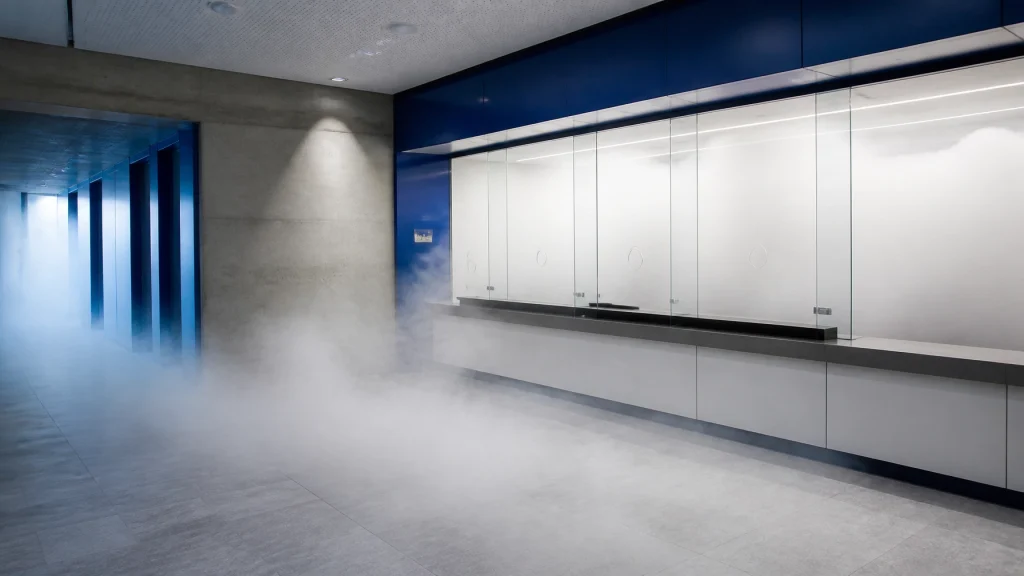
Security fog deploys in well under a single second, creating zero visibility as it fills the protected volume. This is the operational gap between detection and response. A monitoring centre may identify the alarm immediately, but an intruder can still have several minutes before a responder arrives. The purpose of active security is to make that time unproductive.
97% of thefts avoided with security fog vs 17% with an alarm/CCTV alone.
Explore public-sector security fog systems UK
Density is approved for use with NSI and SSAIB security systems. The connection is normally designed by a suitably competent security installer using the alarm panel’s available inputs and outputs. The final arrangement depends on the alarm panel, the protected zone, the building layout and the organisation’s operating procedures.
A site survey is therefore essential. The survey should establish the protected volume in m³, likely entry routes, internal divisions, ceiling height, ventilation, occupancy patterns, fire and life-safety arrangements, alarm zones, CCTV views and the position of valuable assets. It should also assess whether one protected room, several connected rooms or multiple separate zones require coverage.
The correct system is selected by volume, not by a generic room label. Density Basic covers up to 390 m³ per shot. Density UNIK covers up to 600 m³ and is a niche, battery-powered option for one high-value point, such as a pharmacy cabinet or secure store. Other currently sold options include Density 600C Line, Density 900, Density 2400 and Density 2400C Line. Larger sites may require HP6000 for up to 6,000 m³ or HP14000 for up to 14,000 m³ per generator. The final specification should be confirmed against the measured protected volume and the relevant datasheet.

The key benefit for NHS facility security systems is that existing detection remains useful. The alarm still identifies the event. CCTV still records the activity outside the obscured area and provides pre-event footage. The fog creates an immediate physical deterrent inside the protected zone. It is non-toxic, non-corrosive and designed to leave no residue, making it suitable for properly assessed environments containing medical equipment, documents and other sensitive assets.
The same principle applies to council depot security fog. A depot may already have perimeter detection, doors protected by contacts and CCTV covering vehicle access points. A fog system can be allocated to a plant store, cable store, workshop or high-value equipment room. For council fleet compound security, the fog would normally be considered for an enclosed secure area rather than an open yard. The survey should identify which assets are most exposed and which areas can be effectively filled.
For government building security fog, the design should follow a documented cause-and-effect process. This records which alarm event triggers the fog, what CCTV view is presented, which monitoring station receives the signal, who can inhibit or abort activation, and what actions follow deployment.
The trigger logic should reflect the risk. A lower-risk secure room may be configured to activate when a confirmed intrusion occurs. A higher-risk pharmacy, metals store or police evidence store may require a more immediate response once the site is armed and a protected door or detector is triggered. There is no universal configuration. The alarm installer and site owner should agree the logic based on false-alarm history, occupancy, asset value and response arrangements.
CCTV integration should be equally deliberate. NPSA guidance on integrated electronic security describes the value of linking detection, CCTV and control-room processes so that the correct camera view and response action follow an alarm. A fog activation event should be mapped to the relevant camera group or video management platform where possible. Cameras inside the room may become visually obscured, but cameras covering the entrance, corridor, loading point and external approach can continue to support verification and response.
The operating procedure should tell control-room staff what the event means. The alarm receiving centre or security control room should receive a distinct fog activation or system-status signal alongside the intrusion alarm. Operators should review available pre-event and external footage, follow the agreed escalation process and notify the nominated response organisation. Staff should not enter the affected area until the site’s clearance and ventilation procedure has been followed.
Testing should take place before handover and at defined intervals afterwards. A commissioning test should verify the alarm trigger, arming state, inhibit function, abort arrangements, fog activation signal, CCTV response, ARC notification, local indicators and fault outputs. The installer should record the test results and provide the cause-and-effect documentation to the responsible facilities or security team.
Routine maintenance should include system status, tamper protection, power supply, battery condition, fluid level, activation history and communications. After any deployment, the system should be inspected, the consumable replaced and the event reviewed. A test that only checks whether an alarm reaches the monitoring centre is not enough. The organisation must confirm that the complete detection, fog, CCTV and response chain works as designed.
The same approach supports municipal depot break-in prevention, council metals theft deterrent, school and academy site protection and police evidence store security. In each case, the objective is not to remove the alarm or CCTV. It is to ensure that detection leads to an immediate protective action.
FAQ box
Can security fog connect to an existing intruder alarm?
Yes. Density systems are designed to work with existing alarm infrastructure through suitable inputs and outputs. The installer must confirm compatibility, wiring, alarm grade, trigger logic and the requirements of the relevant system.Does CCTV need to be replaced?
No. CCTV remains valuable for detection, verification, investigation and recording. The design should account for the fact that cameras inside a fog-filled room may be temporarily obscured. External and approach cameras can continue to support the response.How quickly does security fog deploy?
Security fog deploys in well under a single second after a valid trigger and creates zero visibility in the protected area as the fog fills the space. The time to reach the required density depends on the selected generator, protected volume and installation design.Which Density system is suitable for a public-sector site?
The selection depends on the protected volume in m³ and the risk profile. Options include Density Basic for up to 390 m³, Density UNIK for one high-value point up to 600 m³, Density 600C Line, Density 900, Density 2400 and Density 2400C Line. Larger spaces may require HP6000 or HP14000. A site survey should confirm the specification.Can fog be used in an NHS pharmacy or secure document store?
Density fog is non-toxic and non-corrosive, with no residue designed to remain on protected contents. NHS estates and facilities teams should still assess the particular room, ventilation, occupancy and operational requirements before installation.What does EN 50131-8 mean for procurement?
BS EN 50131-8 sets requirements for security fog devices used as part of intruder and hold-up alarm systems. NSI and SSAIB approval relates to the relevant installer and alarm system arrangements. Buyers should request the manufacturer’s technical documentation and ensure the integrated installation is designed and maintained by an appropriate NSI or SSAIB provider. Further information is available from NSI and SSAIB.What happens after activation?
The organisation’s agreed procedure should cover notification, CCTV review, site attendance, access restrictions, ventilation, inspection, reset and replenishment. Staff training and clear signage are important parts of the handover process.
A properly integrated system should be treated as a security project, not simply an additional device. Start with a threat and risk assessment, then document the operational requirement for each protected zone. The design should show the alarm inputs, fog outputs, CCTV actions, monitoring signals, inhibit controls and response responsibilities.
For multi-site estates, maintain a common standard while allowing for local differences. Council depots, civic offices, NHS stores, academies and police facilities will not have identical layouts or procurement routes. Scotland, Wales and Northern Ireland also operate different procurement frameworks, so public-sector buyers should check the relevant national framework, standing orders and tender requirements before specifying equipment.
Useful next steps include reviewing the Density product range, reading relevant Density case studies, and comparing the Density Basic and Density UNIK. The final selection should always follow a site survey and installer-led design.
What you can't see you can't steal.
Request a site assessment for public-sector security fog systems UK