Why civic buildings need active protection
Council offices, civic buildings, archives, service hubs and municipal storage rooms often become unattended once the working day ends. At that point, an intruder may have time to force an entry, search for keys or equipment, remove IT assets and damage internal doors before a keyholder or emergency responder arrives.
The risk is not limited to the value of what is taken. A burglary can interrupt public services, delay housing or benefits administration, compromise records management, remove essential equipment and create additional costs for repairs, investigation and temporary accommodation. For facility managers and procurement teams, civic site theft prevention is therefore part of operational continuity and duty of care.
Alarms and CCTV remain important layers. They detect an intrusion, raise an alert and provide a record of events. They do not, by themselves, create a physical barrier between an intruder and the assets inside the building.
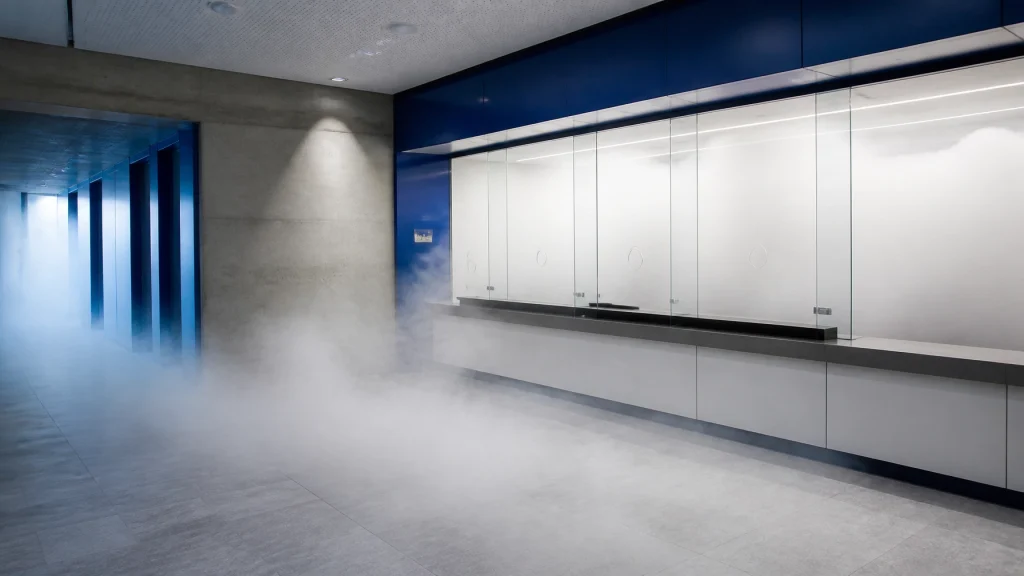
Security fog adds that active layer. Connected to an existing alarm or door sensor, security fog deploys in well under a single second to create zero visibility in the protected area. An intruder cannot easily locate equipment, identify storage points or move safely through the room. The objective is to interrupt the theft in progress while keyholders and emergency services follow their established response procedures.
97% of thefts avoided with security fog vs 17% with an alarm/CCTV alone.
Alarms detect. CCTV records. Density prevents. Passive security fails.
Find out more about public-sector security fog systems UK
Civic buildings are rarely uniform. A council office may contain open-plan work areas, reception points, server rooms, archives and secure stores. A service hub may include plant, laptops, communications equipment or controlled-access rooms. Each area needs to be assessed by its protected volume, access routes, alarm zones and the time required for a response.
A suitable system should work with the security infrastructure already in place. Density security fog is approved for use with NSI and SSAIB security systems, allowing public bodies to add active deterrence without replacing their existing alarm arrangements. The fog is non-toxic, non-corrosive and leaves no residue, making it suitable for environments containing documents, IT equipment, medical equipment and other sensitive public assets.

For a smaller secure room, the Density® Basic provides coverage of up to 390 m³ per shot. The Density® 600C Line covers up to 600 m³, while the Density® 900 covers up to 900 m³. For larger civic storage areas, office floors or connected zones, the Density® 2400 and 2400C Line cover up to 2,400 m³. HP6000 covers up to 6,000 m³, and HP14000 covers up to 14,000 m³ per generator where the protected volume requires it.
The right specification depends on the complete volume being protected, not simply the building’s footprint. A site survey should consider ceiling height, partitions, doorways, ventilation and whether several rooms require separate protection. Product information is available through the Density product range and the Basic fog system pages.
The same approach applies across the wider public estate. Council depot security fog can protect equipment stores and high-risk internal areas. NHS facility security systems may use fog to protect pharmacy stores, technical rooms and medical equipment areas. School and academy site protection can focus on IT stores and restricted rooms, subject to safeguarding, estates and duty-of-care assessments. Police evidence store security requires careful planning around access control, alarm zoning, ventilation and local operating procedures.
Density UNIK is available as a niche, battery-powered option for one high-value point, such as a single cabinet or small secure room. It should not be treated as a whole-building solution. Larger civic sites generally require a mains-powered system sized to the protected volume and connected to the existing alarm infrastructure.

FAQ Box
What is government building security fog?
Government building security fog is an active security layer that deploys when an existing alarm or sensor identifies an intrusion. It fills the protected area with dense fog, creating zero visibility and disrupting the intruder’s ability to locate and remove assets.How quickly does Density security fog deploy?
Security fog deploys in well under a single second after the confirmed trigger signal, then fills the protected area according to the system specification and room volume.Can a council use security fog with its existing alarm?
Yes. Density works with NSI and SSAIB alarm systems through the existing alarm infrastructure. The final connection should be designed and commissioned by a suitably qualified installer in line with the alarm manufacturer’s requirements.Which Density system is suitable for a civic building?
The answer depends on the protected volume and layout. Density Basic covers up to 390 m³ per shot. The 600C Line covers up to 600 m³, the 900 covers up to 900 m³, and the 2400 and 2400C Line cover up to 2,400 m³. HP6000 and HP14000 are intended for larger volumes. A site survey confirms the appropriate specification.Is security fog safe around council records and equipment?
Density fog is non-toxic, non-corrosive and leaves no residue. The site assessment should still consider ventilation, occupancy procedures, fire controls, sensitive equipment and the organisation’s local recovery process after activation.Does security fog replace alarms, CCTV or keyholders?
No. It complements those controls. Alarms detect, CCTV records and keyholders or responders investigate. Security fog provides an immediate active deterrent during the period between detection and arrival.Is active security now required for every public building?
There is no single UK-wide requirement that every civic building must use security fog. Public bodies should complete a risk-based assessment and review their insurer, risk protection and procurement requirements. Active security systems such as Density security fog are increasingly mandated as a prerequisite of cover in some arrangements, so requirements should be checked before renewal or tendering.
Civic building protection should be documented as part of a wider security plan. Begin with the assets that would create the greatest operational disruption if removed or damaged. Review out-of-hours occupancy, alarm grading, access control, keyholder arrangements, responder routes and the likely time before assistance reaches the site. Consider whether a single secure room, several alarm zones or an entire municipal facility requires protection.
Procurement teams should also record the system’s coverage in m³, trigger method, alarm compatibility, installation requirements, maintenance arrangements, staff procedures and post-activation process. Scotland, Wales and Northern Ireland operate different procurement frameworks, so public bodies should check the relevant arrangements rather than assuming that an English framework applies across the UK. Current opportunities and contract requirements can be reviewed through the Crown Commercial Service, Contracts Finder and ProContract, alongside local procurement rules.
For practical examples of how active deterrence is specified and deployed, review the Density case studies. The aim is not to remove every risk. It is to add a fast, physical response that helps protect public assets, preserve service continuity and support a layered security strategy.
What you can't see you can't steal.