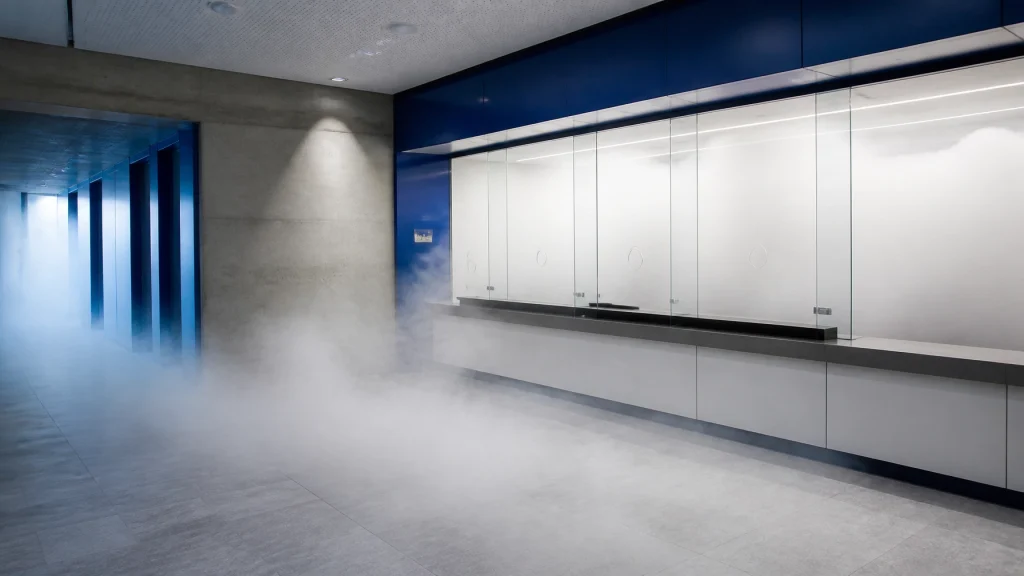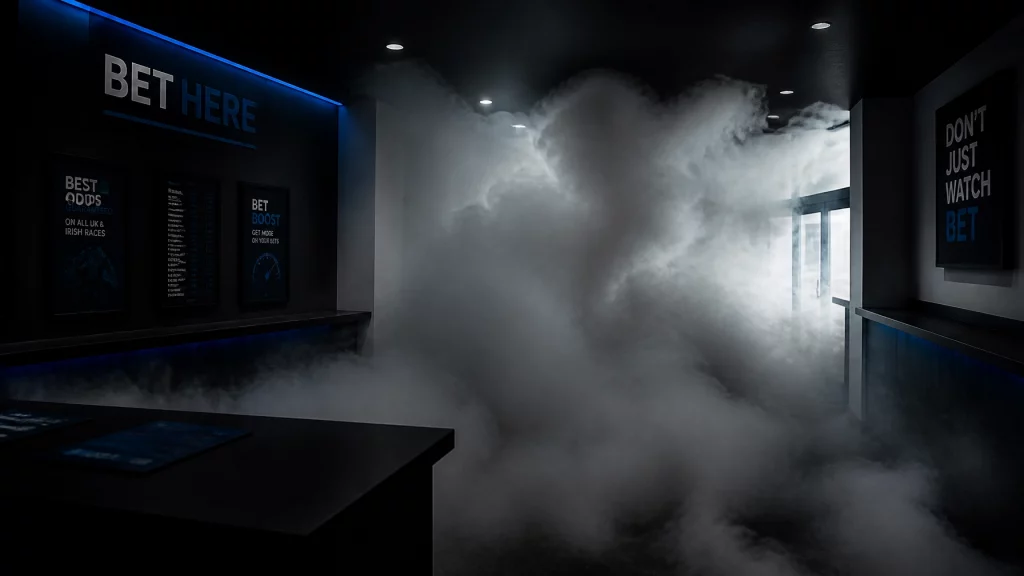
Licensed Betting Offices (LBOs) in the UK increasingly operate with single-staff shifts to manage overheads and extend opening hours. While economically viable, solo working introduces significant physical and psychological risks for employees. Passive security measures like CCTV and traditional alarms offer no immediate intervention during a robbery or violent confrontation. For operators, the deployment of betting shop security fog systems provides an essential, active layer of protection that removes the need for staff-intruder confrontation.
Legal Framework and Employer Liability for Solo Shifts
The Health and Safety Executive (HSE) guidance, specifically INDG73, mandates that employers conduct a rigorous risk assessment for any lone worker scenario. In a betting shop environment, this assessment must account for high cash holdings, public accessibility, and the potential for intoxicated or aggressive customers. Failure to address these foreseeable risks can lead to significant legal liability. The landmark case of Nicholls v Ladbrokes (2013) demonstrated that failing to implement sufficient security measures and conduct proper risk assessments constitutes negligence. When an employee is left alone, the duty of care increases, requiring technology that actively prevents crime rather than just documenting it.
The BRC Crime Report 2026 highlights the scale of the challenge, recording an average of 1,600 incidents of violence or abuse daily across the retail sector. For lone workers, these incidents are not just statistics; they are direct threats to physical safety. An Usdaw March 2026 survey found that 78% of retail workers faced verbal abuse in the preceding year. In an LBO, where high-stakes gambling and alcohol consumption often intersect, the risk of escalation is heightened. If a lone worker is forced to wait for a 10-minute police response during a robbery, the physical and mental trauma is often irreparable. Passive security fails because it does not stop the intruder's progress. Security fog changes this dynamic by instantly removing the intruder's ability to see and navigate the premises.

The Reality of Violence in Lone Working Environments
Research by Banks & Addis (2020) into LBO robberies revealed that lone working was a factor in at least 28% of recorded incidents. These situations often targeted female staff or those perceived as vulnerable during late-night or early-morning shifts. The study underscored that the presence of passive security, such as cameras, did not deter motivated offenders who masked their faces. In contrast, the Density 600 Lite is designed to deploy within seconds of a confirmed intrusion or panic button activation. By filling the shop with a dense, impenetrable fog, the system forces the intruder to exit immediately. What you can't see you can't steal.
Implementing the Density 600 Lite or the UNIK system ensures that staff do not need to play the hero. The fog acts as a physical barrier between the staff member and the criminal. This non-confrontational approach is vital for single staff LBO protection. While CCTV merely records the crime for later prosecution and alarms simply detect the breach, Density prevents the crime from concluding. Manufacturer data indicates that 97% of thefts are avoided when security fog is present, compared to just 17% with alarm and CCTV systems alone. This disparity highlights the fundamental flaw in traditional security: it relies on a response that is almost always too late.
| Security Measure | Function | Outcome for Lone Worker |
|---|---|---|
| CCTV | Records | Evidential only; no protection during the event. |
| Alarms | Detects | Alerts authorities; response time is often 10+ minutes. |
| Density Fog | Prevents | Instantly stops the intruder; creates a safety screen. |
"Alarms detect. CCTV records. Density prevents. Passive security fails."
FAQ: Staff Safety and Security Fog Deployment
| Question | Answer |
|---|---|
| Is it safe to have fog deploy around a staff member? | Yes. Density security fog is non-toxic, non-corrosive, and food-safe. It is specifically designed to be used in occupied spaces without causing respiratory distress or damaging electronics. |
| Will fog affect staff ability to exit the premises? | Staff are trained on the layout and exit routes. The fog is designed to disorient intruders who are unfamiliar with the environment, while staff can use established safety protocols to reach secure areas or exits. |
| Does fog replace other lone worker safety measures? | No. Security fog is a critical layer in a multi-faceted safety strategy. It should be used alongside personal panic alarms, MAG locks, and robust conflict de-escalation training. |

Active Prevention with the Density 600 Lite
For most betting shop layouts, the Density 600 Lite provides the optimal balance of power and rapid deployment. It is approved for use with NSI and SSAIB systems, ensuring it integrates seamlessly into existing security infrastructures. The fog produced is not only dense but exceptionally persistent, remaining in the air to prevent re-entry for significant periods. This is particularly effective for staff safety betting shop strategies where the primary goal is to end the threat as quickly as possible. The system can be triggered manually by the lone worker via a foot-rail or wearable panic button, or automatically via the alarm system.
Operators must also consider the insurance implications of solo shifts. While we do not quote specific percentages, many operators report reductions in their insurance premiums after installing approved security fog systems. This is a direct reflection of the reduced risk profile of the premises. By moving from a passive to an active security posture, LBO owners meet their legal obligations under HSE guidance while providing their staff with a tangible sense of security. The Basic Fog System and high-capacity models like the UNIK offer scalable solutions for larger multi-site operators looking to standardise their lone worker protection protocols.