Understanding the Latest ONS Data on Non-Residential Burglary
The Office for National Statistics (ONS) and the Home Office have released their official crime statistics for the year ending March 2026. While total police-recorded burglary offences across England and Wales decreased by 9% to 223,456 incidents, the data for business and community premises reveals an ongoing vulnerability across unattended public-sector facilities. For facility managers, council depots, NHS trusts, and educational establishments, these numbers underline a stark operational reality: passive security measures are failing to stop out-of-hours intrusion.
According to Home Office crime outcome statistics accompanying the release, roughly 70.6% of non-residential burglary investigations concluded with "no suspect identified," while only 9.0% resulted in a charge or summons. When high-value assets, municipal metals, IT equipment, and critical supplies are targeted during out-of-hours raids, waiting for police response or relying on recorded video evidence provides zero operational recovery. Alarms detect. CCTV records. Density prevents. Passive security fails.
Facility managers seeking to upgrade resilience can explore public-sector security fog systems UK standards to protect municipal assets before breaches occur.
For a comprehensive overview of engineering specifications and device capabilities, review our complete range via /products/, discover specialized deployments at /case-studies/, or evaluate compact solutions like the /unik-fog-system/, the /basic-fog-system/, and the /lite-fog-systems/.

Why Passive Security Fails Public Sector Estates
Traditional security infrastructure relies entirely on detection and documentation. When an intruder breaches a perimeter fence or forces an access door at a council depot or school store, standard alarm systems trigger a remote notification, and CCTV cameras begin recording footage of the theft in progress. However, average police response times and private security patrols mean criminals routinely have 10 to 20 minutes of unimpeded access: more than enough time to strip copper cables, harvest catalytic converters from council fleet vehicles, or steal high-value medical supplies from NHS facilities.
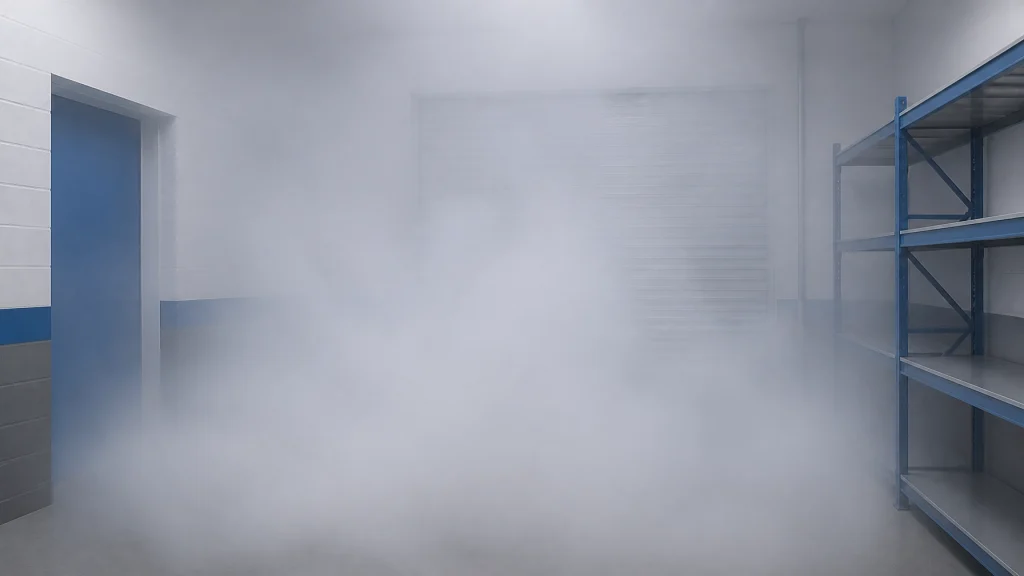
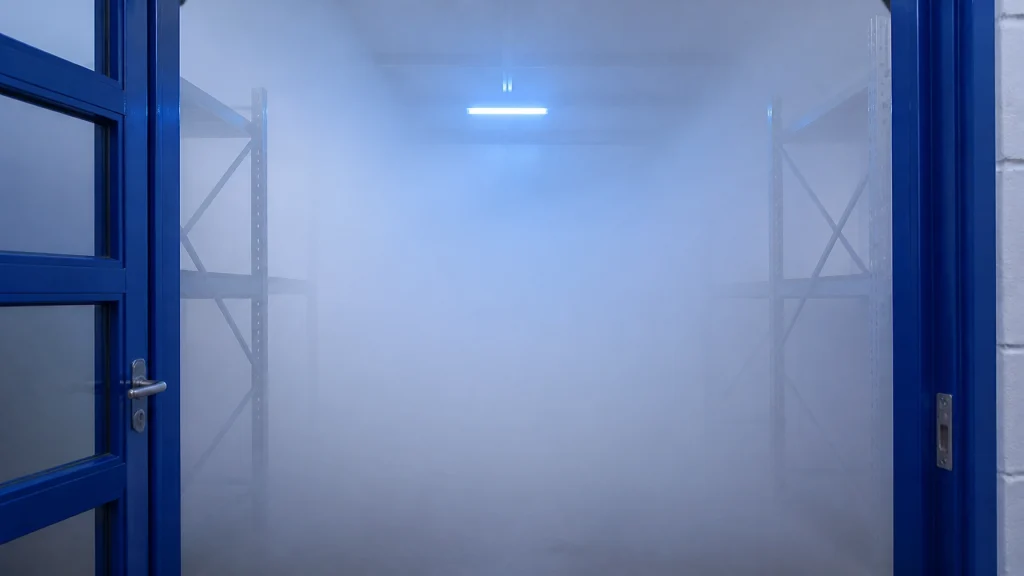
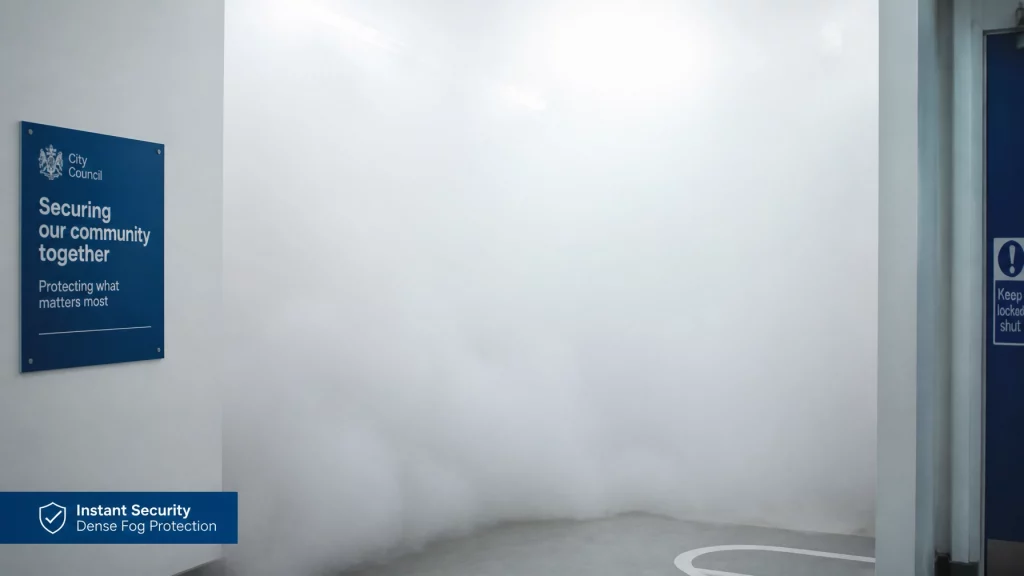
The statistics speak for themselves. With over seven out of ten non-residential burglaries resulting in zero suspects identified, post-incident investigation offers negligible deterrence. Insurers and risk protection arrangement (RPA) schemes increasingly recognize that recording a crime does not prevent loss. Active security systems: such as Density security fog, which deploys in just 3 seconds to achieve absolute zero visibility: are increasingly mandated as a prerequisite of cover. What you can't see you can't steal.

Frequently Asked Questions
How quickly does Density security fog deploy during a break-in?
Density security fog systems deploy in a remarkable 3 seconds, instantaneously flooding the protected space and creating total zero visibility that stops intruders in their tracks before theft can occur.
Is security fog safe for public sector environments such as schools and NHS trusts?
Yes. The fog is entirely non-toxic, non-corrosive, and leaves zero residue on sensitive items like IT hardware, medical equipment, or archived documents, complying fully with EN 50131-8 standards.
Are these systems compatible with existing alarm infrastructure?
All units are fully approved for use with NSI and SSAIB security systems, integrating seamlessly with your current panel infrastructure without requiring costly replacement systems.
What coverage capacity do the systems offer?
Units range from compact configurations like the Density 600 Lite and Density 900 Lite up to high-capacity options such as the Density 2400 Lite, which secures up to 2,400 m³ in a single deployment. The Density UNIK provides a specialized, battery-powered option for single high-value points.

Securing Your Facilities Against 2026 Burglary Trends
As public sector budgets face mounting pressure, the financial and operational fallout of equipment theft, facility damage, and operational downtime cannot be absorbed. Implementing proven active deterrence shifts the dynamic from post-incident recovery to immediate interception. Data confirms that 97% of thefts are avoided with security fog, compared to just 17% with an alarm or CCTV alone.
To protect your civic buildings, council depots, and municipal sites from the rising tide of unprosecuted break-ins, ensure your procurement strategy aligns with certified active protection standards.
Protect your estate today by visiting public-sector security fog systems UK to discuss specification requirements with our security engineering team.