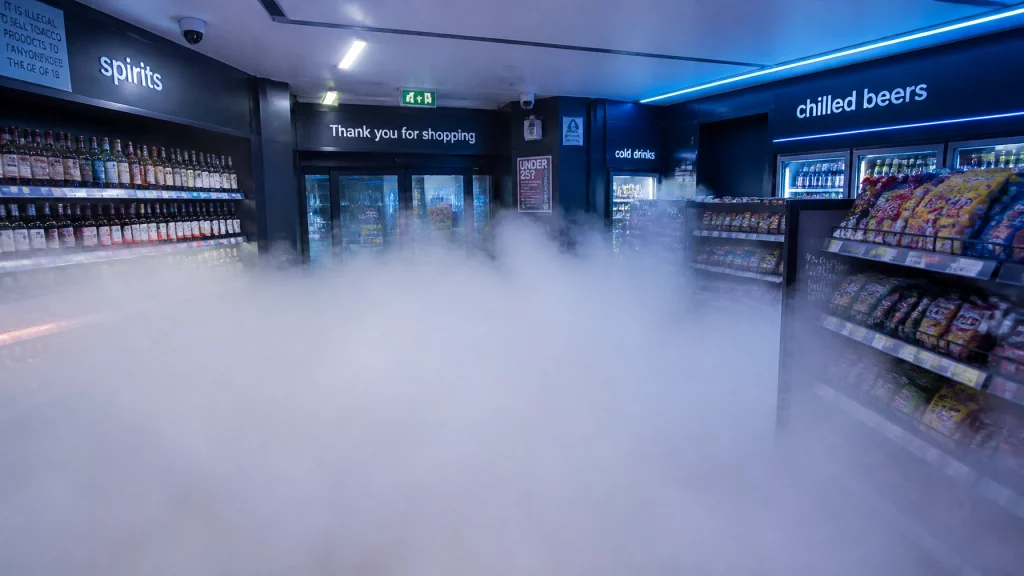
Four questions come up again and again before a business commits to a security fog system. Is the fluid actually safe? What standard should it meet? Will it upset the fire alarm? Does it help with insurance? Here’s the short answer to each. A full explainer is linked wherever you want more detail.
Is the fluid itself safe?
Yes. Density’s fluid is certified non-toxic to humans and animals by Eurofins, evaluated to EN ISO 16000-1:2006. It’s also certified to the Food Contact regulation, Reg. (CE) No. 1935/2004. That’s why it’s cleared for use in grocery stores, supermarkets, bars, restaurants, delicatessens, and food warehouses. It leaves no residue and doesn’t taint stock. Full certificate detail sits on the certifications page.
What standard should a fog device meet?
Look for EN 50131-8:2019. That’s the European standard covering security fog devices as part of an intruder and hold-up alarm system. Density systems meet it, along with CE, EMC and FCC. It’s a product standard, and it’s separate from two other things buyers often mix it up with:
- NSI and SSAIB approve installer companies and monitored alarm services. They don’t approve the fog device itself. Read how the two fit together.
- BS 5839-1 governs UK fire alarm systems — a completely separate scope from EN 50131-8:2019. Neither standard says how the two systems behave together in the same room. That’s an installation question, covered next.
Will it interfere with my fire alarm?
It can, in one specific case. If an optical or dual-sensor smoke detector sits inside the fogged zone, dense fog can scatter light the same way smoke does. It’s a real mechanism, not a vague caution. It’s exactly why a proper site survey checks detector type before install, not after. See the full breakdown, including what a competent installer checks.
Does it affect my insurance?
It can help build a case for a lower premium. No vendor can promise a set figure — that sits with your own insurer, your claims history and your wider risk profile. But the case itself is a strong one. A fog system steps in during a theft, rather than only recording or alerting after it. The manufacturer’s own figure backs this up: 97% of thefts avoided with fog and an alarm combined, against 17% with an alarm alone. Read the honest version of this case.
Standards and bodies at a glance
| Body / standard | What it actually covers |
|---|---|
| EN 50131-8:2019 | The fog device itself, as part of an intruder and hold-up alarm system |
| NSI / SSAIB | Installer companies and monitored alarm services — not standalone devices |
| BS 5839-1 | UK fire alarm systems — a separate scope entirely from fog/intrusion standards |
| Reg. (CE) No. 1935/2004 | Food-contact safety of the fog fluid itself |
| EN ISO 16000-1:2006 | The toxicological evaluation basis for the non-toxic fluid certification |
Why this matters more than it looks like it should
None of these four questions are edge cases. They come up in almost every serious buying conversation. Usually they come from whoever signs off the purchase, not whoever wants it. A single generic “yes, it’s all approved” doesn’t answer any of them properly. A straight, specific answer to each one is what actually moves a compliance-led buyer from interested to confident.
That’s also why each of these four answers links out to a full page rather than trying to cram everything in here. The detail matters, and it’s easier to trust an answer you can check for yourself than one that asks you to take it on faith.
Frequently asked questions
Is security fog covered by a single overall approval?
No. Several separate things each do a different job. There’s a product standard for the device, EN 50131-8:2019. There are separate certifications for the fluid itself. And separately again, there’s whatever approval covers your monitored alarm company — NSI or SSAIB. There isn’t one badge that covers all of it at once.
Do I need to tell my fire alarm company before installing a fog system?
It’s worth it if optical or dual-sensor detectors sit in the zone the fog will reach. A proper site survey checks this as standard. Raising it yourself first is never the wrong move.
Is the fluid different from ordinary smoke or theatrical haze?
Yes. It’s a food-grade glycol and water mix, not combustion smoke. It’s certified non-toxic and safe for contact with food. That’s a very different safety profile from anything involving actual burning or industrial haze fluid.
Where do I start if I want to check all of this for my own premises?
Get a quote and raise any of these points directly during the site survey. That’s the right stage to confirm detector type, alarm integration and paperwork for your insurer, before anything’s fitted.