UK logistics operators are facing a paradox where insurance premiums for cargo are softening globally, yet local theft risks and fleet costs continue to climb. I’m going to show you how shifting from passive CCTV to active security fog can give you the leverage you need to slash your 2026 insurance spend.
TL;DR: The Active Security Advantage
- Active vs Passive: Traditional alarms only record crime; freight depot security fog systems stop it in 3 seconds by removing an intruder's ability to see.
- Premium Leverage: Insurers are increasingly looking for loss-prevention tech that satisfies NSI and SSAIB requirements to justify lower deductibles.
- The 97% Stat: Security fog boasts a 97% success rate in preventing theft, compared to just 17% for standard alarms and CCTV.
The Insurance Market Shift in 2026
As we look toward the 2026 renewal cycle, the cargo insurance market in the UK is in a strange state of flux. On one hand, global capacity is high, which generally pushes premiums down. On the other hand, the cost of claims remains a massive headache for underwriters. According to market outlooks from firms like Aon and Lockton, well-managed risks: those with robust, documented loss-mitigation strategies: are the only ones seeing significant rate reductions.
In my experience talking to logistics managers across the Midlands and the South East, "standard" security just isn't enough to impress a broker anymore. If your depot relies on a perimeter fence and some 10-year-old CCTV, you aren't a "well-managed risk": you're a sitting duck. To get a better deal for 2026, you need to demonstrate that you've moved beyond passive recording and into active deterrence.

The Passive Security Trap: 17% vs 97%
We’ve all seen the footage. An intruder breaks into a loading bay, clears a pallet of high-value electronics into a waiting van, and vanishes in under four minutes. The CCTV records it all in 4K, but by the time the police arrive, the goods are already being offloaded in a different county.
The data is sobering: 97% of thefts are avoided with security fog vs only 17% with alarm/CCTV alone.
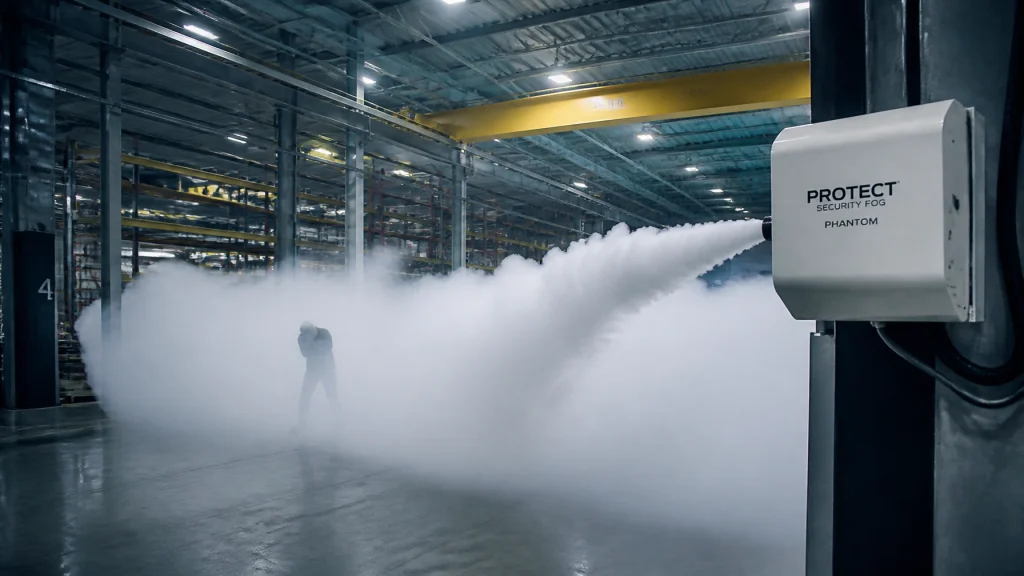
Why is the gap so massive? Because CCTV doesn't stop a crime; it just provides a movie of it for the insurance claim. When we install our Lite-range systems for loading bay coverage, the intruder is met with a wall of dense, non-toxic fog within 3 seconds of a breach. If they can’t see the cargo, they can’t steal it. This is the exact kind of "active intervention" that makes an underwriter's ears perk up during a site survey.
NSI and SSAIB: Speaking the Underwriter's Language
I often get asked if our systems are "accredited." While that's a common term, what actually matters to your insurer is that our systems are approved for use with NSI and SSAIB security systems.
When a monitoring station (ARC) can remotely trigger a fog event because they see a confirmed intruder on your loading bay security system, the risk of a "total loss" event drops to near zero. Insurers love this because it removes the "human element" of police response times, which are currently stretched to breaking point across the UK. By integrating an SSAIB-compatible fog system, you aren't just buying hardware; you're buying a lower risk profile.

High-Value Inventory? Meet Your New Best Friend
Whether you are managing cross-dock pharma lanes or high-value bonded cages, the threat level isn't uniform across your site. This is where a tiered approach to security fog helps in your insurance negotiations.
- For Large Depot Floors: The HP range provides massive coverage for open warehouse spaces.
- For Cross-Docks: Our Basic fog systems are ideal for mid-sized zones where high-turnover goods dwell overnight.
- For High-Value Cages: The UNIK system is battery-operated and compact, perfect for protecting specific "gold-standard" zones like tobacco, electronics, or pharmaceutical lanes.
When you can show your broker that you have specific, targeted protection for your most vulnerable "target stock," you aren't just asking for a premium reduction: you're proving that a major loss is practically impossible.
The NaVCIS Reality: Why 'Standard' Alarms Aren't Enough
The latest data from the National Vehicle Crime Intelligence Service (NaVCIS) shows that freight crime remains at crisis levels. In 2025 alone, there were over 3,400 recorded incidents resulting in £65 million in direct losses. The Midlands, particularly the "Golden Triangle," remains a primary target for organised crime groups (OCGs).
These OCGs are professional. They know exactly how long they have before a security guard or the police arrive. Most "smash and grab" raids on warehousing facilities are over in minutes. Passive alarms simply can't react fast enough. Security fog, however, changes the environment instantly. By filling a space in under 30 seconds, you force the intruders to retreat immediately, usually empty-handed.

Negotiating Your Next Renewal: 3 Steps to Take Now
If your insurance renewal is coming up in early 2026, don't wait until the last minute to discuss your security upgrades. Here is how I recommend approaching the conversation:
- Request a Risk Survey: Ask your broker to walk your site and identify "target zones." Specifically mention that you are looking at NSI-compatible active deterrence.
- Highlight the 'Action' Time: Don't just say you have an alarm. Tell them: "Our system deploys security fog in 3 seconds, meaning visibility is zero before an intruder can reach the first pallet."
- Use the Stat: Bring the 97% success rate to the table. Most underwriters are used to seeing the same old CCTV specs; showing them a technology that physically prevents the theft is a game-changer.
We provide a UK-wide approved installation network, ensuring that your system isn't just effective, but also compliant with all safety and insurance standards. Our fog is non-corrosive and safe for all goods, including electronics and pharmaceuticals, so there's no "collateral damage" to worry about after a deployment.
Key Takeaways for Logistics Managers
- Stop the Clock: Theft happens in minutes; fog reacts in seconds.
- Integrated Security: Ensure your system is approved for use with NSI and SSAIB monitoring for maximum insurance leverage.
- Targeted Protection: Use different units (UNIK, Basic, Lite) to protect specific high-value zones rather than just the perimeter.
- Evidence-Based: Use NaVCIS data to justify the investment to your board: the "low risk/high reward" nature of freight crime requires a high-tech response.
Headline Stat: "97% of thefts avoided with security fog vs 17% with alarm/CCTV alone."
Protect your cargo before it leaves the bay.
Explore our freight depot security fog systems or use our Logistics Sector Quote Tool to get a tailored security plan for your facility today.