Organised cargo crime in the UK has reached unprecedented levels in 2026, with distribution centres becoming primary targets for sophisticated criminal gangs. This report maps the current theft hotspots and explains why warehouse security fog systems are now a critical requirement for high-value logistics operations.
TL;DR
- Rising Risk: UK cargo crime notifications reached 3,424 in 2025, with losses exceeding £65 million according to NaVCIS.
- Hotspot Zones: The M1 corridor remains the most dangerous route, with the West Midlands and East Midlands reporting the highest facility breach rates.
- Active Deterrence: Traditional alarms fail during the 15-minute police response window; security fog physically stops theft in under 30 seconds.
The 2026 UK Cargo Crime Landscape
The logistical heart of the UK is under sustained attack. According to the latest data from TAPA EMEA, the UK recorded 5,865 cargo-crime incidents in the two years leading to September 2025, with total losses reaching approximately €72 million. What is most concerning for facility managers is the shift in tactics: by December 2025, 48% of all recorded incidents were thefts directly from facilities and warehouses, rather than just vehicles in transit.
This surge in facility-based crime is driven by organised gangs targeting "high-yield" environments. A single breach at a Paris electronics warehouse in late 2025 resulted in a staggering €30 million loss, a trend that UK police forces are now seeing replicated across the Midlands. Data from NaVCIS (National Vehicle Crime Intelligence Service) in 2025 showed an average of nine notifications per day, totalling £65 million in annual losses. For businesses operating in these zones, the question is no longer if they will be targeted, but how they will survive the "critical window" between an alarm trigger and police arrival.
Regional Hot Spots: Mapping the Risk
The distribution of cargo crime is not uniform across the UK. Criminal gangs focus their efforts on regions with high concentrations of 3PL providers and distribution hubs. According to TAPA regional data, the most dangerous areas for logistics operations in 2026 are:
- West Midlands: 1,034 incidents
- East Midlands: 768 incidents
- Yorkshire & Humber: 549 incidents
- South East: Persistent high-volume activity
The M1 corridor remains a persistent hotspot, largely due to the high density of "Big Box" distribution centres and a critical shortage of secure truck parking. The UK currently faces a deficit of approximately 11,000 secure parking spaces, forcing drivers to use unsecured laybys where curtain slashing: accounting for 26.9% of incidents: is rampant. However, the most significant financial damage occurs when these gangs move from the roadside into the warehouse. By deploying warehouse security fog systems, operators can create an immediate, physical barrier that protects the facility even when external parking security is breached.

Warehouse Security Fog Systems: High-Value Targets Electronics, Food, and Apparel
The motive behind these thefts is clear: resale value. A BSI/TT Club report highlighted that 33% of all thefts now occur at warehouses, with UK losses in 2024 alone reaching USD 149 million. The most frequently stolen goods include:
- Electronics (15%): Small, high-value items like smartphones and tablets.
- Food & Beverage (11%): Hard-to-track commodities with instant resale markets.
- Apparel (8%): Designer clothing and high-end footwear.
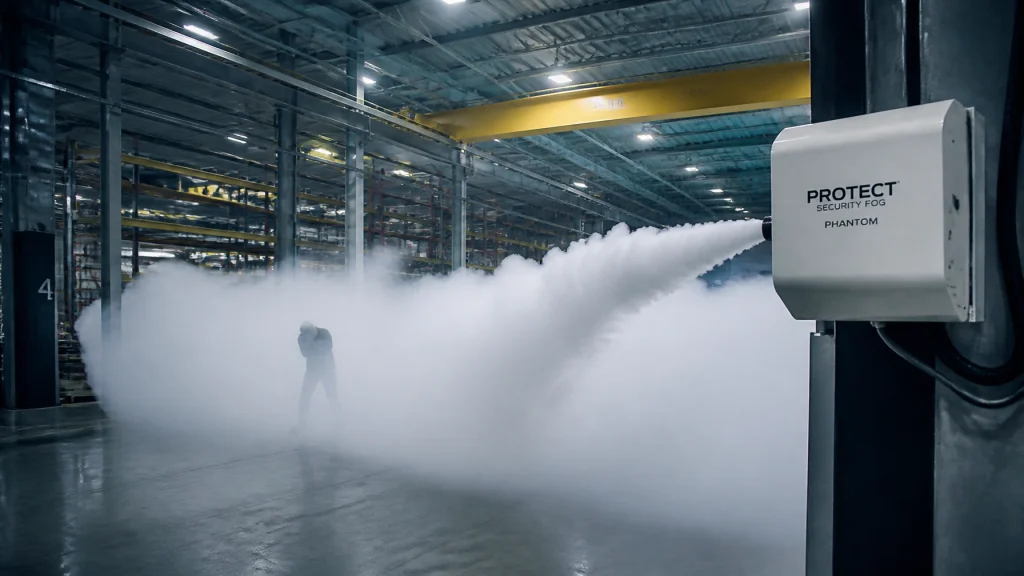
For these sectors, standard CCTV and passive alarms are insufficient. In an out-of-hours warehouse break-in, thieves can clear a high-value racking bay in less than five minutes. Most police response times exceed 10 to 15 minutes, leaving a massive "security gap." Warehouse security fog systems like the Lite Fog Systems close this gap by rapidly filling vulnerable warehouse zones with dense, harmless fog within 30 seconds. If a thief cannot see the stock, they cannot steal it.
Why Passive Security Fails in 2026
Traditional security measures are designed to record crime, not prevent it. While CCTV provides evidence for prosecution, it does nothing to stop the immediate loss of stock or the subsequent rise in insurance premiums. In 2026, many UK warehouse managers are finding that their insurance providers are mandating active deterrence measures.
Our fog generators are NSI & SSAIB compatible, meaning they integrate seamlessly with your existing alarm panels. When an intruder is detected, the fog is deployed instantly, reducing visibility to less than 30cm. This is not "smoke": it is a non-toxic, food-grade glycol-based fog that leaves no residue on electronics, apparel, or food-grade storage. It transforms the warehouse from an open target into a zero-visibility environment, forcing intruders to flee empty-handed before they can even locate the goods-in bays or high-value cages.
Protecting the "Goods-In" and "Goods-Out" Windows
The transition points in a warehouse: loading bays and goods-in areas: are the most vulnerable. Trailer hook-up thefts are on the rise, and gangs often strike during the frantic "golden hours" of shift changes or late-night loading. Protecting these large, open apertures requires a high-volume solution.
For massive warehouse footprints, we recommend the Lite Fog Systems for aisle coverage or the UNIK Fog System for high-value zones like bonded cages or cash offices. These systems ensure that even if a loading bay door is forced open, the interior of the facility remains protected. By physically preventing the theft during that critical window between alarm trigger and police arrival, you protect not just your stock, but your operational continuity and insurance standing.
Key Takeaways
- Regional Risk: Logistics hubs in the West and East Midlands are the highest-risk zones for facility breaches in 2026.
- Inventory Focus: Electronics and food/beverage remain the most targeted sectors, requiring specialized protection like the UNIK system for high-value cages.
- Insurance Alignment: Using warehouse security fog systems that are NSI & SSAIB compatible can help satisfy commercial insurance requirements and lower premiums.
- Deployment Speed: Fogging systems stop theft in under 30 seconds, whereas traditional police response times leave a 15-minute window for criminals to operate.
- Stock Safety: Density fog is non-toxic and safe for all stock types, including electronics and food-grade items.
Protect your distribution centre from the 2026 cargo crime surge.
Map the 2026 UK cargo theft hotspots and see how warehouse security fog systems stop distribution centre losses. Get your free quote.
Learn more about our warehouse security fog systems, our Basic Fog System, or use our interactive quote tool to get a custom security specification for your facility today.