For independent retail owners across the UK, keeping a shop secure has always been a balancing act between welcoming customers and guarding against theft. Recently, however, official crime data has laid bare a startling shift in how retail crime is measured. Figures from the Office for National Statistics (ONS) reveal a staggering 91% surge in police-recorded business property robberies. For independent operators looking at off-licence security UK solutions, this dramatic spike requires an immediate reassessment of what happens when a routine theft escalates into active violence or threats against staff.
Understanding why these numbers have jumped so dramatically: and what they mean for independent merchants operating high-risk premises: is critical for anyone managing valuable stock, spirits, and cash on site.
The Real Drivers Behind the 91% ONS Robbery Surge
To make sense of the headlines, store owners must look past the raw numbers. The ONS has clarified that the 91% increase in recorded business property robberies is primarily driven by updated Home Office crime-recording rules rather than a sudden explosion in criminal offending.
Under the revised counting rules (specifically classification 34A for robbery of business property), any incident where an offender enters retail premises, steals items, and uses or threatens violence against a shop worker, security guard, or bystander: or uses threats to escape: is now systematically recorded as a robbery, rather than being split into separate counts of shoplifting and common assault.

Previously, much of this violence and intimidation was masked within broader shoplifting statistics. The new rules bring that hidden reality to the surface. For lone traders and single-staff operations managing late-night shifts, this statistical adjustment confirms what many already knew: petty theft is increasingly prone to aggressive escalation when confronted. Traditional passive measures like CCTV and standard bells-and-rounds alarms simply record these encounters; they do nothing to stop a violent intruder from cornering staff or cleaning out high-value spirits shelves.
Ready to upgrade your protection?
Protect your staff, high-value spirits, and cash overnight with active security fog engineered for independent retail.
Insurance, Police Response, and the Limitations of Passive Alarms
In the wake of these updated recording standards, commercial insurers are placing renewed scrutiny on risk management. When a break-in or robbery occurs, insurers evaluate whether the business maintained active preventative measures or merely relied on passive recording devices. Traditional alarms that sound after the cash register is breached or cameras that archive footage of a masked intruder walking out with £5,000 of spirits do not stop the crime in progress.
As outlined across our specialist off-licence security fog systems, passive security fails because it operates after the fact. When criminals target high-value, portable inventory like premium spirits and tobacco, every second counts. Police response times vary, and by the time sirens arrive, the perpetrators are long gone.

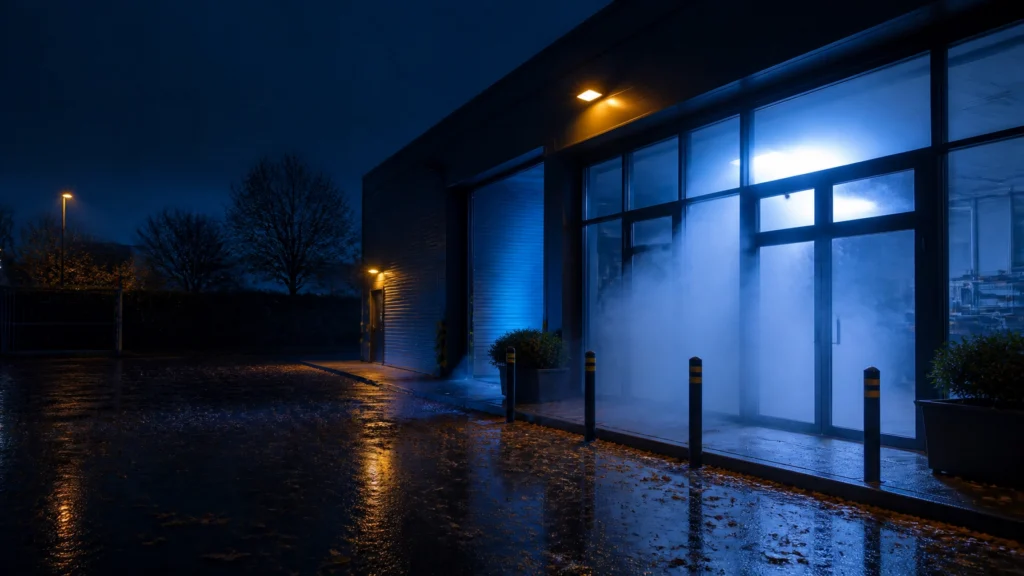
Active security fog changes this dynamic entirely. Instead of waiting for law enforcement or recording a loss, active systems deploy a dense, harmless barrier within 30 seconds of an alarm trigger. By filling the premises with zero-visibility fog, criminals are instantly disoriented, making it physically impossible to navigate, locate stock, or exit with goods. As the industry mantra goes: What you can't see you can't steal.
For multi-zone premises or larger retail layouts, integrating the robust Density® 600 Lite provides comprehensive coverage up to 600m³, while targeted till and spirit displays can be secured instantly using the battery-backed Density® UNIK system.
Frequently Asked Questions
Why did recorded shop robberies jump by 91%?
The surge is primarily the result of a change in Home Office crime recording rules implemented in April 2025. Shop thefts that involve violence, intimidation, or threats against staff are now formally classified as "robbery of business property" rather than being recorded separately as shoplifting and assault. This administrative reclassification makes existing violence more visible in official statistics.
Does security fog damage alcohol or food stock?
No. Approved for use with NSI and SSAIB systems, Density security fog is entirely non-toxic, leaves zero residue on products or shelving, and is fully safe for use around food, drink, and valuable spirit displays.
How quickly does the Density system deploy?
Our systems deploy in under 30 seconds from the moment an authorized alarm is triggered, filling the target area to absolute zero visibility before intruders can locate high-value stock.
Can security fog integrate with my existing alarm system?
Yes. Density units seamlessly integrate with all existing NSI and SSAIB approved alarm setups, operating as an active physical barrier that activates the moment your perimeter or intruder alarm trips.

Securing Your Business Against Escalating Threats
The 91% spike in recorded business robberies is a stark reminder that modern retail crime is evolving. For independent merchants operating on tight margins, absorbing a £10,000 to £20,000 stock loss or risking staff safety during a late-night raid is simply not an option. Alarms detect and cameras record, but active security fog prevents the loss before it happens.
Whether you need targeted protection for high-value spirits using our compact units or comprehensive coverage across a larger retail footprint via our lite-fog-systems/ and unik-fog-system/ range, investing in active prevention is the most effective step you can take to safeguard your livelihood.
Secure your off-licence today
Speak with our team to arrange a professional assessment tailored to your shop layout and stock profile.