The loading bay is the single highest-risk point in most warehouses. It is where external vehicles, time pressure and several people meet, and it is where a large share of stock loss happens — through theft, short-loading and fraud as goods change hands, and through forced entry once the site is closed.
It earns that risk because it is open by design. Doors are up, vehicles come and go, and the people on the dock are focused on turnaround, not security. That combination is exactly what an opportunist or an organised crew looks for.
Why the dock is a hotspot
Goods-in and despatch concentrate value and access in one place. A pallet of high-resale stock can be diverted, a load can be signed short, or an outsider can walk in behind a legitimate delivery. The pressure to keep things moving makes checks easy to skip, and a skipped check is rarely noticed until a stock count weeks later.
The numbers reflect it. NaVCIS recorded 5,373 cargo-theft cases in the UK in 2023, worth an estimated £68 million, and a single month in 2024 saw a 58% jump on the previous peak. Much of that loss happens at or near the dock, where goods are most exposed and most mobile.
The ways stock leaves the dock
Loading-bay loss is not one problem. It is several, and they need different answers.
- Short-loading — a load leaves with fewer units than the paperwork says, the difference quietly resold.
- Fraudulent collection — a vehicle arrives posing as a booked pickup and leaves with real stock.
- Walk-in theft — an outsider slips in behind a legitimate delivery while doors are open.
- Forced entry after hours — roller and loading doors are an obvious target once the site is empty.
Tighten the daytime process
Verify and schedule
Most dock loss is preventable with discipline. Verify drivers and deliveries against expected bookings, schedule arrivals so the bay is not overwhelmed, and reconcile loads as they move rather than after they have gone. Position cameras to capture plates and faces at the dock line, where identity actually matters.
Control who crosses the line
Keep the boundary between the bay and the main floor clear. Only authorised staff cross it, access is logged, and visiting drivers stay in a defined area. That stops a delivery becoming a route into the high-value racking beyond, and it makes a fraudulent collection far harder to carry off.
Account for insiders
A share of dock loss involves someone on the inside — a waved-through vehicle, a load signed off without a proper count, information passed to an outside crew. Rotating duties, two-person checks on high-value despatches and honest reconciliation make that cooperation much harder to hide. The same logs that catch an outsider also show which shift handled a missing load.
Cover the bay after hours
Out of hours, the dock changes character. The fraud risk goes home and a forced-entry risk takes its place — roller doors and loading doors are an obvious way in, and they open straight onto the stock. This is where an active deterrent matters most.
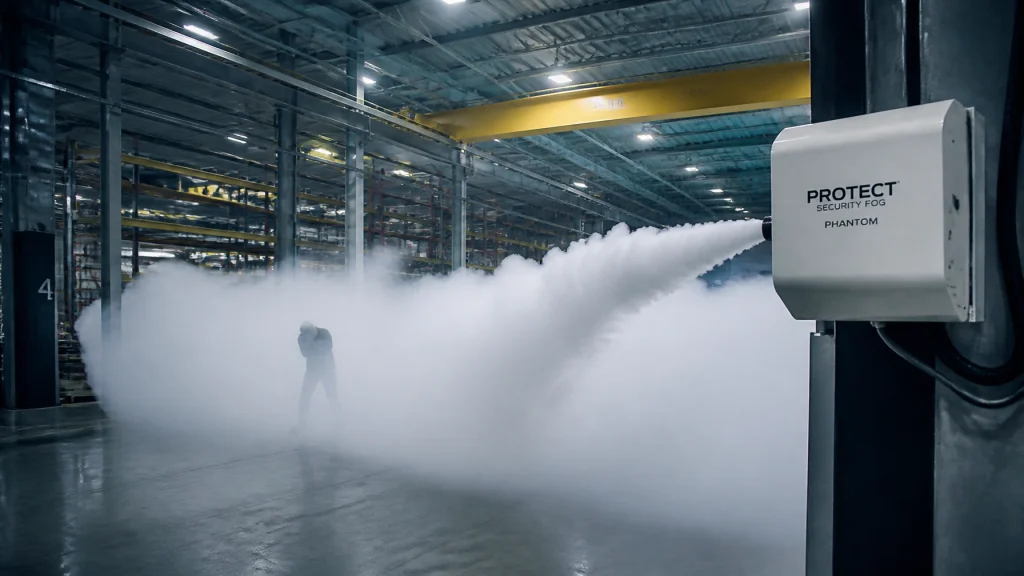
A security fog system links to your alarm and, on a confirmed break-in, fills the bay and the stock behind it with dense, harmless fog in seconds. An intruder who has forced a loading door finds nothing they can see, locate or carry — and no clear way back to the vehicle.
97% of thefts are avoided with a fogging system and an alarm, compared with 17% for an alarm on its own (Density® manufacturer figure). At a dock, that turns a known weak point into a dead end.
Coverage is sized by volume, so the fog protects the full height of the bay and the racking it opens onto. The fog is non-toxic, Eurofins-certified and residue-free, works with your existing alarm panel and with Ajax, and meets EN 50131-8:2019.
Frequently asked questions
Why is the loading bay a theft hotspot?
It combines external vehicle access, time pressure and multiple people in one place, which makes theft, short-loading and fraud easier and checks easier to skip. After hours, the same doors become an obvious forced-entry point.
How do I reduce loading bay theft?
Verify drivers and deliveries, schedule arrivals, reconcile loads as they move, control who crosses from the bay to the floor, account for insider risk with two-person checks, and add an active security fog system to cover the dock after hours.
Can security fog protect a loading bay?
Yes. The system covers the bay and the stock behind it, filling the space with dense fog within seconds of a confirmed break-in so nothing can be located or removed. Coverage is sized by volume, so it protects the full height of the dock and the racking it opens onto, and it triggers from the alarm you already use.
Does the fog interfere with daytime operations?
No. It only deploys on a confirmed break-in through the alarm system, so normal loading, unloading and deliveries are unaffected. It is there for the moment the site is closed and a door is forced.
Is the loading bay really worth protecting separately?
In most warehouses it is the area most exposed to loss, by day and by night. Treating it as its own protected volume — with its own checks during opening hours and active fog after them — addresses the weakest point directly rather than relying on general site cover that was never aimed at the dock.
Secure your loading bay
Close the warehouse’s weakest point. See how active fog protects high-value stock and racking, explore warehouse security fog, or book a survey.