High-value freight is a target. Organised crime groups see it as a commodity, low-risk compared to street robberies, and worth fighting for. In 2025 alone, UK freight theft losses reached £37.5 million, with distribution centres accounting for 41% of recorded cargo theft incidents across Europe. But the numbers don’t capture the full picture: insider threats, multi-point vulnerabilities, and coordinated attacks mean that single-layer security—even good security—often fails.
Protecting high-value loads demands a response that matches the complexity of the threat.
Understanding the Organised Crime Landscape
Organised crime groups targeting freight are different from random thieves. They plan ahead. They identify high-value loads. They even buy haulage firms and set up fake carriers with forged papers.
They hit every weak point: roadsides, motorway stops, transfer yards, and warehouses at quiet times. What sets them apart is the money and the planning. A single load of pharmaceuticals or electronics can be worth tens of thousands. Target the same warehouse weekly, and profits add up to millions.
40% of UK distribution centres suffered security breaches in 2025. The concentration of theft at warehouse and logistics hubs is no accident.
Insider Risk: The Human Vulnerability
One in five freight thefts involve an insider. This does not mean the employee is stealing directly. Often, it is just information: when the stock arrives, when shifts change, or where valuables sit. Crime groups build these relationships through friendship, pressure, or money.
An insider does not need to unlock the door. They just need to be absent when it matters, delay reporting a breach, or disable a sensor. They provide the timing that allows a coordinated external team to strike.
The Transfer and Loading Vulnerability
Freight moves between points: from factory to warehouse, from warehouse to loading bay, from bay to truck. Each transition is an opportunity. Transfer and loading points are often in open yards, under time pressure, with fewer cameras and lower staffing. A forklift operator or loader with criminal links can move stock aside, allow access, or delay reporting.
These moments—5 minutes before a truck departs, a handover between shifts—are where organised teams strike.
The Overnight Vulnerability
Warehouses and distribution centres are quieter overnight. External security may be limited to perimeter fencing and perhaps one guard. Staff on night shift are minimal. Organised crime groups often probe these periods: testing alarms, identifying camera blind spots, or waiting for the shift change when no one is watching the loading bay.
A high-value load staged for early morning collection—pallets of electronics, spirits, or pharmaceutical stock—sits in that window undefended.
Why Fog + Alarm Beats Either Approach Alone
Many distribution centres rely on alarms and CCTV. These work as a deterrent and for post-incident investigation. But they do not stop a thief in the act. An alarm summons police; police arrive in minutes, but minutes are enough for a coordinated team to load and drive away. CCTV captures faces and vehicles, useful for prosecution, but only after the theft.
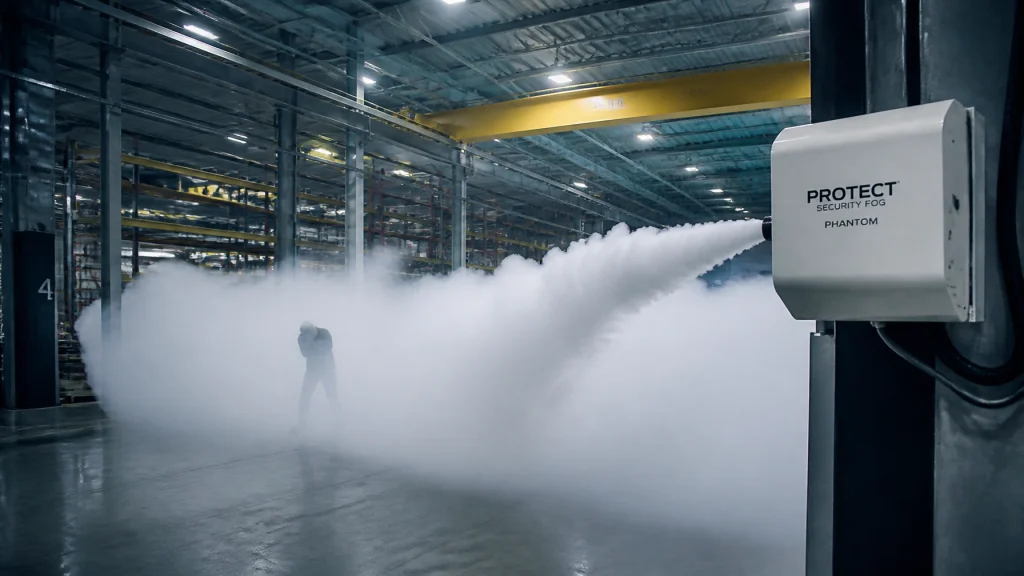
Active fog deploys instantly when an alarm triggers. It blocks sight lines and slows movement. When combined with an alarm, fog makes theft impractical. The thief cannot see, cannot move quickly, and knows police are on the way.
97% of thefts are avoided with a fogging system AND an alarm, compared with 17% with an alarm only. This is a manufacturer figure from Density, based on real-world deployment data. The difference is the fog layer: it transforms the threat response from reactive to active.
A Layered Security Framework
Defending high-value freight needs more than one tool. Access control, alarms, CCTV, and staff vetting all help. But without something that stops the thief *right now*—not after the fact—there is a gap.
Fog fills that gap. It is particularly effective at distribution centres and warehouses because:
- Large coverage. The Density HP system protects up to 6,000 m³ (HP6000) or 14,000 m³ (HP14000), covering large warehouses.
- Works with existing systems. Compatible with all major alarm panels, Ajax, CCTV, and access control.
- Certified to EN 50131-8:2019, the UK security standard, for commercial use.
- Always on. Fog responds instantly to alarms 24/7, with no breaks or fatigue like a human guard.
For the logistics sector, where high-value freight moves through vulnerable points, a fogging system is not a luxury. It is a baseline control for insider threat and coordinated theft.
Addressing the Insider Threat Component
Fog alone does not fix insider risk. But it removes incentive: an insider knows that any breach triggers fog and an alarm, and the area becomes useless for theft. The payoff disappears.
Add staff checks, surprise audits, and reporting channels to fog. Use fog as the last line of defence, not the only one.
Related Logistics security guides
- How Organised Crime Targets Freight and Distribution — The tactics and networks that crime groups use to find and steal high-value loads.
- Securing Freight at Transfer and Loading Points — Risks at handover moments and practical controls to stop theft during transfers.
- Protecting High-Value Loads Overnight at the Depot — How to secure freight overnight and reduce warehouse exposure.
- How Active Fog Defends a Freight Hub Against Coordinated Theft — How fog stops live theft and prevents heists.
Frequently asked questions
Will a fogging system alone protect my warehouse from theft?
No. Fog works best as part of a layered approach with access control, alarms, and staff vetting. But when paired with an alarm, fog greatly increases your chances of stopping theft. Crime groups weigh risk and reward on each target; fog tips that balance against them.
How quickly does fog deploy when an alarm is triggered?
Fogging systems designed for commercial security deploy within seconds of an alarm trigger. This instant response is critical because it stops the thief before loading is complete and makes the area unusable for theft.
Does fog damage stock, equipment, or the warehouse itself?
No. Fog is non-toxic, certified safe by Eurofins for humans and animals, and leaves no residue. It disperses without staining goods, equipment, or walls. In food environments, it is also certified to food-contact rules (Reg. (CE) No. 1935/2004), so it is safe around food stock.
Can a fogging system integrate with my existing alarm panel and CCTV?
Yes. Fog systems work with all major alarm panels, Ajax, CCTV, and VMS. Remote monitoring is available via ActiveCloud, and APIs connect to other security tools.
What size warehouse can a fog system protect?
It depends on the system. The HP range protects up to 6,000 m³ (HP6000) or 14,000 m³ (HP14000) for large warehouses. Smaller systems cover less. A specialist survey will find the right system for your site.
Freight theft is rising, and crime groups are organised. A single defence—alarm, CCTV, or access control alone—is not enough. A layered response with fog and alarm is how UK logistics leaders protect their supply chains.
Ready to protect your operation? Book a security survey with a Density specialist. We assess your site, find weak points, and recommend a system for your warehouse and risk. Start with a survey and a quote.