Transfer and loading points are where freight is most exposed. Unlike a warehouse closed at night, these hubs stay open and busy, with multiple crews, time pressure and competing priorities. That is exactly what theft crews exploit.
A pallet moves between trucks. Paperwork passes between drivers. Goods sit exposed while equipment is positioned. In those moments, a load can be short-loaded, swapped for lower-grade stock or taken outright. The loss often goes undetected for days.
Why transfer points concentrate risk
Transfer facilities are designed for speed and throughput, not security. Multiple trucks arrive on schedule. Doors open. Goods get counted by different teams. Papers change hands between companies. The more people involved, the harder it becomes to spot when something is wrong.
External drivers arrive to deliver and collect. Warehouse staff hand goods over. Third-party logistics operators verify counts. Each handover is a moment when goods are unguarded and paperwork can be faked or altered. Someone inside could tip off a theft crew about which loads are valuable and worth targeting.
Time pressure breaks discipline. A late pickup causes a backlog. A shipment that looks suspicious might be let through anyway. A pallet count error during busy hours gets logged as “resolve later” and then forgotten entirely.
How goods go missing at transfer points
Loss at transfer points takes several forms. Each needs different security measures.
- Short-loading. A truck departs with fewer pallets than the paperwork states. The missing stock is quietly resold elsewhere.
- Fraudulent pickups. A driver appears with forged papers and collects real stock, posing as a legitimate collection.
- Load swaps. High-value goods are swapped out for damaged or used items and the switch gets logged as a counting error.
- Insider involvement. An employee signals which loads are worth taking, allows after-hours access or signs off shipments without checking.
Secure transfer points during working hours
Verify shipments before release
Check all deliveries against your booking system and expected arrival times. Verify driver identity and vehicle registration details. Match paperwork to actual goods present — count pallets, check barcodes and serial numbers on high-value items. Only sign off when everything matches exactly.
Use security cameras to record truck plates and driver faces at the loading point itself. Photos taken at handover are far more useful for investigating loss than footage from hours before arrival. Position cameras to capture identity at the moment goods change hands, not just vehicle movement.
Separate and rotate duties
One person should never both receive stock and sign off a collection. Rotate staff through different roles so that no single employee can consistently steal. Two-person verification on valuable shipments should be enforced as standard practice.
Reconcile losses the same day
Do not wait for weekly or monthly reconciliation. Use a system that logs each transfer as it happens — pallet counts, driver details, entry and exit times. Check paperwork against your records immediately, before trucks leave the site.
Fix discrepancies fast. When losses go unchecked for days, they become impossible to recover or trace.
Protect transfer points after hours with fog
Transfer facilities are staffed during the day but unattended overnight and at weekends. That is when forced-entry theft becomes viable. Someone breaks the gate or loading door and takes accessible stock from an empty site.
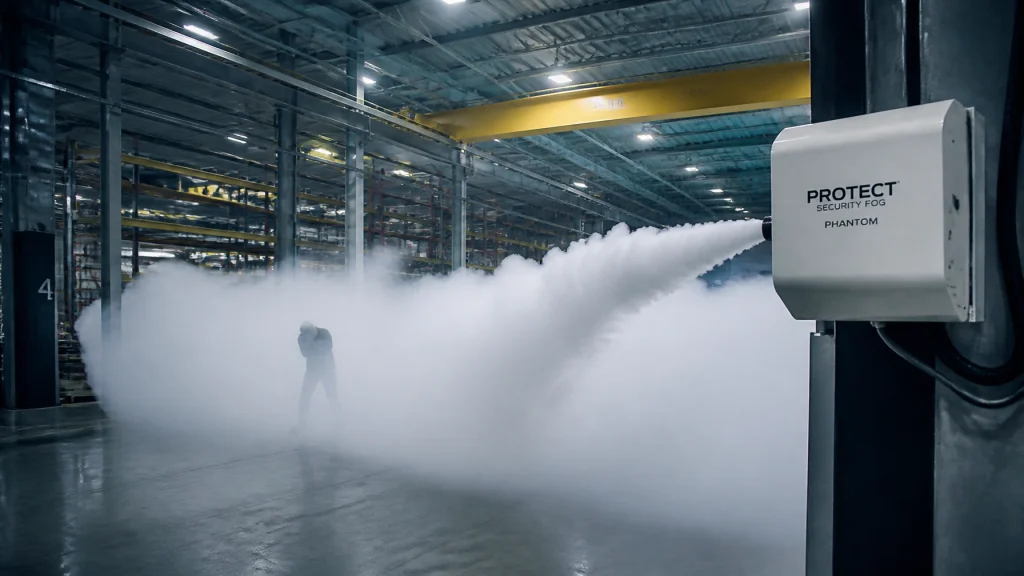
Active fog changes that. When linked to your alarm, it responds to a confirmed break-in by filling the loading area and adjacent stock with dense, non-toxic fog within seconds. An intruder who enters a fogged space cannot see, locate or move goods. They cannot leave safely either.
97% of thefts are avoided with a fogging system and an alarm, compared with 17% for an alarm on its own (Density® manufacturer figure). At a transfer point, that turns an undefended loading area into an active deterrent.
Transfer hubs vary in size. Small independent operators protect a single bay with a system covering 600 m³. Larger facilities use the HP range. The HP6000 protects volumes up to 6,000 m³. The HP14000 covers up to 14,000 m³. Both options provide full height protection from loading dock to high racking without gaps.
The fog is non-toxic and certified by Eurofins. It is tested for food contact under EU regulation 1935/2004, so it is safe where goods are destined for shops or food premises. Systems meet EN 50131-8:2019 security standards. They work with any existing alarm panel and are fully compatible with Ajax, ActiveCloud and all standard VMS systems.
Combine control by day and defence by night
No single measure stops transfer-point loss. Daytime controls prevent routine theft and fraud. Active fog stops forced-entry break-ins after hours. Working together, they address transfer points as the operational security problem they are.
Frequently asked questions
Why are transfer points high-risk for theft?
Transfer points combine multiple operators, time pressure, external vehicle access and constant handovers. Goods are frequently unguarded. Paperwork changes hands and can be forged. Pressure to move fast means security checks are skipped. Insider staff can help theft crews.
How do I prevent short-loading and swaps?
Count pallets and check high-value items at the moment of handover, not afterwards. Use two-person verification on valuable loads. Reconcile discrepancies the same day. Rotate staff so no single employee can repeatedly steal without being noticed.
Can security fog protect a transfer point?
Yes. When your alarm detects a break-in, fog fills the loading area with thick mist in seconds. Intruders cannot see or move goods. The fog is non-toxic, leaves no residue and works with any existing alarm system.
Will fog interfere with daytime operations?
No. Fog deploys only on a confirmed break-in, so normal loading, unloading and handovers during business hours are completely unaffected. It only activates when the facility is closed and a door is forced.
What size fog system do I need?
It depends on the volume of your transfer area. Small bays need a system covering 600 m³. Larger multi-use hubs can use the HP range. The HP6000 protects 6,000 m³ and the HP14000 covers 14,000 m³. A security survey will determine the right fit for your specific site.
Discover how active fog secures high-value freight against organised crime, explore logistics security solutions, or see the HP range for large-scale transfer facilities.