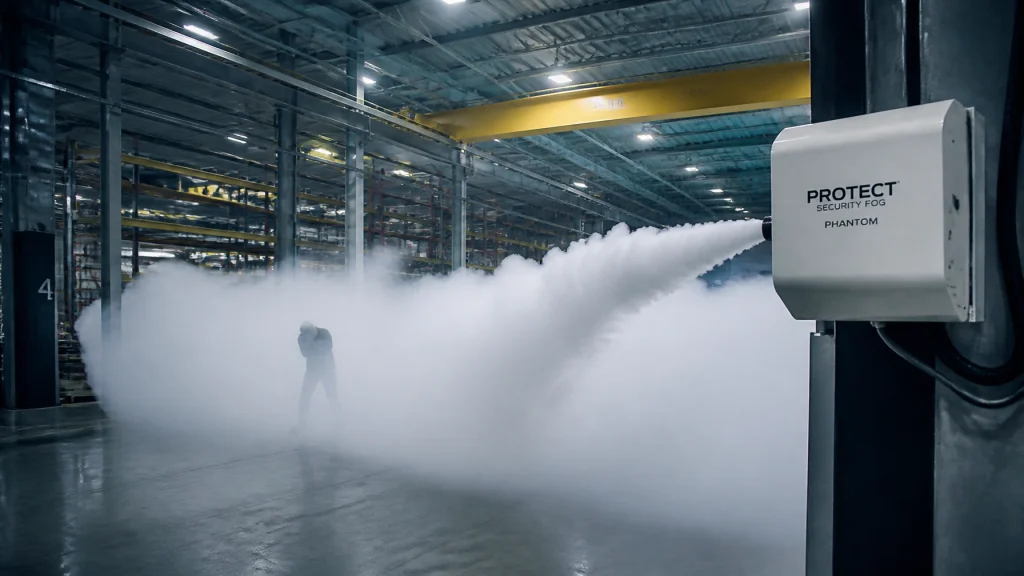
In an open-plan warehouse, high-value stock sits in plain sight on shared racking with few internal barriers. That openness is efficient for picking and movement, but it gives an intruder a clear run at your most valuable lines. Protecting it means adding control and an active deterrent without rebuilding the floor.
The goods make the target. Electronics, tools, pharmaceuticals, spirits and branded stock all resell fast, so a single open run of racking can hold a lot of easily moved value within easy reach of a loading door.
The open-plan trade-off
Open layouts exist for good reasons. Forklifts move freely, pickers cover ground quickly, and you can reconfigure racking as stock changes. The same qualities that make the floor efficient, though, make it easy to cross. There are no internal walls to slow anyone down, and nothing separating the low-value bulk stock from the lines worth stealing.
Picture a forced entry through a side door at 2am. On a compartmentalised site, an intruder has to defeat door after door. On an open floor, they are already standing among the stock the moment they are inside, with a direct line to the racking and back to the vehicle.
Why cameras leave gaps here
CCTV is essential, but a large open space is hard to cover completely. Fixed cameras watch fixed angles, and tall racking, deep gangways and poorly lit corners all create blind spots. Footage shows that something happened; it does not stop it happening, and on a big floor it often does not even show it clearly.
That leaves the same problem every passive system has. An in-progress break-in is usually over in minutes — stock loaded and gone long before anyone can respond. The record survives. The stock does not.
Add control where the layout has none
Zone the highest value
You do not need to wall off the warehouse. Give your top lines their own controlled area — a caged or access-restricted zone — rather than leaving them on open racking. A secure cage with a single logged entry point concentrates protection where it matters and turns “anywhere on the floor” into one defined space to watch.
Tighten internal access
Open floors invite internal as well as external loss, because everything is reachable and little is logged. Restrict who can enter the high-value zone, record it, and keep a clear boundary between the goods-in area and the main floor. The same access logs that deter an outsider also show who was near a missing line.
Close the response gap with fog
The layer most open-plan sites lack is one that acts during the break-in itself. A security fog system links to your alarm and, on a confirmed intrusion, fills the space with dense, harmless fog in seconds. With visibility near zero, an intruder cannot find the high-value racking, cannot judge where they are, and cannot carry anything to an exit they can no longer locate.
97% of thefts are avoided with a fogging system and an alarm, against 17% for an alarm alone (Density® manufacturer figure). On an open floor with nothing to slow an intruder, that active layer does the stopping.
Coverage suits an open floor
An open-plan space is actually straightforward to protect with fog, because there are few walls to block it. Coverage is sized by volume, so the fog fills the full height of the room, including above the racking, and spreads quickly and evenly across the floor. The HP Line covers volumes up to 6,000 m³ (HP6000) and 14,000 m³ (HP14000), with units placed to reach the high-value zones first.
The fog is non-toxic, Eurofins-certified and leaves no residue, so stock and equipment are unharmed and there is no clean-up. It also fits what you already run: Density units are compatible with all existing alarm panels and fully compatible with Ajax, and meet EN 50131-8:2019.
Lighting and detection still matter
An active layer does not replace the basics. Good, even lighting removes the dark corners an open floor creates, and cameras still earn their place at entrances and despatch. The point is that those measures detect and record — they do not stop a determined intruder reaching open racking. Pairing them with fog means the gaps between camera angles are no longer gaps in protection: the moment the alarm confirms a break-in, the whole floor goes dark to whoever is in it.
Frequently asked questions
How do I protect high-value stock on open racking?
Combine a controlled or caged zone for your top lines with an active security fog system that stops a break-in as it happens, rather than relying on cameras that leave blind spots on a large open floor.
Why is an open-plan warehouse harder to secure?
Fewer internal barriers mean little stands between an intruder and the stock, and large open spaces create camera blind spots and unlit corners. An active deterrent closes the gap that the layout leaves open.
Does fog work better in an open space?
An open floor has few walls to block the fog, so it spreads quickly and evenly. Coverage is sized by volume to fill the full height of the room, including above the racking.
Will a secure cage slow down operations?
Not if it is sized and placed sensibly. A cage with a single logged entry, holding only the highest-value lines, adds one short step for a small share of stock while removing the easiest target on the floor.
Protect your open-plan stock
See how active fog secures high-value stock and racking, explore warehouse security fog, or book a survey.