High-value warehouse stock is lost in two ways: a forced break-in after hours, and a quiet leak through goods-in, picking and despatch during the day. Protecting it means covering both — securing the building when it is empty, and the processes when it is busy.
The stock itself makes a warehouse a target. Electronics, pharmaceuticals, tools, spirits and branded goods all resell quickly, and organised crews know it. So the real question is not whether you are at risk, but where the loss actually happens and what stops it.
Where warehouse stock actually goes
Loss splits roughly into two routes. External break-ins hit the building out of hours, when no one is there to respond. Internal and process loss happens in daylight, through receiving errors, short-loading and theft at the points where goods change hands.
Both are large. TAPA EMEA logged 5,865 cargo-crime incidents in the UK between October 2023 and September 2025, and internal theft remains a major share of UK warehouse shrinkage. A camera records either type. It does not stop it.
Securing the building after hours
When the site is empty, the threat is a forced entry aimed straight at the highest-value racking. Perimeter fencing, monitored alarms and good lighting all help an intruder get noticed. But noticing is not stopping.
The response-time gap
An in-progress break-in is often over in minutes. Stock is loaded and gone long before anyone arrives. That gap — between detection and response — is where the loss lands, and it is exactly the gap an active deterrent is built to close.
Active security fog
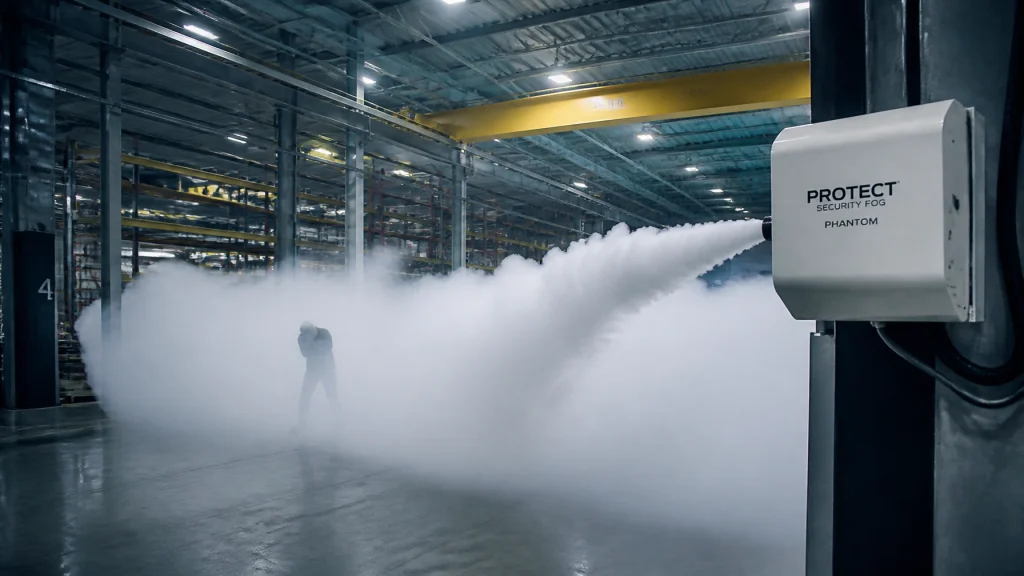
A security fog system links to your intruder alarm. The moment a genuine break-in is confirmed, it floods the protected area with dense, harmless fog in seconds. Visibility drops to almost nothing. An intruder cannot find high-value stock, cannot load it, and cannot locate the exit they came through.
97% of thefts are avoided with a fogging system and an alarm, compared with 17% for an alarm on its own (Density® manufacturer figure). That is the difference between recording a break-in and stopping it.
Protecting stock during the day
Daytime loss is quieter. The loading bay and goods-in area carry the highest risk, because external vehicles, time pressure and several people meet in one place. Tight delivery verification, dock scheduling and access logs cut both supplier fraud and opportunist theft.
Inside, give your highest-value lines their own controlled zone — a caged or access-restricted area rather than open racking on the main floor. Limit who can enter, and log it.
Mind the process gaps
Most daytime loss is not a dramatic raid. It leaks through the routine — a load signed short, stock that never makes it from receiving to the rack, a pallet quietly diverted during picking. Tight reconciliation at each handover, and clear accountability for who signed for what, closes the gaps that otherwise add up across a year. Process discipline and physical security are not separate jobs; the same access logs that deter an outsider also show who handled a missing line.
Coverage is about volume, not floor area
Fog fills a space, so its reach is measured by volume in cubic metres, not floor area. That matters in a warehouse, because the fog protects the full height of the building, including the air above tall racking where cameras struggle to see.
For large sites the HP Line is built for the scale. The Density HP6000 protects volumes up to 6,000 m³ and the HP14000 up to 14,000 m³, so even a high-bay unit can be covered by sizing the right units to the space and aiming them at the aisles and bays that matter.
Safe around stored goods
The fog is non-toxic, certified by Eurofins, and tested to the Food Contact regulation, Reg. (CE) No. 1935/2004, so it can be used where food is stored. It leaves no residue on boxes, pallets or electronics — there is no clean-up and no damaged stock after it deploys.
It also fits what you already run. Density units are compatible with all existing alarm panels and fully compatible with Ajax, and can be monitored remotely through ActiveCloud. The systems meet EN 50131-8:2019, alongside CE, EMC and FCC.
Frequently asked questions
How do I protect high-value stock in a warehouse?
Cover both routes of loss: secure the building after hours with monitored alarms and an active deterrent such as security fog, and control daytime risk at goods-in and despatch with delivery verification, access logs and a restricted zone for your highest-value lines.
Does security fog work above high racking?
Yes. Because coverage is measured by volume, the fog fills the full height of the space, including above tall racking. The HP Line covers volumes up to 6,000 m³ (HP6000) and 14,000 m³ (HP14000).
Where do most warehouse losses happen?
Forced break-ins target high-value racking out of hours, while daytime loss concentrates at the loading bay and goods-in area, where external vehicles and several people meet under time pressure.
Is the fog safe around stored stock?
It is. The fluid is non-toxic and Eurofins-certified, and the fog is tested to the Food Contact regulation, Reg. (CE) No. 1935/2004. It leaves no residue, so stock and equipment are unharmed.
Will it work with the alarm and cameras we already have?
Yes. Density units are compatible with all existing alarm panels and fully compatible with Ajax, so the fog is triggered by the system you already run. ActiveCloud adds free remote monitoring, and the units meet EN 50131-8:2019 alongside CE, EMC and FCC.
Related warehouse security guides
- Sizing warehouse fog coverage by volume — get the cubic-metre figure right so the system is not undersized.
- Protecting stock in open-plan warehouses — adding control on a floor with no internal walls.
- Securing the loading bay — closing the warehouse’s highest-risk point.
- How security fog fills the space above racking — covering the height cameras miss.
Protect your high-value warehouse stock
See how active fog covers the racking your cameras can’t. Explore warehouse security fog, view the HP Line for large sites, or book a survey.