The Association of Convenience Stores (ACS) Crime Report 2026 has confirmed a staggering reality for independent retailers: the industry spent a record £313 million on retail security solutions over the last twelve months. With an average investment of £6,213 per store, business owners are digging deep into their margins to combat a wave of theft that still accounts for 5.8 million incidents annually. This "crime tax" now costs local shops roughly 11p on every single transaction.
Despite this record spending, many off-licence owners find themselves in a frustrating cycle. They invest in high-definition CCTV and upgraded alarms, yet they still arrive at work to find shutters smashed and spirits shelves cleared. The reality is that the vast majority of that £313 million is being spent on passive security. While CCTV is excellent for recording a crime and alarms are necessary for detection, they do not physically stop a determined intruder from clearing your stock in the three minutes it takes for the police or a keyholder to arrive. In late night retail security, every second counts, and recording the loss is not the same as preventing it.
Why Passive Security Fails to Protect Your Stock
Traditional off-licence security UK relies on the hope that a siren or a camera will act as a deterrent. However, for organised gangs or repeat offenders targeting high-value spirits and tobacco, these are merely "operational hazards." They know that by the time a response team is dispatched, they will be gone with thousands of pounds in inventory. Data suggests that while 64% of operators are reporting more incidents to the police, the recovery rate for stolen goods remains critically low.
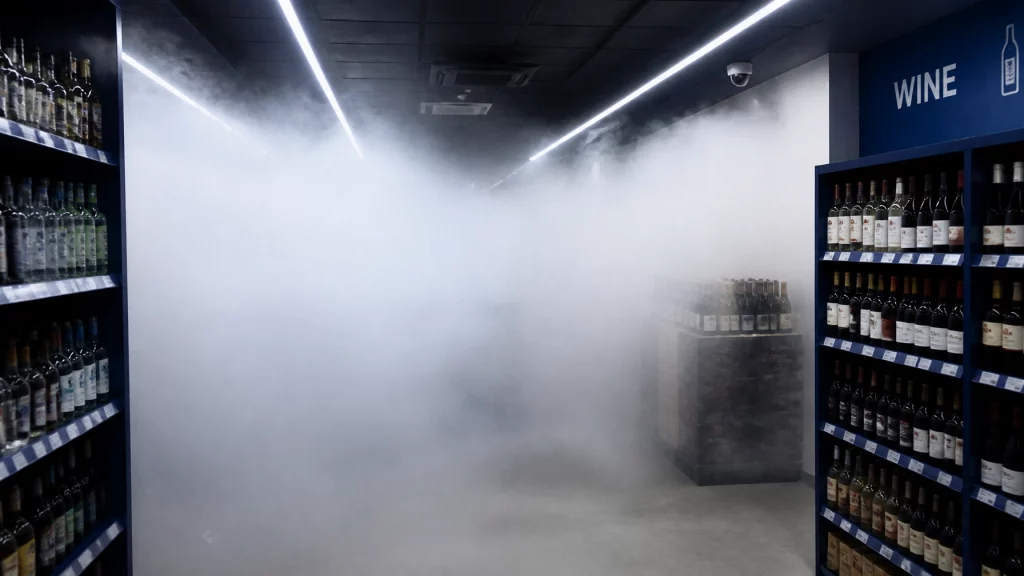
This is where the distinction between "detecting" and "preventing" becomes vital. Alarms detect. CCTV records. Density prevents. Passive security fails because it lacks a physical barrier to entry or navigation. By the time the alarm sounds, the intruder is already inside your shop. If they can see your stock, they can steal it. Our data shows a stark contrast in outcomes: while traditional alarms and CCTV alone help avoid only 17% of thefts, the introduction of off-licence security fog systems helps retailers avoid up to 97% of stock loss. We create an immediate, physical environment where crime is impossible.
Get a free off-licence security quote
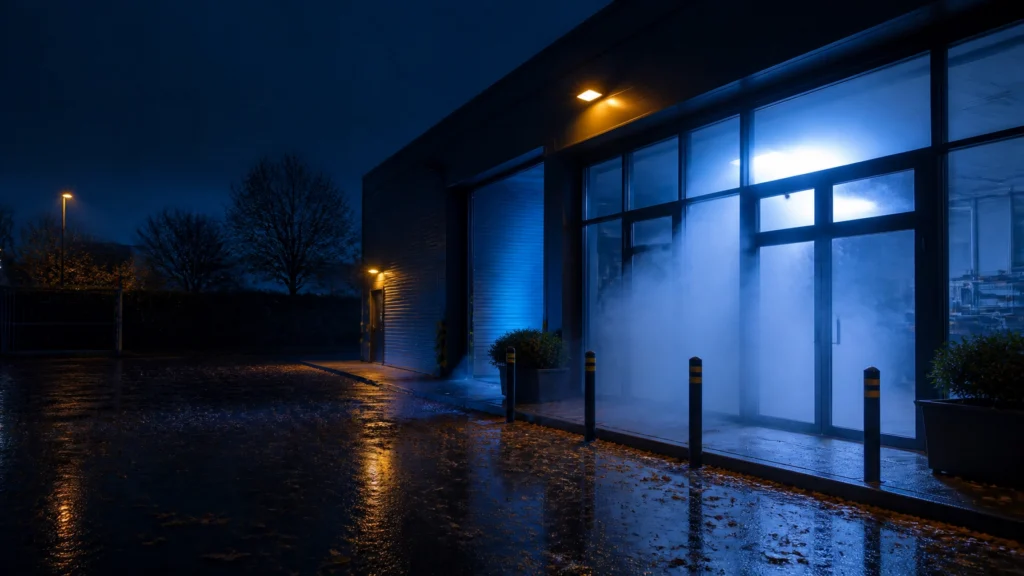
The core of the problem for the modern wine merchant or bottle shop owner is the speed of the raid. Shutter ram raids and "smash and grabs" are over in minutes. To counter this, you need a system that reacts faster than the criminal. Our Density® 600 Lite is designed specifically for these high-pressure environments, capable of covering up to 600m³ in under 30 seconds. By filling the shop floor with a dense, harmless fog, you instantly strip the intruder of their most valuable asset: their vision.

For smaller premises or targeted "hot zones" like the cigarette gantry or the premium spirits wall, the Density® UNIK provides point-specific protection. This battery-powered unit ensures that even if a power cut is part of the burglary plan, your most valuable assets remain hidden behind a wall of fog. For more compact spaces or back-office cash rooms up to 390m³, the Density® Basic offers an entry-level solution that maintains the same high-speed deployment standards.
| Feature | Passive Security (CCTV/Alarms) | Active Security (Density Fog) |
|---|---|---|
| Primary Function | Record & Detect | Physically Stop Theft |
| Response Time | Minutes/Hours (Police/Keyholder) | <30 Seconds (Instant) |
| Visual Deterrent | High (but often ignored) | Absolute (Stock is hidden) |
| Stock Protection | Post-incident evidence | Real-time prevention |
| Success Rate | ~17% avoidance | ~97% avoidance |
Common Questions About Off-Licence Fog Systems
Will the fog damage my stock or electronics?
No. Our security fog is completely non-toxic and leaves no residue. It is safe for use around food, wine, spirits, and sensitive electronic point-of-sale systems. It has been specifically tested to ensure it doesn't affect the taste or integrity of bottled goods.Is it legal to use fog in a retail environment?
Yes. Density systems are designed to meet the BS EN 50131-8 standard, which is the European benchmark for security fogging devices. Our systems are approved for use with NSI and SSAIB approved alarm systems, ensuring they meet the requirements of your insurance provider.How much does an off-licence fog system cost?
Costs vary based on the volume of your shop (measured in m³). However, when compared to the £20,000 loss of a single tobacco raid or the 11p "crime tax" per transaction identified by the ACS, the return on investment is often realised after the very first thwarted break-in.Does it work for lone trader shop safety?
Absolutely. For single staff late night safety, fog can be triggered via a panic button, creating an immediate barrier between the staff member and a potential aggressor, allowing the employee to retreat to a safe zone.

For many retailers, the threat isn't just a one-off event. Being a repeat target off-licence is a reality because criminals know the layout and the response times. Once you have been hit, you are statistically more likely to be hit again within six months. Upgrading to an active system breaks this cycle. When a burglar enters a shop and is met with a wall of fog within seconds, they don't stay to investigate: they exit immediately to avoid becoming trapped.
Investing in off-licence burglary prevention is no longer just about meeting insurance requirements; it is about business continuity. A major raid doesn't just cost you the stock; it costs you the repairs to shutters, the loss of trading days, and the psychological impact on your staff. By shifting your budget from passive recording to active prevention, you ensure that your business remains a difficult target.
What you can't see you can't steal.