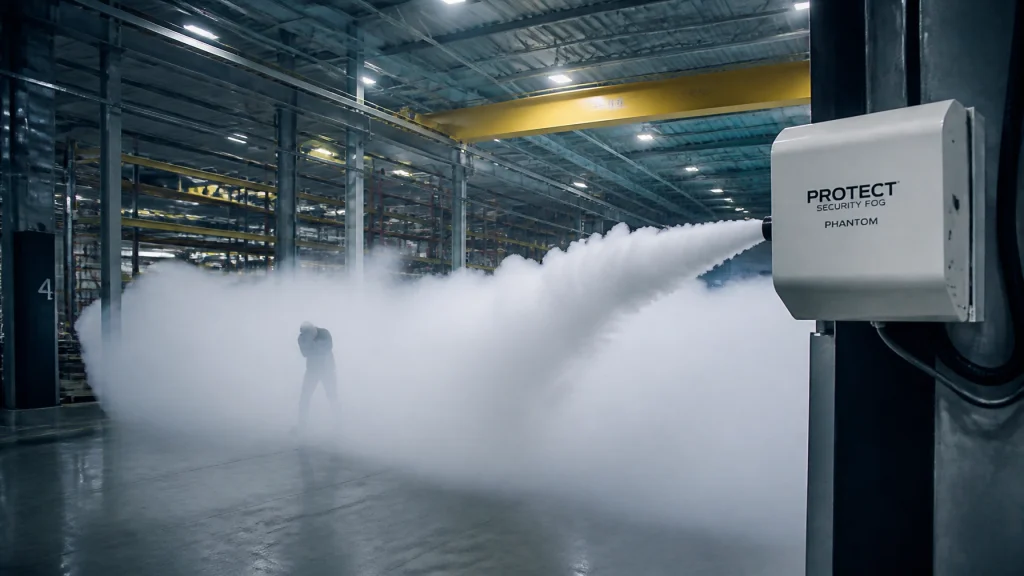
Security fog may form part of a warehouse security plan. It does not, by itself, prove that your insurer will accept the risk or reduce a premium. Your insurer or broker must confirm the requirements and terms of your own policy.
The useful starting point is your site: what needs protecting, how a break-in would be detected, and what happens before a response arrives. A survey can turn those questions into a planned setup that you can discuss with your broker.
What security fog can add
An intruder alarm detects a break-in. Security fog adds a response inside the protected space by reducing visibility. It works as part of the alarm and response plan, rather than replacing access control, monitoring or physical protection.
For a warehouse, the design needs to account for more than its external size. Racking can divide the space. Loading bays open to the air. A locked stockroom may need a different approach from an open storage hall. These details affect where fog is released and how the protected zones are arranged.
Separate product compatibility from policy approval
Density is approved for use with NSI and SSAIB security systems. Share the system proposal with your insurer or broker to confirm the cover and terms for your premises.
Ask your insurer or broker what documents they need and whether they have specific requirements for installation, monitoring or maintenance. Where terms are agreed, keep the written confirmation with your site records.
The certification information is a starting point for that discussion. Ask for the relevant documents for the equipment and fluid proposed for your site; do not treat a general marketing statement as a policy decision.
What a warehouse survey should establish
The survey should define the zones you want to protect, including the goods most at risk. It should also establish how an intrusion is confirmed, how fog links to the alarm, and how staff leave safely.
- Record the dimensions and layout of each protected space, including ceiling height.
- Identify openings, loading bays and ventilation that may affect fog retention.
- Check the alarm panel, monitoring arrangements and proposed trigger.
- Agree safe operation, servicing and what staff should do after an activation.
Coverage is measured in cubic metres, or m³. The Density HP6000 and Density HP14000 have commercial volume figures of up to 6,000 m³ and 14,000 m³ respectively. Your survey matches that output to the layout and zones you want to protect.
Prepare a useful brief for your broker
Share the proposed equipment, protected zones and alarm link, along with the technical documents requested. Include any survey findings that affect the design. This gives the broker a specific proposal to discuss, rather than a broad request to approve “a fog machine”.
Do not build a purchase decision around an assumed discount. Start with the protection the site needs, then ask how the proposal fits the policy. If a condition is unclear, resolve it before installation.
Choose the next step for your premises
You can read how the warehouse security fog approach works or discuss your own site with the team. For high racking, several zones or large open bays, a site-specific design is more useful than choosing a unit from its headline figure alone.
A free survey is a way to establish the proposal. The policy decision remains with your insurer or broker.
Questions before you choose
Will a fog system reduce my warehouse insurance premium?
A reduction cannot be promised. Your insurer or broker must confirm whether a planned setup affects your cover, terms or premium. Ask for that decision before relying on it.
Does NSI or SSAIB compatibility mean my insurer approves Density?
No. Compatibility with a security system and an insurer’s decision about a policy are different matters. Provide the product documents and planned setup details to your insurer or broker.
Can fog protect a warehouse with several rooms or zones?
A site may need several units or a planned distribution system. The survey considers protected volume, layout, openings, stock and the alarm setup. We size and position the units around the areas you need to protect.
What should I send with a survey enquiry?
Include the site postcode, a short description of the stock, rough room dimensions and the alarm details if known. Tell us about loading bays, high racking and any written requirements from your insurer.