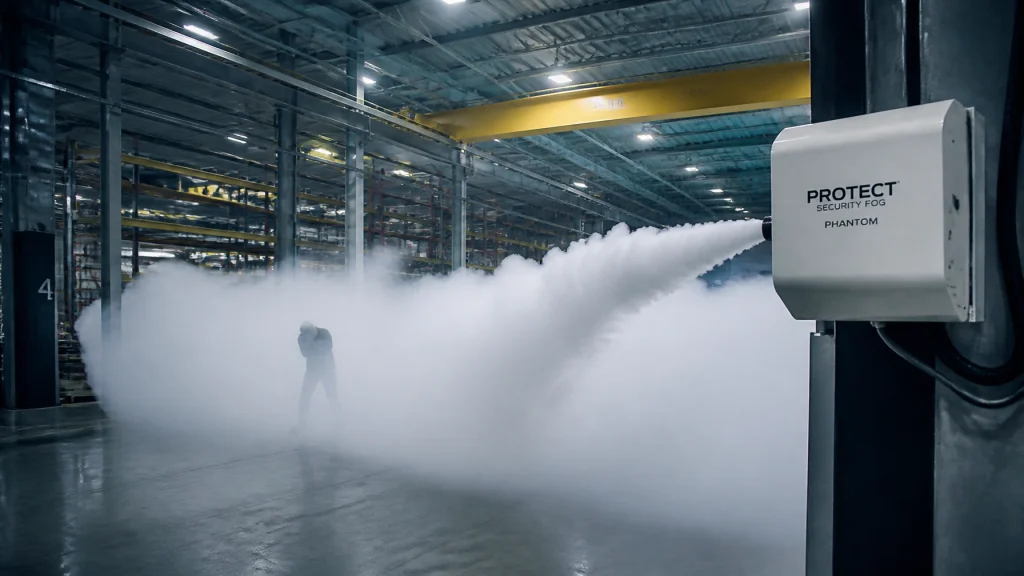
Freight hubs face a sophisticated threat. Organised criminals study shift patterns, map camera blind spots, and time their attacks to catch security gaps. A coordinated attack involves multiple thieves: one forces entry while others load high-value goods into waiting vehicles. Traditional alarms alone are not enough. A fogging system activates alongside the alarm, creating a physical barrier that stops theft mid-operation.
This post explains how active fog defends a freight hub during a coordinated attack, and why combining fog with an alarm works better than either system alone.
The Anatomy of a Coordinated Freight Hub Attack
Thieves targeting distribution centres plan carefully. They spot high-value loads—electronics, pharmaceuticals, branded goods—and coordinate their attack in under five minutes. One thief watches for security. Another forces a dock door. A third loads goods. Speed is their advantage: the faster they move, the lower their risk of being caught.
A traditional alarm alerts staff and police after a break-in. But those few minutes between the alarm and physical arrival are dangerous. That’s the window thieves exploit.
How Fog Stops a Theft in Progress
Active fog changes everything.
When the alarm sounds—triggered by forced entry or motion—the fog activates at the same time. Visibility drops to nearly zero in seconds. Thieves cannot identify valuable stock. They cannot load quickly. They cannot reach their vehicle without stumbling. The coordinated attack becomes chaos.
Unlike police response, fog acts instantly. Thieves face an immediate barrier: they cannot execute their plan if they cannot see.
97% of thefts are avoided with a fogging system AND an alarm, compared with 17% with an alarm only. Density® manufacturer figure.
Scale Matters: Covering the Entire Hub
A small dock area is not enough. Organised gangs exploit gaps. If fog covers only the loading bay, thieves move to the warehouse interior. If one generator protects 600 m³, attackers strike the cold store or sorting zone.
Freight hubs need full coverage. The HP Line fogging systems do this: the HP6000 protects up to 6,000 m³, and the HP14000 up to 14,000 m³. A large distribution centre uses two or three generators positioned to overlap, with no gaps where thieves can hide or regroup.
Positioning is key. Generators sit in high-value zones: the loading dock, secure storage, vehicle marshalling. The alarm panel activates all zones at once, ensuring consistent response.
Integration with Existing Security Infrastructure
Freight hubs already have alarm systems, CCTV, and access control. A fogging system must fit into that setup easily.
Density systems work with ALL existing alarm panels. They connect to Ajax security systems, logistics and warehouse security via LAN and APIs, and support video management systems (VMS) for after-incident review. Remote monitoring via ActiveCloud lets security teams track events from anywhere.
When the alarm triggers, fog deploys. No manual step. No delay.
Why Fog Defeats Coordinated Attack Plans
Thieves plan around visible obstacles. They map cameras, identify staff, time their attack. What they cannot plan for is sudden blindness. Fog is unpredictable—a factor they cannot train around.
A forklift driver cannot operate. A lookout cannot communicate. A loader cannot identify valuable pallets. Panic sets in quickly.
Critically, fog avoids physical confrontation. No risk. No legal liability. Attackers cannot function.
Resilience and Autonomy
Coordinated attacks often target weak points. They strike during shift changes, when communications are slow, or during maintenance windows.
Density systems are built for reliability. The UNIK generator is the smallest model and deploys fog instantly with zero heat. It offers up to six months of battery power. If the main power fails or maintenance happens, the hub stays defended. Generators meet EN 50131-8:2019 standard, the rigorous physical security requirement across Europe.
The fog is non-toxic and certified by Eurofins. It is safe around staff and where food is present. After release, cleanup is quick and operations resume fast.
Beyond the Single Hub: A Network Approach
Modern logistics is a network. High-value freight moves between distribution centres, transfer points, and depots. One defended hub is strong. A network where every hub is defended is stronger.
The hub page on securing high-value freight against organised crime shows how protection covers the entire chain: in-transit security, depot defence, and hub integrity. Fog is the common layer across all touchpoints.
Thieves pick the easiest target. A gang studying five hubs attacks the weakest one. If all hubs are defended with fog, there is no weak target.
The Operational and Psychological Edge
Active systems build confidence. Staff know a break-in triggers immediate response. This confidence sharpens their awareness and speeds manual backup if needed.
For insurers and risk managers, the picture is clear: fog reduces theft risk. Underwriters see fog-and-alarm integration as serious security.
Frequently asked questions
How quickly does the fog deploy when an alarm is triggered?
Fog deploys within one to two seconds of alarm trigger. Full coverage takes 60–90 seconds, depending on hub size.
Can thieves disable the fogging system before it activates?
Fogging systems are hardwired to the alarm panel and backed by batteries. To disable it, they must shut down the entire alarm—which itself triggers alerts. The system cannot be bypassed selectively.
Will fog damage stock or equipment?
The fog is non-toxic and meets EN ISO 16000-1:2006. It does not stain, corrode, or leave residue. In food environments, it meets Reg. (CE) No. 1935/2004. Cleanup is fast.
Can a fogging system work with our existing alarm and CCTV setup?
Yes. Density systems work with all alarm panels, CCTV, and video management systems via LAN and APIs.
What size of hub can a single generator protect?
Coverage depends on the generator model. For large distribution centres, the HP6000 protects up to 6,000 m³, and the HP14000 protects up to 14,000 m³. Multi-zone hubs often deploy multiple generators to ensure overlap and eliminate unprotected areas.
Securing Your Freight Hub Against Coordinated Threat
Organised theft is calculated. Defence requires detection, response, and physical barrier together. Fog with alarm infrastructure creates this alignment. Your hub becomes a location no organised gang will target.
If your distribution centre handles high-value freight and faces coordinated theft risk, audit your security now. A professional survey identifies gaps and confirms whether your hub is truly defended. Get in touch for a no-obligation security survey.