Most cycle retailers rely on a single security measure—usually an alarm. But the most effective defence against theft and break-ins is not one layer; it’s a deliberate combination of complementary systems working together. Understanding which layers matter for your shop, and how to sequence them, is how you move from hoping for the best to actively preventing loss.
This is a decision guide to building a layered security approach that actually works for a bike shop: one where your alarm, CCTV, fog system, and physical security each do their job in concert.
Why One Layer Is Never Enough
A bike shop holds a concentration of high-value inventory—often £100k to £500k of stock—in a relatively compact space. Each bike is portable, easy to re-sell, and a target. During trading hours, foot traffic provides natural surveillance and informal deterrence. After hours or during a smash-and-grab, that advantage vanishes.
An alarm alone will sound, but it does nothing to stop theft while the intruder is still inside. CCTV will record evidence but only after the crime. Physical locks slow entry but don’t prevent a determined break-in. When you layer these systems together—detection, deterrence, and active disruption—you shift from reacting after a crime to preventing it in the first place.
97% of thefts are avoided with a fogging system AND an alarm, compared with 17% with an alarm only. (Density manufacturer figure)
The Three Layers Explained
Layer 1: Detection & Deterrence.
Your alarm system (which meets EN 50131-8:2019, the UK standard for intruder alarm systems) is your first responder. It detects entry via door and window contacts, motion sensors, or vibration detection on display fixtures. The visible alarm box and signage deter casual opportunists. Integration with an alarm monitoring centre means alerts reach a response agent or the police even if the intruder is already inside.
CCTV serves parallel duty: it deters theft by making perpetrators aware they’re being recorded, and it provides evidence after the fact. For a bike shop, positioning cameras to cover high-value sections (premium road bikes, e-bike batteries, the till area) maximises both the deterrent effect and the usability of footage if needed.
Layer 2: Active Disruption.
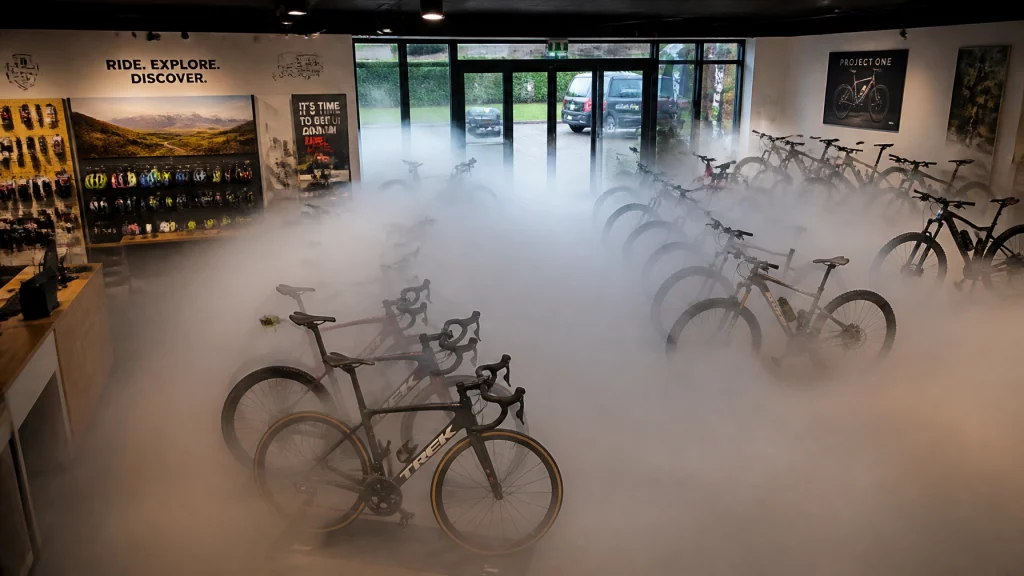
Security fog is the critical missing piece for most retailers. An alarm will sound; CCTV will record. But fog does something different—it stops the theft happening in the first place. The moment an alarm triggers, a fog generator deploys a dense, harmless cloud that fills your sales floor in seconds. Visibility drops to near zero. High-value stock becomes impossible to see or grab. The intruder’s only choice is to abandon the attempt or flee.
The UNIK is ideal for retail: compact, zero-heat, instant deployment. It requires no warm-up time and integrates directly with your existing alarm panel. For larger premises with stockrooms, the 600 Lite system (up to 600 m3 coverage) is available. All Density fog is non-toxic, certified by Eurofins, and safe in food-contact environments (Reg. (CE) No. 1935/2004)—important if your shop has a café or food counter.
Layer 3: Physical Barriers.
Reinforced door frames, deadbolts, and window locks buy time and raise the cost of entry. While not a stand-alone solution, they slow forced entry long enough for your alarm to activate and for fog to deploy.
How the Layers Work Together
The sequence matters. A would-be thief forces a door; the alarm triggers immediately. The fog deploys within seconds. Unable to see or locate the stock, the intruder’s only rational choice is to abandon the attempt or flee. Police are alerted by your monitoring centre. CCTV footage, captured throughout, provides evidence if needed.
Without fog, the same scenario becomes: alarm sounds, intruder grabs stock and runs before response arrives. Without an alarm, fog never deploys at all. Without CCTV, you have no evidence of who entered. Each layer on its own is incomplete; together they form a genuine obstacle.
Integration amplifies this effect. Your fog system works with all existing alarm panels and with Ajax, the popular wireless platform. Remote monitoring via ActiveCloud lets you arm, disarm, and verify alerts from your phone. If your shop has a Video Management System (VMS) for CCTV, the fog system integrates via LAN and APIs for coordinated logging.
Layering for Trading Hours
The risk profile changes during opening. Smash-and-grab incidents target high-value displays near entrances: premium e-bikes, full-suspension mountain bikes, groupset components. Physical locks on display cases, CCTV, and controlled access to stockrooms reduce this risk. You can avoid deploying fog during trading hours, since fog would disrupt genuine customer activity.
Many retailers use a hybrid approach: alarm-only during trading hours, with fog integration available for after-hours activation. Some enable fog only for designated high-value zones (the stockroom, service area, or secure fixture) while keeping the sales floor clear during business.
What Bike Shops Often Miss
The most overlooked layer is the simplicity of integration. A security fog system works with the alarm panel you already have—there is no “replacement” required, no compatibility puzzle. If you have a wired or wireless alarm, activation is a relay or wireless signal; the fog deploys on command.
The second oversight is underestimating the psychological barrier fog creates. Intruders plan crimes with an assumption of visibility and mobility inside the target space. Fog eliminates that assumption. The known presence of a fog system, even if not active, is a powerful additional deterrent.
Starting Your Layered Approach
If you already have an alarm and CCTV, adding a fog system is your next step. If you’re building from scratch, start with a monitored alarm, add CCTV to high-risk zones, and then layer in fog for after-hours protection. The cost-benefit is clear: a single incident involving theft of e-bikes or premium stock often exceeds the annual cost of a complete layered system.
For the full context on securing your bike shop, including after-hours protocols and stockroom best practice, see the complete guide to bike shop security. You can also learn more about security solutions tailored to bike retailers.
Frequently asked questions
Does fog damage bikes or stock?
No. The fog is non-toxic and residue-free. It is certified to food-contact standards (Reg. (CE) No. 1935/2004), making it safe in any retail environment. Stock is unharmed; intruders are simply unable to see what they are targeting.
Will fog activate during trading hours if customers trigger the alarm?
Not with correct configuration. Your installer will set entry/exit delays and zone activation so that customer foot traffic in the sales area does not trigger fog. Fog typically activates only for after-hours detection or for zones designated as “secure” (e.g. stockroom or till area). You retain full control via your alarm panel settings.
What’s the difference between CCTV and fog—can’t fog replace cameras?
No. CCTV provides evidence and acts as a deterrent; fog provides active disruption. CCTV alone cannot stop a theft in progress. Fog alone provides no evidence. Together, they create both prevention and accountability. Both are essential.
How quickly does fog deploy?
Deployment depends on your system type. A compact generator like the UNIK deploys fog in seconds with zero warm-up time. Larger systems may take slightly longer. In all cases, deployment is fast enough to block a thief’s line of sight before they can locate and grab high-value stock.
Does a fog system require a new alarm panel?
No. The fog system integrates with your existing alarm panel via a relay or wireless signal. There is no need to replace your current system. Installation simply connects the fog generator to your alarm’s output circuit.
Getting security right for a bike shop means layering. Alarm, CCTV, fog, and physical barriers work together to make theft impractical. If you’re ready to assess your current setup or discuss a layered approach for your shop, book a security survey with Density. We’ll help you understand which layers matter most and how to integrate them effectively.