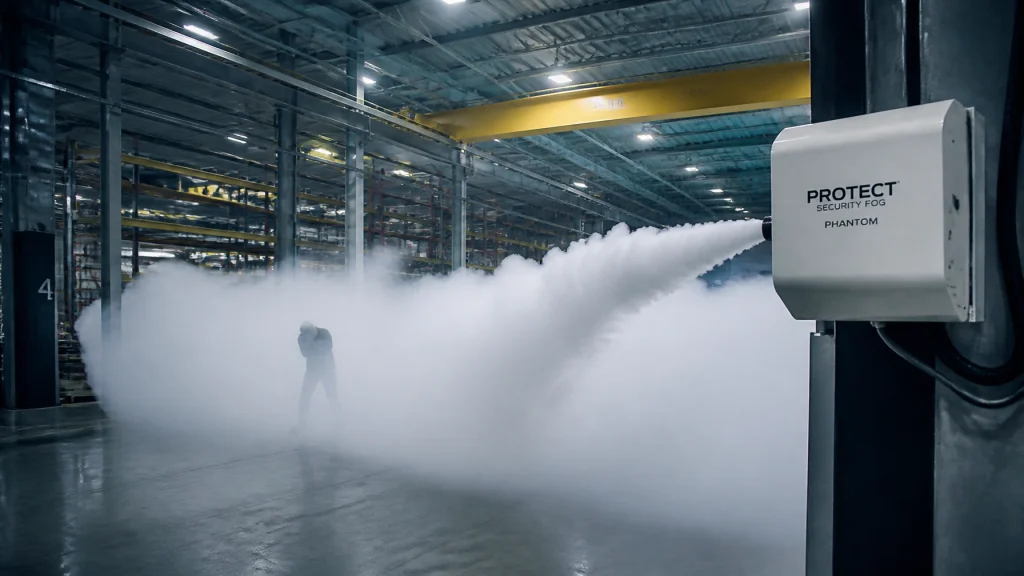
The best warehouse security in 2026 is layered: a strong perimeter, good cameras, controlled access, and one active measure that stops a break-in while it is happening. Most sites have the first three. The last one is where stock is still being lost.
Freight crime is climbing, and warehouses are a prime target. So the question for this year is not “do we have an alarm?” It is “what actually stops the theft in the few minutes before anyone can respond?”
Why 2026 is different
The numbers have moved. TAPA EMEA recorded 5,865 cargo-crime incidents in the UK between October 2023 and September 2025. NaVCIS, the police freight-crime unit, logged 1,844 incidents in 2025 alone, with reported losses near £37.5 million. A Freight Crime Bill reached its second reading in Parliament in November 2025, which tells you how seriously the problem is now being taken.
Organised crews plan these jobs. They watch a site, learn its routine, and sometimes rely on inside knowledge. Against that, a system that only records the event is not enough.
The layers that work
Good warehouse security is built in rings, each one buying time for the next.
Perimeter and access control
Stop people at the boundary, not at the racking. Fencing, gates, and monitored entry points decide whether an intruder is dealt with outside or already inside among the stock. Internally, zoning and access logs cut both outside break-ins and insider theft, which remains a large share of UK warehouse losses.
CCTV and detection
Cameras and intruder alarms are the eyes of the site. They verify what is happening and create the record you need afterwards. But detection is not prevention. An alarm sounds, footage rolls, and the goods can still walk out of the door.
The active layer: security fog
This is the piece most sites are missing. A security fog system links to your intruder alarm and, the moment a genuine break-in is detected, floods the protected space with dense, harmless fog in seconds. Visibility drops to almost nothing. You cannot steal what you cannot see, find, or carry to an exit you can no longer locate.
That matters because of the response gap. An in-progress burglary is often over in a handful of minutes — long before anyone arrives. Recording the theft does nothing to prevent the loss. Removing the intruder’s ability to see ends it on the spot.
97% of thefts are avoided with a fogging system and an alarm, compared with 17% for an alarm on its own (Density® manufacturer figure). The fog is the difference between detecting a break-in and stopping it.
Does fog work at warehouse scale?
Yes — coverage is the thing to get right. Fog fills a space, so coverage is measured by volume, not floor area. That suits a warehouse, because the fog protects the full height of the building, including the air above high racking where cameras struggle.
For large sites the HP Line is built for the job. The Density HP6000 protects volumes up to 6,000 m³, and the HP14000 up to 14,000 m³, so even a tall logistics unit can be covered by sizing the right units to the space. Units are positioned to blanket the aisles and loading areas where goods actually move.
Safe around stock
The fog is non-toxic, certified by Eurofins, and tested to the Food Contact regulation, Reg. (CE) No. 1935/2004 — it can be used where food is stored without affecting it. It leaves no residue on boxes, pallets, or electronics, so there is no clean-up and no damaged stock after a deployment.
It fits what you already run
A fog system is an upgrade, not a rip-and-replace. Density units are compatible with all existing alarm panels and are fully compatible with Ajax, so the fog can be triggered as part of the alarm setup you have. Free remote monitoring through ActiveCloud lets a manager check status from anywhere. The systems meet EN 50131-8:2019, alongside CE, EMC and FCC.
A sensible 2026 checklist
- Harden the perimeter so intrusions are caught at the boundary.
- Keep CCTV and alarms current, and make sure they are monitored.
- Control and log internal access to tackle insider risk.
- Add an active fog layer to close the response-time gap on high-value stock.
- Size fog coverage by volume, and integrate it with your existing alarm.
Detection tells you a theft happened. Prevention stops it. For 2026, the warehouses that lose the least are the ones that have added the layer that acts in the seconds that count.
Frequently asked questions
What are the best warehouse security measures for 2026?
A layered approach: a hardened perimeter, monitored CCTV and intruder alarms, controlled internal access, and an active security fog system that stops a break-in as it happens rather than simply recording it.
How does a security fog system protect a large warehouse?
It connects to your intruder alarm and releases dense fog within seconds of a confirmed break-in, cutting visibility to near zero so intruders cannot find or remove stock before they give up and leave.
Does security fog work in a warehouse with high racking?
Yes. Because coverage is measured by volume, the fog fills the full height of the space, including above tall racking. The HP Line covers volumes up to 6,000 m³ (HP6000) and 14,000 m³ (HP14000).
Is the fog safe around stored stock and food products?
It is. The fluid is non-toxic and Eurofins-certified, and the fog is tested to the Food Contact regulation, Reg. (CE) No. 1935/2004. It leaves no residue, so stock and equipment are unharmed.
Does it work with our existing alarm system?
It does. Density systems are compatible with all existing alarm panels and fully compatible with Ajax, and can be monitored remotely through ActiveCloud.
Protect your warehouse for 2026
See how active fog fits your site and existing alarm. Explore warehouse security fog, compare the HP Line for large sites, or get a quote for a survey.