The commercial insurance landscape for UK independent retailers has shifted significantly. For high-risk retail sectors holding portable, high-value stock: particularly spirits, vintage wines, and tobacco: securing and retaining comprehensive theft and stock cover is no longer straightforward. Underwriters are no longer satisfied with legacy security setups that merely document a break-in after the damage is done. In 2026, navigating off-licence insurance security requires meeting stringent underwriting criteria where active, preventative intervention is increasingly a prerequisite for obtaining cover at all.
For independent merchants and lone traders operating on tight margins, a single out-of-hours raid can wipe out £10,000 to £20,000 of high-turnover stock in minutes. Traditional passive security: such as standard bells-only alarms and CCTV systems: fails because it reacts too late. When insurers assess risk profiles, they look beyond simple detection to ask a fundamental question: does your security system actually stop the theft from happening?
The Shifting Underwriting Standards for High-Risk Retail
Insurers have recalibrated their risk models across the retail sector. Rising rates of organized retail crime, ram-raids, and targeted overnight burglaries mean that underwriters look closely at the vulnerability of premises holding portable high-value inventory. Standard static security measures are now frequently categorized as insufficient baseline protection for high-exposure venues.
When commercial brokers review renewal proposals or new policy applications for independent shops, they evaluate whether the business can mitigate repeat victimization. Traditional cameras and passive alarms provide zero physical resistance. Burglars know police response times average 15 to 20 minutes in many areas, giving them ample time to smash cabinets, clear shelves of premium spirits, and vanish before emergency responders arrive.
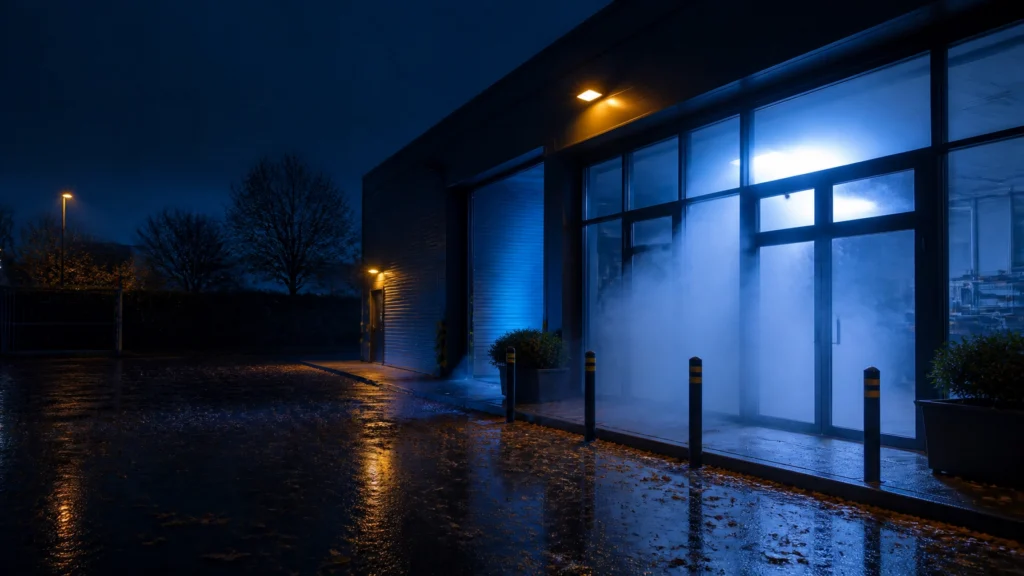
Insurance underwriters look for active security measures that alter the dynamics of a break-in. This is where professional off-licence security fog systems have become vital. Rather than waiting for police or recording a loss for a delayed insurance claim, active security fog deploys within 30 seconds of an intrusion, completely blinding criminals and neutralizing the threat before stock leaves the premises.

Active Protection as a Prerequisite for Cover
A common misconception among retailers is that upgrading security leads directly to discounted insurance premiums. In practice, modern underwriting operates on a binary principle: active security is increasingly a prerequisite for securing and retaining comprehensive cover, rather than a discount mechanism.
For many high-risk independents, insurers will either decline theft and stock cover entirely, impose prohibitive excesses, or mandate specific risk-mitigation standards before underwriting a policy. Passive measures like CCTV are viewed as tools for investigation, not prevention. By contrast, integrating NSI and SSAIB-approved alarm systems with rapid-deployment security fog provides underwriters with the verifiable active protection they require to underwrite vulnerable commercial spaces.
Statistics demonstrate the stark difference in efficacy. While traditional passive alarms and CCTV prevent or deter only around 17% of break-ins, active security fog systems prevent up to 97% of thefts by denying intruders sight, orientation, and access to stock. For store owners, meeting insurer expectations means moving away from reactive recording toward genuine physical denial.
Secure Your Property Against Late-Night Intruders
Don’t wait for your insurer to mandate active protection after a costly incident. Discover our industry-leading units, including the compact Density® Basic for shop floors and the Density® 600 Lite for multi-zone premises.
Meeting Broker Requirements Across Vulnerable Zones
When preparing your premises for insurance renewal or broker assessment, evaluating zone-specific protection is essential. High-value spirits, cash drawers, and tobacco cabinets represent the primary targets for opportunistic thieves. Insurers look favourably on layered security architectures that protect these specific high-risk focal points.
Using the Density® UNIK, retailers can secure critical bottle displays and till points with battery-powered point protection that deploys dense, non-toxic fog instantaneously. Because the fog is certified safe around food and drink stock, store owners do not need to worry about chemical contamination or residue damage to unsealed merchandise.
Furthermore, brokers look for systems that integrate seamlessly with existing NSI and SSAIB-approved security infrastructure. Density systems connect directly to your central control panel, ensuring reliable activation without triggering false alarms or complicating daily operations.

Frequently Asked Questions
Do insurance companies legally require security fog in off-licences?
No UK law explicitly mandates security fog by statute. However, underwriters assessing high-risk retail environments holding portable, high-value stock frequently stipulate robust active security as a prerequisite for offering or renewing theft and stock cover.
Does installing a security fog system guarantee lower insurance premiums?
Insurers generally treat active security as a baseline prerequisite to secure coverage for high-risk premises rather than an automatic discount tool. The primary financial benefit is avoiding catastrophic £10,000–£20,000 stock losses and business interruption that standard policies may cap or penalize through repeated claims.
Is the security fog safe around alcohol and retail stock?
Yes. Density security fog is non-toxic, leaves no harmful residue, and is fully certified for use in commercial environments containing food, drink, and consumable stock. It dissipates naturally without damaging products.
How quickly does the security fog deploy?
Density systems deploy within 30 seconds of an intrusion trigger, instantly filling the target space (whether a 390m³ compact floor or a larger 600m³ zone) and creating zero visibility to stop thieves before stock can be bagged.
Protect Your Stock Before Your Next Renewal
Ensure your premises meet modern underwriting standards with our UK-wide approved installation network. What you can’t see you can’t steal.
Alarms detect. CCTV records. Density prevents. Passive security fails.