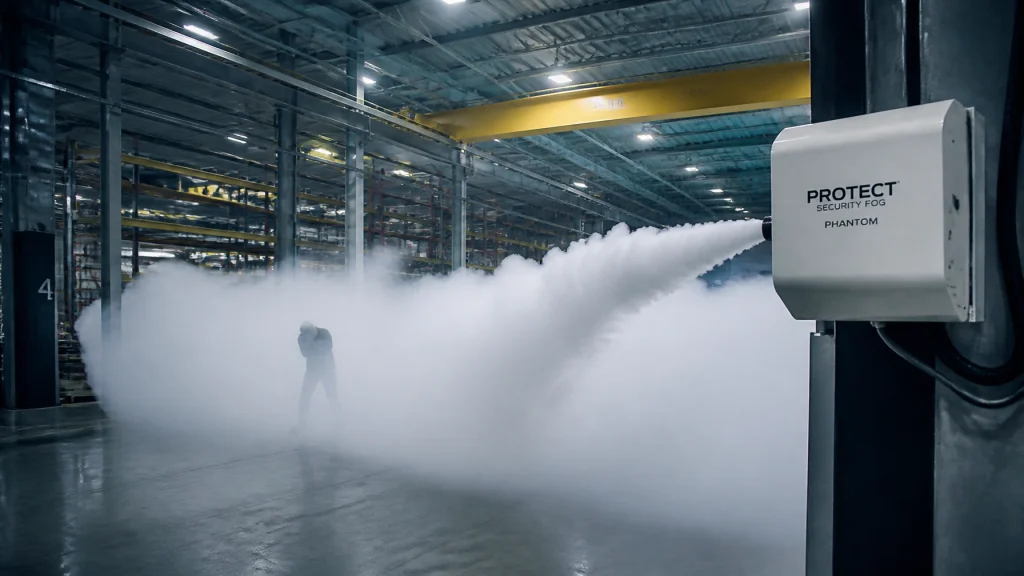
Organised cargo theft is surging across the UK, leaving many logistics managers vulnerable despite their existing security setups. This guide identifies seven common mistakes uncovered in audits and explains how active freight depot security fog systems provide the definitive fix.
TL;DR
- Passive vs Active: CCTV records crime but doesn’t stop it; security fog stops theft in 3 seconds.
- Insurance Matters: Use systems compatible with NSI and SSAIB standards to satisfy underwriters.
- Rapid Deployment: Visibility is lost in under 30 seconds, forcing intruders to retreat immediately.
1. Relying on Passive CCTV (The "Watch it Happen" Problem)
Many facility managers believe a high-definition CCTV network equals a secure site. However, the latest figures from NaVCIS (National Vehicle Crime Intelligence Service) suggest that while cameras provide evidence, they do nothing to prevent the physical removal of goods. Organised criminal gangs now wear masks, use cloned plates, and move so quickly that footage is only useful for the post-mortem.
The mistake is treating surveillance as a deterrent. Real deterrence requires an active response. By integrating freight depot security fog systems with your existing cameras, you shift from passive observation to active denial. When a breach occurs, the fog deploys instantly, making it impossible for the intruder to see the stock they came to steal. If they can’t see it, they can’t take it.
2. Ignoring Insurance & System Compatibility
A common audit failure involves installing security hardware that doesn't meet the specific requirements of cargo underwriters. Many 3PL operators find their claims contested because their security measures weren't approved for use with NSI and SSAIB alarm systems.
Density systems are specifically designed to be NSI & SSAIB compatible, ensuring they work in harmony with high-end monitoring setups. Whether you are protecting a small cross-dock zone or a massive distribution floor, ensuring your hardware is approved for use with accredited monitoring stations is non-negotiable for insurance compliance. Failing to check this before an audit can lead to expensive retrofitting or, worse, a voided policy following a loss.

3. Zero Intruder Denial in High-Risk Zones
Most warehouses focus heavily on the perimeter : fences, gates, and external doors. But once an intruder is inside, they often have free reign of the floor. This "hard shell, soft centre" approach is a major red flag during a TAPA (Transported Asset Protection Association) audit.
You need "intruder denial" at the point of theft. This is where freight depot security fog systems excel. In high-risk areas like bonded cages or pharma lanes, a UNIK fog unit can be triggered the moment a cage door is forced. It fills the immediate vicinity with a dense, non-toxic fog in seconds. This creates a physical barrier of zero visibility, stopping the "smash and grab" before the first pallet is moved.
4. Slow Alarm Response Times
According to the Road Haulage Association (RHA), freight crime has cost the UK economy over £1 billion since 2020. A primary reason for this is the "response gap." Even with a Grade 4 alarm, police or private security response times often exceed 10–15 minutes. In contrast, an experienced gang can empty a loading bay in under four minutes.
You cannot rely on a physical human response to stop a fast-moving theft. Active security fog bridges this gap by providing an immediate, autonomous response. Within 3 seconds of activation, the fog begins to discharge, and within 30 seconds, the protected area is entirely obscured. It buys your site the time that the police simply cannot provide.

5. No Layered Security for High-Value Goods
Audits frequently reveal that low-value and high-value goods are protected by the same basic measures. Organised crime groups often conduct reconnaissance to identify exactly where electronics, tobacco, or pharmaceuticals are stored. If your high-value stock isn't behind a secondary layer of active protection, you're an easy target.
Layering your security means using different tools for different zones. While the perimeter might have traditional alarms, the internal warehousing zones should have targeted fog deployment. The Density range allows for this scalability, from the battery-operated UNIK for small cages to the HP range for massive logistics centres.
6. Lack of Remote ARC Monitoring
Mistake number six is relying on local triggers only. If your security system isn't linked to a remote Alarm Receiving Centre (ARC), you lose the ability to deploy fog safely and strategically. A remote operator can verify a breach via CCTV and manually trigger the fog to prevent a "false positive" or to catch intruders off-guard.
Density systems are built for remote deployment. This capability is a favourite for security directors who want to maintain control over multi-site networks from a central hub. It ensures that even if on-site staff are compromised or absent during an overnight break-in, the site remains defended by an off-site professional who can pull the "fog trigger" the moment a confirmed threat is identified.
7. Using Outdated "Smoke" Technology
One of the biggest mistakes is confusing modern security fog with older "smoke" generators. In the past, some systems used pyrotechnic "smoke" which could be corrosive, leave a residue on stock, and set off fire alarms. This is a nightmare for logistics operations handling sensitive goods like food or electronics.
Density provides a safe, non-corrosive security fog that leaves no residue. It is non-toxic and won't damage equipment or cargo. When the fog clears, your warehouse returns to normal operation immediately, without the need for a deep clean. If your current security audit still lists "smoke" as a solution, it's time to upgrade to a modern, fluid-based fog system that protects your stock without damaging it.
Key Takeaways
- Verify Compliance: Ensure all freight depot security fog systems are approved for use with NSI and SSAIB systems to stay insurance-compliant.
- Act Fast: Choose systems that deploy in under 3 seconds; every second counts in a logistics raid.
- Protect the Goods: Use non-corrosive fog to ensure high-value cargo remains undamaged after deployment.
- Layer Up: Don't just secure the doors; install active deterrence at the point of stock storage.
Secure Your Freight Depot
Don't wait for your next audit to find the gaps in your security. Protect your high-value cargo with the UK's leading active deterrence technology.