UK logistics is currently undergoing a 'second wave' of automation, where the focus has shifted from simple mechanical conveyor belts to intelligent, AI-driven ecosystems. This post explores the top ten trends shaping the industry in 2026 and how savvy operators are using tech to solve the dual challenges of labour shortages and rising cargo crime.
TL;DR
- AI & Robotics: 2026 is the year of 'Agentic AI' and collaborative robots (cobots) that work alongside human staff to increase throughput.
- Proactive Security: With cargo crime costing the UK economy roughly £420 million annually, warehouse security fog systems have become an essential deterrent.
- Flexible Scaling: Models like Robots-as-a-Service (RaaS) allow SMEs to automate without massive upfront capital expenditure.
1. Agentic AI and Autonomous Decision-Making
The move from simple 'if-then' algorithms to 'Agentic AI' is the most significant shift in 2026. Unlike traditional software that requires human input for every exception, these systems can reason, plan, and act autonomously. In the warehouse, this means AI that doesn't just track inventory but actively manages procurement and production scheduling based on real-time market fluctuations.
According to industry reports, the warehouse software market is projected to reach USD 16.6 billion by 2030, with a heavy emphasis on these autonomous execution platforms. For UK logistics managers, this means less time spent firefighting and more time on strategic growth.
2. Autonomous Mobile Robots (AMRs) and Cobots
We are seeing a massive uptake in Autonomous Mobile Robots (AMRs) across UK distribution centres. Unlike older Automated Guided Vehicles (AGVs), AMRs don't require fixed tracks or wires. They navigate using onboard sensors and AI, allowing them to work safely in shared spaces with human employees.
By 2026, global installations of AMRs are expected to exceed 500,000 units. These 'cobots' handle the repetitive, 'dull, dirty, and dangerous' tasks: like moving heavy pallets across a 100,000 sq. ft. facility: allowing human workers to focus on complex picking and quality control.
3. Advanced Warehouse Security Fog Systems
As automation increases, so does the value of the inventory stored. Statistics from NaVCIS and RSA Insurance show that cargo crime in the UK has reached a critical point, with over 5,300 cases recorded in a single year. Standard CCTV and alarms are no longer enough because they only record the crime; they don't stop it.
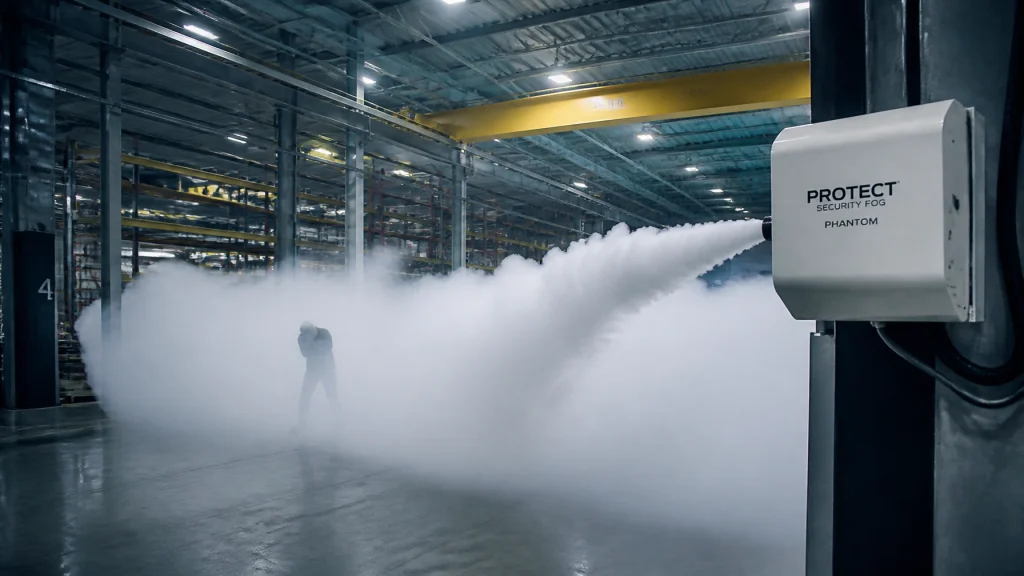
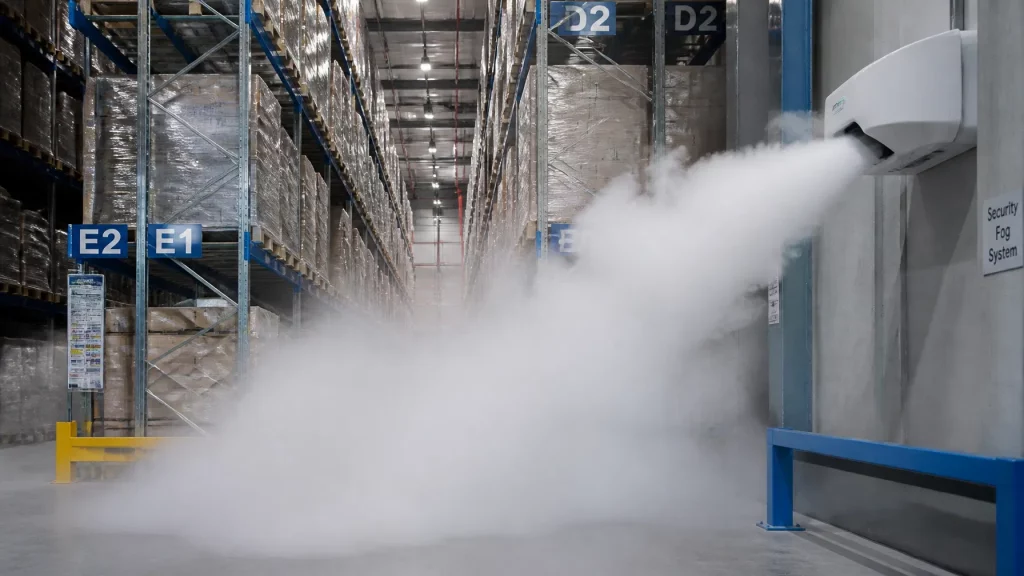
This has led to the widespread adoption of warehouse security fog systems. When an unauthorised entry is detected out of hours, systems like the Density HP14000 can fill a high-bay warehouse aisle with impenetrable fog in seconds.
By obscuring visibility entirely, you provide a physical barrier that stops intruders in their tracks before they can reach high-value stock. It is the ultimate proactive deterrent for 2026, ensuring that even if thieves bypass the perimeter, they cannot leave with the goods.
4. Digital Twins and Brownfield Retrofitting
In 2026, automation is no longer just for 'greenfield' (new-build) sites. Most UK logistics operators are now focused on 'brownfield' optimisation: retrofitting existing warehouses with smart tech.
Digital twins: virtual replicas of a physical warehouse: allow managers to simulate new workflows, identify bottlenecks, and calculate ROI before a single piece of hardware is installed. This reduces the risk of expensive automation projects failing to meet performance targets.
5. Goods-to-Person (GTP) Systems
The 'walking time' of a picker can account for up to 50% of their shift. Goods-to-Person systems reverse this logic. High-density storage robots or shuttles bring the required items directly to a stationary picking station.
This trend is essential for high-volume e-commerce fulfilment where speed is the primary USP. When combined with a Basic Fog System in the goods-in/out areas, these high-efficiency zones remain protected against 'slash and grab' incidents that are increasingly common in the UK.
6. Robots-as-a-Service (RaaS)
One of the biggest barriers to automation has always been the initial cost. In 2026, the 'as-a-service' model has matured. Companies can now lease robotic fleets on a subscription basis. This allows 3PLs and SMEs to scale their capacity during peak seasons (like the run-up to Christmas) without being tied to long-term capital leases for hardware that might be idle six months later.
7. Sustainable Automation and Green Logistics
With the UK's Net Zero targets looming, automation is being viewed through a green lens. Modern AMRs are more energy-efficient than traditional forklifts, and AI-driven routing reduces the total distance travelled by goods within the warehouse. Furthermore, automated high-density storage allows for smaller building footprints, reducing the heating and lighting requirements of massive distribution hubs.
8. Micro-fulfilment Centres (MFCs)
As consumers demand 30-minute delivery windows, the 'mega-hub' is being supplemented by urban micro-fulfilment centres. These are small, highly automated facilities located closer to customer clusters. Because these MFCs often hold high-value electronics or pharmaceuticals in urban areas, they are prime targets for theft. Implementing a Lite Fog System is the standard 2026 approach for securing these smaller, high-risk footprints.
9. Hyper-Personalisation in Picking and Packing
Automation isn't just about moving boxes; it’s about the customer experience. In 2026, automated packing lines can include personalised notes, custom-branded packaging, and eco-friendly void-fill based on individual order data. This level of personalisation was previously too slow for manual teams but is now a standard feature of AI-integrated packing stations.
10. Cyber-Physical Security Integration
As warehouses become 'cyber-physical': where every robot and sensor is connected to the cloud: security has moved beyond the physical fence. Protecting the network is now as important as protecting the loading bay.
The most advanced UK warehouses in 2026 use integrated security hubs that monitor both digital anomalies and physical breaches. For instance, if an AI detects a strange pattern in robot movement, it can pre-arm the security fog systems as a precaution, creating a truly 'active' defence layer.
Key Takeaways for Logistics Managers
- Move beyond passive security: If your security system only records crime, it’s failing. Invest in proactive deterrents like warehouse security fog systems.
- Prioritise software integration: Hardware is a commodity; the real value in 2026 lies in the AI that orchestrates your robots and inventory.
- Scale with RaaS: Don't let high CAPEX stop you from automating. Explore subscription models to stay competitive.
- Protect the 'Goods-In' risk window: Use high-speed automation and instant-intervention security to protect stock during the vulnerable transition from trailer to shelf.
Ready to future-proof your warehouse?
At DNET UK ltd, we specialise in the intersection of high-tech logistics and ironclad security. Don't wait for a breach to happen.
- View our Warehouse Solutions: Secure Warehouse Fogging
- Get an Instant Quote: Automation & Security Quote Tool