A high-value e-bike can be loaded into a van in seconds. Police response to a break-in can take minutes or longer—and often, far longer still. For e-bike shop owners, this gap between intrusion and response is where losses happen. Thieves don’t wait around. Neither should your security system.
This is not a problem an alarm alone can solve.
The Speed of Modern Retail Theft
E-bikes are among the most targeted items in the UK. In 2025, London saw 2,966 e-bike thefts—a 21% spike on the previous year. These are not opportunistic street crimes; organised teams systematically target high-value stock, particularly at night or during gaps in staffing.
A typical smash-and-grab at a retail premises unfolds in a window of 30 to 90 seconds. A trained team can load multiple e-bikes (batteries removed or still attached) into a vehicle in that timeframe. They know police response is measured in minutes, not seconds. They also know that only 1% of bike thefts in London result in any prosecution or arrest.
That gap between the alarm sounding and a physical response arriving is the entire vulnerability.
Why Alarms Fail in the Response Window
An alarm is a signal. It summons help. But it does not stop a thief who is already inside your premises and moving merchandise. A thief who hears an alarm does not freeze or leave; they accelerate. They know they have a short window before anyone arrives.
A study of retail theft over five years found that e-bikes and high-ticket components were moved out of premises fastest under alarm conditions—not slowest. The sound of an alarm actually increases urgency for professional thieves. They have a timeline and they know how to work within it.
This is the core problem: an alarm announces a threat but takes no direct action against it.
97% of thefts are avoided with a fogging system AND an alarm, compared with 17% with an alarm only. Manufacturer figure (Density).
How Fog Closes the Response Gap
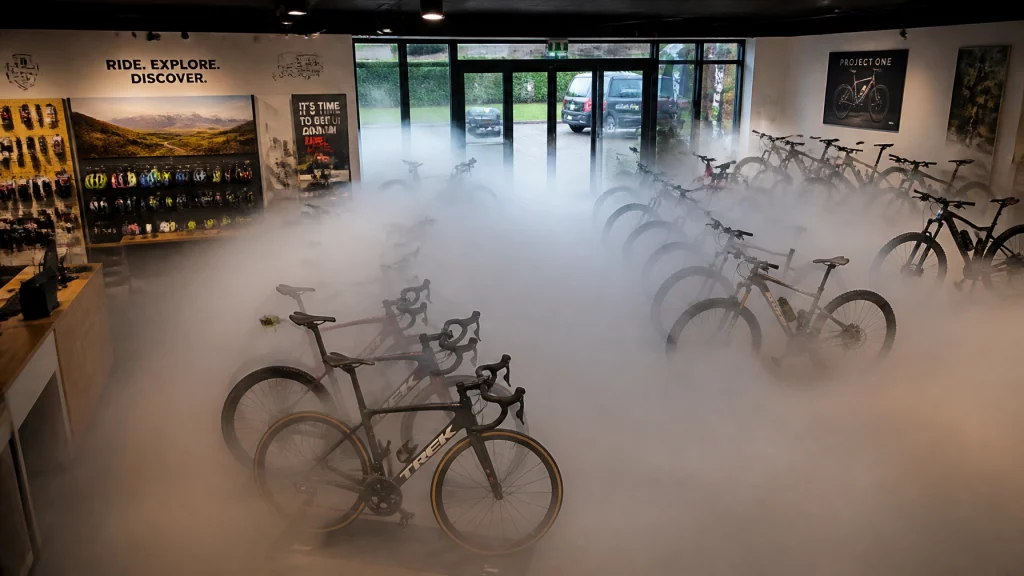
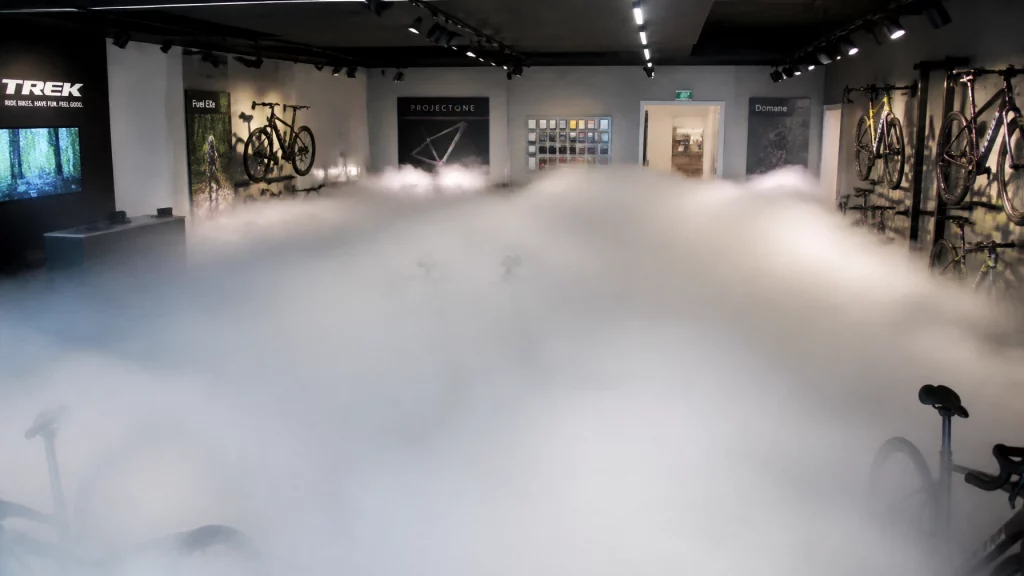
A security fog system fills your premises with a non-toxic mist within 15–30 seconds of an intrusion trigger. Visibility drops to near zero. Thieves cannot identify what they are loading. They cannot move safely through your space. They cannot see exits clearly.
Critically, this happens during the response window—before police arrive, often before any staff member can physically reach the premises.
The fog itself is not aggressive. It causes no damage, no harm to anyone inside. But it is immediately effective. Experienced theft teams will abandon a job the moment fog deploys. They know visibility-zero environments render their speed advantage useless. They cannot work blind and cannot know what they are stealing.
For a typical e-bike shop, fog deployment in seconds is the difference between losing zero bikes and losing your entire nightstock. The financial and operational impact of overnight theft is severe; fogging prevents it during the exact window when thieves expect to operate.
Fog Integrates with Everything You Already Have
You may already have an alarm system, CCTV, sensors on door and window contacts, or a combination of these. A security fog system works alongside all of them. It does not replace your alarm; it amplifies it.
Fog systems are compatible with ALL existing alarm panels. They integrate fully with Ajax systems and connect directly to your CCTV or VMS via LAN or APIs. If you use ActiveCloud remote monitoring, deployment logs and video capture are sent to your phone in real time. You see the intrusion, see the fog deploy, and have a record of exactly when it happened.
For larger premises—a warehouse, a multi-unit retail complex, or a distribution centre—the UNIK fog generator provides instant deployment at any size, from small stockrooms up to 600 m³ of coverage. The UNIK requires zero heat, uses battery backup for up to six months of autonomy, and deploys at the moment an alarm triggers.
Installation is straightforward; integration with your existing security is standard practice.
What “Stops the Break-In” Actually Means
In retail security, “stopping” a theft does not always mean catching a thief. It means preventing the loss of stock. A thief interrupted at the moment of loading—unable to see what is valuable, unable to navigate your space, unable to execute the grab—will abandon the job and leave.
From your perspective, the break-in stopped the moment the fog deployed. Your stock remained in place. Your loss was zero.
This is why fogging systems are rated at such high effectiveness figures for high-ticket retail. The response window is not eliminated; it is controlled. You seize back the initiative during that critical 30–90 second window when thieves expect to operate unimpeded.
Real-World E-Bike Scenarios
Imagine a night-time break-in at a typical e-bike shop: alarm sounds, fog deploys in 20 seconds. Thieves inside cannot identify individual bikes, cannot load quickly, cannot move without bumping into stock they cannot see. They leave within 10 seconds of fog arrival. Police arrive 4 minutes later to find the premises full of fog, the stock intact, and clear CCTV and deployment logs showing exactly what happened and when.
Compare that to an alarm-only scenario: alarm sounds, thieves spend 60–90 seconds loading high-value bikes into a van, they leave before police arrive, your stock is gone, and your shop begins the long process of dealing with insurance claims and inventory recovery.
E-bike shops across the UK face the same choice. The first scenario is becoming standard practice in high-security retail. It is not a luxury; it is cost-effective loss prevention.
Frequently asked questions
Is the fog safe around stock and premises?
Yes. The fog is non-toxic and certified by Eurofins for human and animal safety, with toxicological evaluation to EN ISO 16000-1:2006. It is also tested and certified to Food Contact regulation (CE 1935/2004), making it safe where food or public areas are present. For e-bike retail environments, the fog leaves no residue and clears naturally.
How does fog work with my existing alarm system?
Fog systems are compatible with ALL existing alarm panels—no replacement necessary. They trigger from your standard alarm inputs, integrate with Ajax, and connect to CCTV and VMS via LAN or APIs. ActiveCloud remote monitoring sends deployment logs and alerts to your phone in real time.
Do I need to replace my alarm if I add fog?
No. Your existing alarm remains the detection layer; fog becomes the response layer. The two work together. Your alarm still triggers emergency alerts and police call-outs. Fog now ensures thieves cannot act during the response window.
What size e-bike shop can fog protect?
The UNIK fog system covers up to 600 m³ and is ideal for small to medium e-bike retail spaces, stockrooms, and service areas. Coverage is measured in cubic metres of air volume. A typical compact retail unit might contain 150–300 m³; a standard two-storey shop around 400–500 m³. For larger multi-unit or warehouse premises, larger generators (600 m³, 900 m³, up to 6,000 m³) are available.
How long does deployment take?
The UNIK fog system deploys in 15–30 seconds. Older systems may take longer; modern systems are designed for speed. Thieves expect at least 60–90 seconds before disruption; 30-second deployment collapses their timeline.
Take Back the Response Window
The gap between intrusion and response is where e-bike shops lose stock. An alarm does not close that gap; it announces it. A fogging system closes it in seconds, during the exact window when thieves expect to operate unimpeded.
Learn more about protecting high-value e-bikes and batteries, or explore e-bike shop security solutions. The UNIK fog system is purpose-built for retail environments where speed of deployment and real-time integration matter most. Book a survey to see how fog and alarm together reach that 97% prevention rate for your premises.