Bike shops are a prime target for thieves. Their stock is valuable and easy to move and sell. A smash-and-grab hit on a cycle shop can yield thousands of pounds in just minutes. Understanding why your shop is targeted is the first step to stopping it.
Smash-and-grab has one goal: speed. A thief breaks glass, loads bikes or bags, and leaves. Bike shops are easy targets for this.
Why Cycle Stock Is Prized by Thieves
Bikes—especially mid-range and premium models—have three qualities that make them prime theft targets. First, they carry significant value. A single carbon-fibre road bike or high-spec mountain bike retails for £1,500 to £5,000. Second, they are portable and stack quickly into a van within seconds. Third, they sell rapidly through online marketplaces, scrap dealers, and parts retailers, where buyers rarely ask questions about provenance.
Individual components are equally prized. Groupsets, wheelsets, hydraulic disc brakes, and electronic shifting systems can be dismantled and resold as separate items. A thief can systematically strip high-value drivetrain components from your display within minutes.
The Economics of Bike Shop Smash-and-Grab
A typical bike shop displays between 30 and 100 bikes, each valued at £800 to £1,200. A coordinated gang hitting the shop during closing hours or overnight can remove £15,000 to £40,000 in inventory within 2 to 5 minutes. The risk-reward calculation heavily favours the offender. Standard alarms and CCTV deter some opportunistic theft, but they do not stop organised retail crime networks that operate systematically across multiple locations.
Bike theft remains a significant and persistent crime across the UK. In 2025, police forces in England and Wales recorded 49,085 bicycle theft reports. Whilst retail and workshop environments account for a sizeable proportion, precise breakdowns are not routinely disclosed. Organised criminal networks execute these crimes with tactical precision. They survey the shop thoroughly, identify high-value stock, locate camera coverage gaps, time their attack to avoid peak footfall and police patrol routes, and establish pre-arranged escape routes.
The Smash-and-Grab Sequence
A smash-and-grab strikes with speed and precision. The gang arrives in an unmarked vehicle or on foot. A hammer or crowbar shatters the front window or entry door. The alarm activates, but police response times typically range from 15 to 30 minutes. In that interval, team members load bags or the vehicle with bikes and components and retreat. CCTV footage captures faces, but identification and prosecution proceed slowly. Your stock vanishes, customers lose confidence, and insurance claims span weeks.
The aftermath is expensive. You fix the broken window, restock empty shelves, pay your insurance excess, and refund angry customers. Staff morale drops. Your security reputation suffers.
97% of thefts are avoided with a fogging system AND an alarm, compared with 17% with an alarm only. Density manufacturer figure.
How Security Fog Changes the Outcome
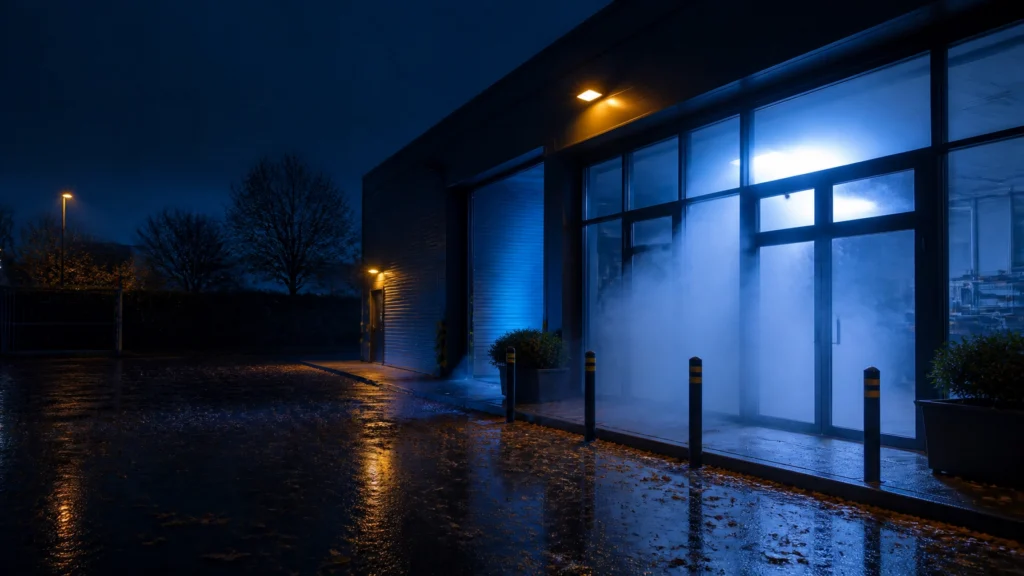
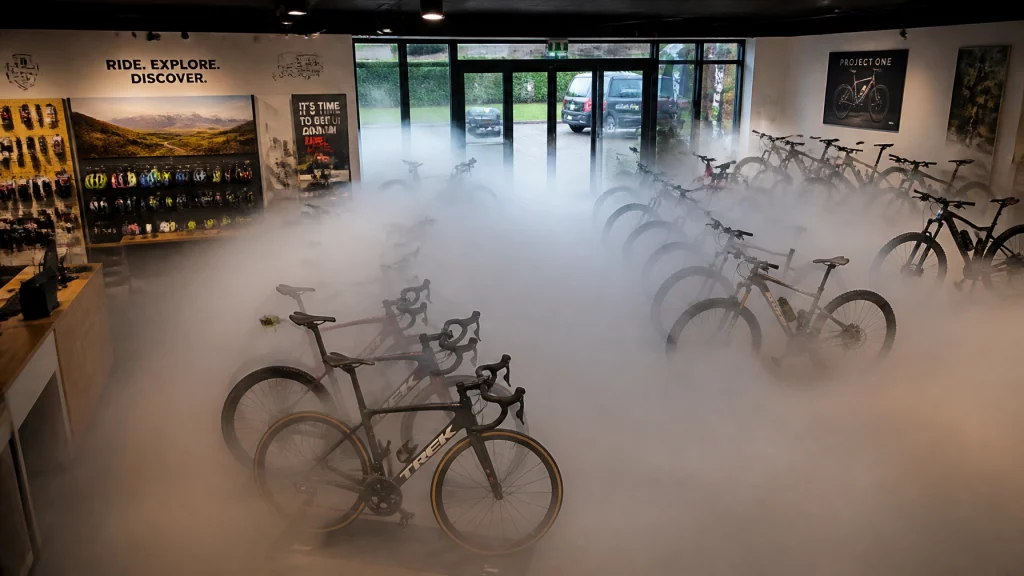
Fogging disrupts the smash-and-grab calculus fundamentally. A thief cannot see what they are targeting or stealing. A security fog system activates within seconds of a forced entry and fills the retail space with a thick, harmless mist. Visibility drops to near-zero. Offenders cannot identify valuable bikes, extract components with precision, or navigate exits without stumbling, colliding with stock, or becoming disoriented.
The system meets EN 50131-8:2019, an international safety standard. The fog is non-toxic and safe for occupied spaces. It leaves no residue and does not stain stock. Combined with an alarm, it is powerful. A thief knows that entering means being blinded, losing their way, and being caught.
The UNIK Fog System is a good example. It turns on in seconds, uses instant fog generation with no heat, and runs on battery for up to six months. For your bike shop, this means round-the-clock protection—opening, closing, and overnight—without power reliance or slow response.
Integration With Your Existing Alarm
Fogging works best with alarms. Most bike shops already have CCTV, door alarms, and panic buttons. A fog system connects to your alarm panel without extra wiring or complex work. When the alarm goes off, the fog turns on. The two act as one system. This layered approach combines visible deterrents (cameras and signs) with active deterrents (fog), making your shop unattractive to gangs.
Good bike shop security has many parts: barriers, stock layout, cameras, and emergency plans. The Complete Guide to Bike Shop Security covers each one. Fogging is the last active line of defence—it stops thieves once they break in.
Frequently asked questions
Will fogging damage my bikes or components?
No. The fog is non-toxic and residue-free. It dissipates within minutes of deployment. Bikes, electronic systems, and components sustain no damage. The fluid is certified to Food Contact Regulation (CE) No. 1935/2004, meaning it is safe even in food retail environments.
Can customers get stuck in the fog during an emergency?
Fogging only turns on when the alarm goes off, which happens when doors or windows are forced. This usually happens when customers are not there. If a customer is inside during a break-in, the alarm alerts staff and police. Customers know their way out using familiar exits (till area or back door). The fog helps them escape by blocking a thief from chasing them.
What coverage do I need for a typical bike shop?
Coverage is measured in cubic metres (m³), not floor area. A typical bike shop needs roughly 270 to 400 m³ of coverage. The UNIK system covers up to 600 m³, so it works for most bike shops, including multi-storey ones. A site survey will confirm your exact needs.
How does fogging deter theft compared to CCTV alone?
CCTV records what happens; fogging stops it happening. A thief will risk being filmed. They will not risk being blinded. Fog turns the situation from “slow police arrival” to “instant blindness.” The 97% avoidance rate shows how well fog and alarm work together.
Can fogging be triggered by accident (false alarms)?
Fog only turns on when the alarm goes off. Good systems use two sensors or time delays to prevent accidents from bumps or shakes. After install, your alarm engineer will set the sensitivity for your shop.
Moving Toward a Secure Retail Environment
Smash-and-grab theft is not inevitable. It is a crime based on easy opportunity. By adding barriers, alarms, cameras, and fog, you change the odds. Thieves target shops where they can move fast and unseen. Your shop becomes one they skip.
For more on securing your stockroom and workshop, see our bike shop security guide. If you are thinking about adding fog to your security setup, the UNIK Fog System deploys fast, leaves no residue, and works with your alarms.
Book a free site survey to talk about your layout, stock, and security needs. Our team will assess your space and suggest the right security options for your shop.