Depot theft is a significant problem in UK logistics. While transfer points and loading bays face coordinated raids, overnight depots present a distinct threat: reduced staffing, limited visibility, and perimeter access points that become harder to defend after dark. Active deterrence—beyond just alarms—is now essential.
The risk grows during 8–12 hour overnight windows. Organised teams with site knowledge can breach a standard perimeter, find high-value cargo, and remove it before morning staff arrive. Alarms and CCTV only record what happened. They don’t stop theft.
Why Overnight Is the Weak Point
Organised gangs specifically target depots during night hours. Staffing levels reduce significantly. CCTV monitoring is often remote, introducing response delays. Entry points—loading doors, overhead doors, perimeter gates—become harder to defend when fewer personnel are on site. This combination of factors creates an ideal theft window.
An experienced thief working with knowledge of the site layout can operate with considerable speed. They can identify high-value pallets, breach a loading door, and load a vehicle within 20 minutes. By the time an alarm notification reaches the property owner or emergency services, the vehicle is already departing. This delay—the gap between detection and actual response—is precisely where the vulnerability lives.
This is where detection-only security fails. A camera detects an intrusion. An alarm sounds. But the thief is already loading cargo. Detection responds after the theft starts. Prevention stops it before it starts. That difference determines whether your cargo leaves.
Active Fog Stops Theft Before It Starts
Active security fog operates on a fundamentally different principle from traditional alarms. It makes theft physically impossible, not merely detectable. Where an alarm records what happens, fog prevents it from happening.
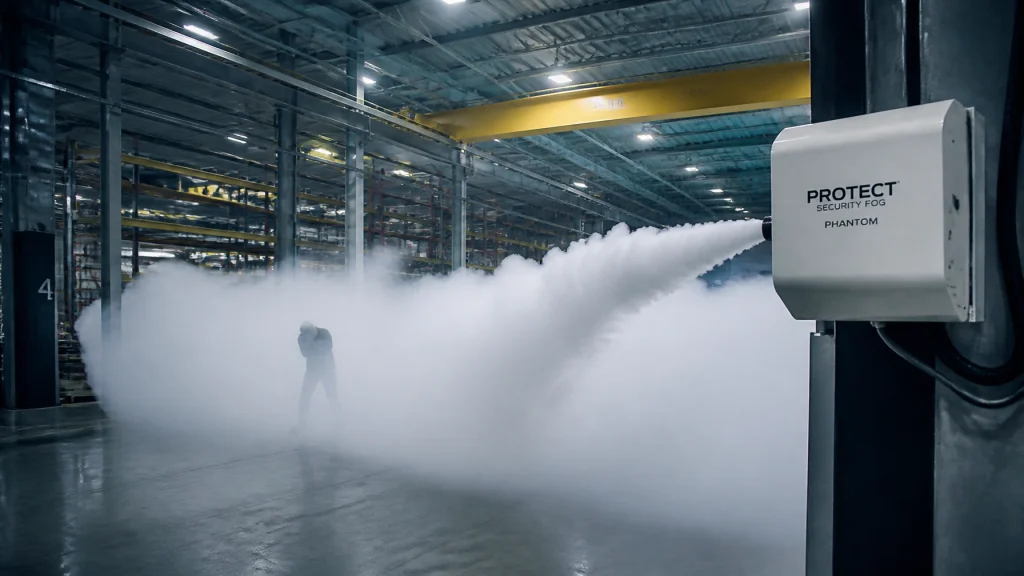
When a sensor detects a breach or a door is forced, the system activates instantly. Dense fog fills the space within seconds. Visibility drops to near-zero. An intruder cannot find cargo. They cannot move safely. They cannot load a vehicle. The physical risk rises—collision and falls become real hazards. Most critically, they cannot gather intelligence or record container locations for future jobs.
The fog is non-toxic and independently certified by Eurofins. It is safe for humans, animals, and plants. It meets Reg. (CE) No. 1935/2004, the EU food-contact standard. This means it can be used in food storage areas without harming products or breaking regulations.
97% of thefts are avoided with a fogging system and an alarm, compared with 17% with an alarm only. Density® manufacturer figure.
That jump—from 17% to 97%—represents the difference between documenting crime and stopping it. An alarm alone allows some theft to happen. Fog alone has limitations. But fog plus an alarm makes theft impossible. Fog provides physical prevention instantly. The alarm provides monitoring and response. Together, they close all paths for success.
System Scale Matches Depot Layout
Depot size determines system choice. The HP6000 covers up to 6,000 cubic metres. The HP14000 covers up to 14,000 cubic metres. Both are sized for complete coverage with no dead zones.
Both activate instantly when a sensor detects a breach. No delay. No warm-up. Fog reaches full density in seconds—faster than any cargo removal can complete safely.
The fog clears naturally as ventilation restores standard air exchange. It leaves no residue, no staining, and no damage to stored cargo of any type.
This zero-residue characteristic is one reason the technology is increasingly adopted in high-value depot environments. Unlike some deterrent approaches, active fog doesn’t compromise the merchandise it protects.
Integration With Existing Security
Fog doesn’t replace existing alarms. It integrates with them. The system is compatible with all alarm panel types and fully works with Ajax. Your team can monitor activations and system status live via free ActiveCloud access from anywhere.
VMS platforms connect via API or LAN. This creates a unified timeline showing what triggered the fog, when it deployed, and the full sequence of events. This record helps with investigation and operational review.
Why Deterrence Wins Over Detection
Many managers think alarms plus CCTV is enough. Both offer value, but both work after the theft. You see the footage. You report it. Police are called. But cargo is gone.
Organised teams know this. They plan around it. Detection documents crime. It doesn’t stop it.
Fog is different. The deterrent is visible and unmistakable to thieves. When word spreads that a depot has active fog, most gangs move to easier targets. Those who try discover visibility collapses the instant they breach the perimeter. They abort and leave. The deterrent is immediate and measurable—reflected in the 97% avoidance figure when fog and alarms work together.
This is why the 97% avoidance figure holds such weight. Fog doesn’t just catch fewer thieves; it stops them from trying.
The Certification Assurance
Density systems meet EN 50131-8:2019, the professional standard for security equipment. They also meet CE, EMC, and FCC requirements. The fog is independently certified as non-toxic.
These certifications matter. They confirm the system is designed, tested, and safe. They protect against regulatory and liability risk. They provide insurance documentation.
Density systems operate in over 80 countries. UK operators get proven, internationally validated technology with lower implementation risk.
Frequently asked questions
Will fog damage cargo stored overnight?
No. The fog is non-toxic and leaves no residue. It does not interact with packaging, pallets, or product materials. It clears naturally within minutes once ventilation restores normal airflow. Most depots operate on scheduled ventilation cycles, so the fog dissipates long before morning shift staff arrive for work.
How fast does fog activate?
It starts instantly when a sensor detects a break-in. The space fills within seconds. No delay. The thief can’t get far before they’re lost in fog.
Can I use fog in a food storage depot?
Yes. The fog meets Reg. (CE) No. 1935/2004, the EU food-contact standard. It is safe around food. It leaves no residue on products or packaging.
Does fog work with my existing alarm?
Yes. It fits all alarm panel types and integrates fully with Ajax. You get free ActiveCloud remote monitoring. If you use a VMS, the system connects via API or LAN to log all events.
Can the fog trigger by accident if staff are working at night?
No. The system only triggers on perimeter breaches or door contacts, not routine staff movement. During installation, your sensors are set so that legitimate entry points (like a staffed door) don’t set off the fog. Your team can also manually disable the system if needed.
Overnight depots need active defence, not just cameras and alarms. When cargo sits unattended for hours, the theft window is wide. Active fog closes it. It stops theft the moment an intruder crosses the perimeter. With a monitored alarm, it shifts security from finding crime to preventing it.
If your depot is concerned about overnight theft, a security fog system is worth exploring. We can survey your site, size the coverage, and show how it fits your existing alarm setup. Learn about our logistics security solutions, or see the HP-series coverage models. For more on high-value freight security, read our guide to defending freight against organised crime. Get in touch to book a survey and assessment.