Organised crime groups targeting distribution operations don’t strike at random. They follow a deliberate planning cycle: identify a facility, monitor its routines, map its vulnerabilities, then move in with precision. Understanding how these crews work is the first step toward defending against them.
Your distribution hub runs to a rhythm. Shifts change at predictable times. High-value consignments arrive on known schedules. Particular routes carry cargo worth targeting. Organised crime operators know all of this—and they’re watching.
The Surveillance Phase
Criminal groups invest weeks or months observing a site before a theft occurs. They note guard patrol patterns, camera blind spots, and the times when fewer staff are present. They track which delivery drivers arrive when, which routes carry what cargo, and how long gaps last between security checks.
This isn’t guesswork. They study supply chains, driver schedules, and cargo values. They find vulnerable stopping points on major routes. They plan attacks with precision.
They recruit insiders—staff, drivers, or contractors. These insiders pass information about high-value loads, shift patterns, and security weaknesses. One in five cargo theft incidents globally involve insider help.
Warehouses across the UK account for 41% of all recorded cargo theft incidents in Europe. This makes distribution hubs prime targets. UK freight theft losses jumped from £68 million in 2023 to £111 million in 2024. The true cost is even higher when you add vehicle damage, supply chain disruption, and insurance increases.
Mapping Your Vulnerabilities
Once observation is complete, criminals map your operation’s weak points.
- Loading dock congestion—where vehicles linger unattended
- Shift-change handover gaps when alertness dips
- Perimeter fencing with access points cameras don’t cover
- Busy periods when staff can’t monitor everything
- Night hours or early mornings with minimal presence
They study your cargo handling procedures. Do goods sit in vehicles awaiting collection? Do container seals get checked visibly or routinely? Where are expensive electronics, tools, or branded stock stored—and how long could a crew access them?
Tactics: From Insider Fraud to Smash-and-Grab
Organised groups use multiple methods depending on what they learn.
Insider diversion. A corrupt staff member signals that a high-value load is about to leave, ensuring criminals are ready to intercept it en route or at a transfer point.
Forged pickups. Criminals fake being licensed carriers. They arrive with fake paperwork and take goods. By the time the real driver shows up, the cargo is gone.
Violent forced entry. After weeks of watching, a crew arrives with vehicles and staff. They breach the perimeter, overwhelm security, and take entire loads. These raids target specific high-value shipments they’ve already spotted.
Curtain-side attacks. For HGVs in transit or at rest, organised thieves use cutting tools to slash the side of trailers, quickly identify what’s inside, then return with transport to extract entire loads.
Gangs now exploit real-time tracking data and freight management systems. They use phishing emails and hacking to monitor where shipments go. This lets them hit loads at their weakest points.
The Digital Dimension
Modern organised crime isn’t just boots on the ground. Criminals use AI to build phishing emails and malware. They target warehouse management systems. A breach of your freight data system can leak schedules, cargo types, values, and driver information.
They blend this digital data with their physical surveillance. Now they know exactly which loads to target, when to strike, and how to move them.
Why Standard Security Falls Short
CCTV alone doesn’t stop a coordinated raid. Alarms can be triggered, but by then goods are already being moved. Locked gates slow entry but don’t prevent it. Trained security staff are outnumbered if the crew is large enough.
What stops determined thieves is the immediate and overwhelming loss of visibility and control. Active fogging systems do exactly this.
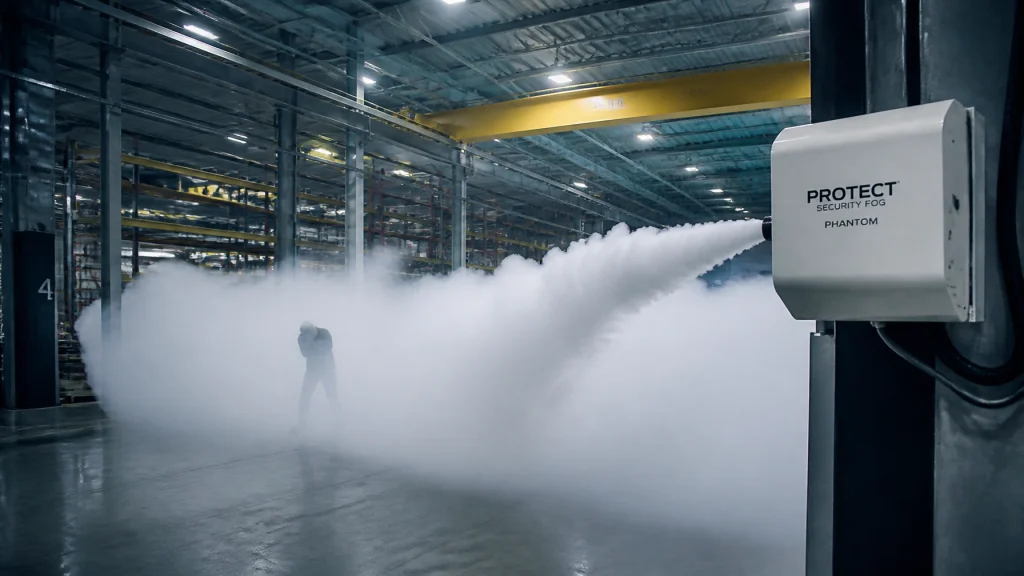
When an intrusion is detected at your distribution hub, a logistics-scale fogging system deploys dense fog that fills the entire space within seconds. Criminals cannot see what they came to steal. They cannot move safely. They cannot load cargo. The fog triggers your alarm, alerting authorities, and the criminals have no choice but to abandon the attempt.
A Density HP system can protect spaces up to 6,000 or 14,000 cubic metres—covering everything from single-warehouse units to large multiyard distribution hubs. The fog is non-toxic, food-safe, and compatible with all alarm systems.
Research shows that 97% of thefts are avoided with a fogging system AND an alarm, compared with 17% with an alarm only (Density manufacturer figure). For a sector where organised crime invests weeks planning an attack, active fog eliminates the ROI: they can’t complete the theft regardless of how well they’ve prepared.
Adding Fog to Your Defence Strategy
Fogging is part of a layered approach. It works alongside CCTV, perimeter security, staff training, and access controls. But it’s the layer that stops the theft at the moment it matters.
Learn more about defending high-value freight against organised crime and how fogging fits into a comprehensive security strategy for distribution operations.
Frequently asked questions
How do criminals decide which distribution sites to target?
They watch for sites with predictable routines, known high-value cargo, shift gaps, and weak perimeter security. They use insiders or public freight data. They check police response times and local enforcement.
Can active fog be deployed in a site with regular staff presence?
Yes. Fogging systems are designed to trigger only on alarm activation. During normal operation, nothing is discharged. Staff work normally without any impact from the system. The fog is non-toxic and food-safe, certified by Eurofins and compliant with EN ISO 16000-1:2006, so it poses no hazard to workers or goods.
What cargo doesn’t require security fogging?
Sites holding low-value, bulk, or non-perishable goods may face lower organised crime risk. However, any distribution hub handling electronics, tools, branded stock, pharmaceuticals, or speciality foods is a high-priority target.
How long does fogging deployment take?
Deployment within your security system takes seconds once an alarm is triggered. Installation and system design can be completed within weeks, depending on site size and alarm integration. The system meets EN 50131-8:2019 and integrates with all major alarm panels.
Is fogging effective if criminals arrive in large numbers?
Yes. Numbers don’t matter if the space becomes completely obscured and the alarm has triggered police dispatch. Organised gangs cannot steal what they cannot see, and they cannot move safely in dense fog. The objective—fast extraction—becomes impossible.
Your distribution hub is valuable precisely because it’s organised, predictable, and efficient. Organised crime exploits those same qualities to plan attacks. Adding active fog removes the theft window they’re counting on. Interested in learning how fogging fits your site? Get in touch for a security survey and quote tailored to your operation.