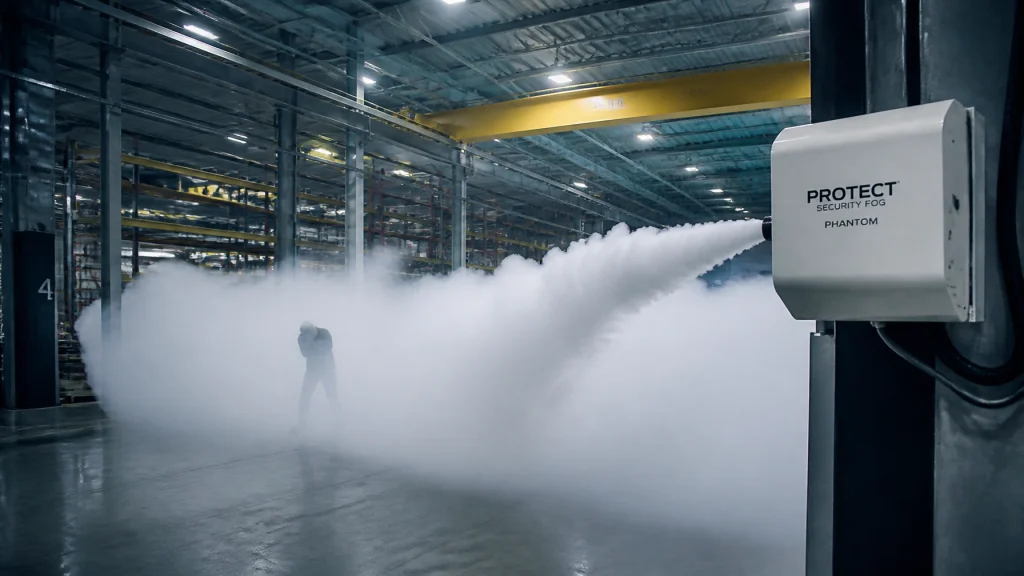
Security fog protects the air above high racking because it fills a space by volume, not by floor level. When it deploys, dense fog rises and spreads through the full height of the building, so the stock sitting metres up is hidden just as fast as the goods on the floor.
That is the gap it closes. Cameras and lighting work best at ground level and along aisles; the upper racking is where their view runs out. Fog does not have that limit — it occupies the whole volume it is sized for.
Why height is the weak point
In a high-bay warehouse, most of the value is stored well above head height. A fixed camera can watch an aisle, but it struggles to see what is happening on the top racking, especially across a large or poorly lit floor. Lighting fades with distance and angle, and a determined intruder who knows the layout heads straight for the high, hard-to-watch bays.
A passive system records the event from below. It does nothing to stop someone reaching stock the camera cannot properly cover. The footage may help afterwards, but the goods are already gone — and at height, the footage is often the least clear.
Why height defeats other measures
A grille protects a window. A bollard protects a door. Neither does anything for stock sitting four metres up on a rack in the middle of the floor. Height is the one dimension most physical security ignores, because barriers work at the edges of a building while the value sits in its volume.
Fog is the rare measure that treats that volume as the thing to protect, filling it from floor to roof rather than guarding a perimeter the intruder is already inside. That is why it pairs so well with the perimeter and detection layers most sites already have: it covers the space they cannot.
How the fog covers the full height
It fills, it does not spray
Security fog is not a jet aimed at a doorway. On a confirmed break-in, the unit releases a dense cloud that expands to fill the protected volume, occupying the whole space — floor to roof — so visibility drops to almost nothing at every level, including the top of the racking. And it is not a momentary burst: the cloud holds, so the space stays unusable to an intruder rather than clearing in a few seconds.
Sized by volume to reach the top
Because coverage is measured in cubic metres, the system is sized to the real height of the building, not just its footprint. The HP Line is built for this scale: the HP6000 covers volumes up to 6,000 m³ and the HP14000 up to 14,000 m³, with units placed so the cloud reaches the high-value bays first and is not blocked by solid racking runs.
97% of thefts are avoided with a fogging system and an alarm, against 17% for an alarm alone (Density® manufacturer figure). The fog stops the theft at the height where cameras lose sight of it.
Fast enough to matter
Speed is the point. An in-progress break-in is usually over in minutes, so a deterrent that takes effect later is no deterrent at all. The fog fills the space within seconds of a confirmed alarm — inside the window a burglary actually lasts — which is what lets it stop a theft rather than simply document one.
It links to the system you already run, firing only on a confirmed intrusion. Density units are compatible with all existing alarm panels and fully compatible with Ajax, can be monitored remotely through ActiveCloud, and meet EN 50131-8:2019. Because it works off the alarm you already trust, there is no second system to learn — the fog is simply the part that acts when the alarm confirms someone is inside.
Safe and clean at any height
The fog is non-toxic and Eurofins-certified, and it leaves no residue on stock high or low, so there is no clean-up and no damaged goods after it deploys. It is also tested to the Food Contact regulation, Reg. (CE) No. 1935/2004, so it is safe even where food is stored on upper racking. Once the alarm is reset and the space ventilates, the warehouse goes back to work.
Frequently asked questions
Does security fog reach the top of high racking?
Yes. The fog fills the protected space by volume, rising to the full height of the building, so stock on upper racking is obscured as quickly as goods at floor level — provided the system is sized to the real cubic-metre figure.
How fast does the fog fill the space?
Within seconds of a confirmed break-in — well inside the few minutes an intrusion typically lasts — cutting visibility to near zero throughout the protected volume, and holding rather than clearing straight away.
Will the fog damage stock stored high up?
No. The fluid is non-toxic, Eurofins-certified and residue-free, so stock and equipment are unharmed at any height and there is no clean-up afterwards. It is also tested to the Food Contact regulation, Reg. (CE) No. 1935/2004, so it is safe even where food is stored on upper racking.
Does it replace my cameras and alarm?
No — it completes them. Cameras and alarms detect and record; fog stops the theft in the space they cannot fully cover. It triggers from your existing alarm, so the layers work together.
Cover the racking your cameras can’t
See how active fog protects high-value stock and racking, view the HP Line for large sites, or book a survey.