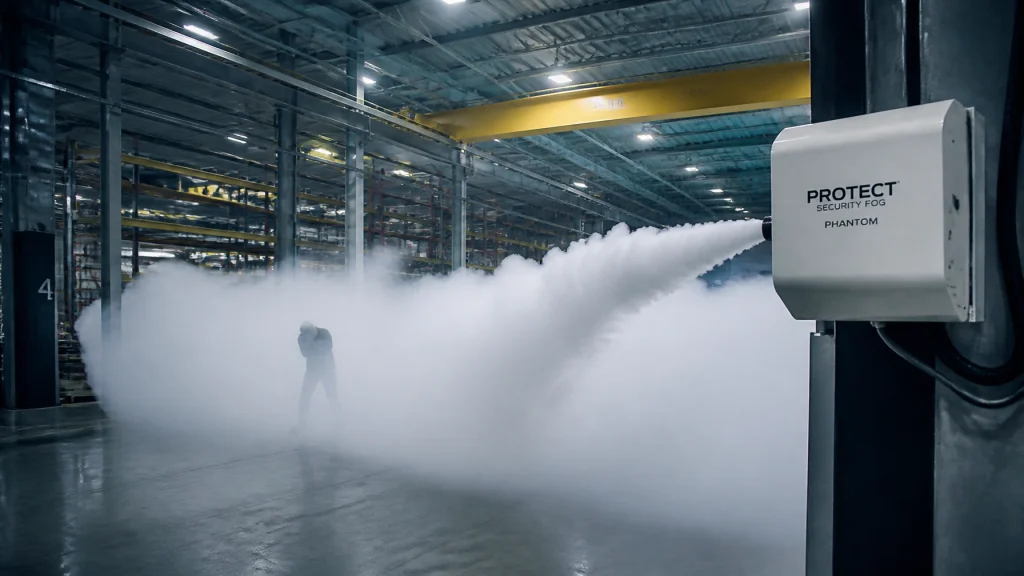
Fog coverage in a warehouse is sized by volume, not floor area. You work out the cubic metres of the space you need to protect, then match fog units to that figure. Size it by floor area alone and the system will be too small, because it ignores everything above head height — which, in a warehouse, is most of what you are protecting.
That single distinction decides whether a system works. Get it right and the whole protected space goes dark to an intruder in seconds. Get it wrong and you have paid for cover that stops at the top of the aisles.
Why volume, not square metres
A burglar in a high-bay warehouse does not work at floor level. Stock sits metres up, on racking a fixed camera often cannot see past. Security fog rises and fills the full height of the room, so the honest measure of what it protects is length × width × height — the volume in cubic metres.
Floor area describes a footprint. It tells you nothing about an 8-metre eaves height or a mezzanine, and those are exactly where the value sits. A system quoted on square metres can clear the gangways while leaving the upper racking visible — which is the part you most needed to hide.
How to size a system
Measure the real volume
Take the internal dimensions of each area you want to protect and multiply them out. A unit 40 m long, 25 m wide and 8 m to the eaves is 8,000 m³ — not a “1,000 m²” figure. Use the true clear height, not a rounded guess, because under-measuring height is the most common way a system ends up too small.
Treat the building as several spaces
Few warehouses are one simple box. A high-bay store, a lower mezzanine, a separate goods-in hall and a caged high-value area are different volumes with different priorities. Measure each on its own. You may choose to protect the high-value cage and the main racking heavily, and treat a low-risk empties area differently. Averaging the whole building into one number hides those decisions rather than making them.
Match units to the figure
Density’s HP Line is built for warehouse scale. The HP6000 protects volumes up to 6,000 m³ and the HP14000 up to 14,000 m³. Larger or awkward sites combine several units, each sized and aimed at the volume in front of it, rather than relying on one generator to reach the far corners of a big floor.
A single HP14000 covers volumes up to 14,000 m³ — enough to blanket a sizeable high-bay area in seconds, including the racking your cameras struggle to watch.
The mistakes that undersize a system
Two errors come up again and again. The first is sizing to floor area and forgetting the height, which leaves upper racking exposed. The second is treating one big number for the whole building, when the real layout is several volumes that each deserve a decision.
A third is ignoring obstructions. Solid racking runs, full-height partitions and large machinery shape how fog spreads, so the number of units and where they sit matter as much as the headline output. A generator in the wrong place can leave a shadow exactly where the high-value stock lives.
What a survey settles
A short site survey turns the rough volume into a real plan. It confirms the clear height and the separate volumes, identifies the high-value zones to prioritise, and fixes how many units go where so the fog reaches those zones first and is not blocked by the racking. It also confirms the practical things: power, mounting positions, and how the system ties into the alarm.
That integration is part of the sizing job, not an afterthought. The fog only fires on a confirmed break-in, so it has to read the alarm correctly. Density units are compatible with all existing alarm panels and fully compatible with Ajax, can be monitored remotely through ActiveCloud, and meet EN 50131-8:2019 alongside CE, EMC and FCC.
Sizing for a working warehouse also means planning for change. Racking gets reconfigured, mezzanines get added, and a quiet bay becomes a high-value store when product mix shifts. Quoting a little headroom into the volume, and choosing unit positions that still make sense if the layout moves, saves resizing the system every time the operation changes.
Frequently asked questions
How is warehouse fog coverage measured?
By volume in cubic metres — length × width × height of the space — not by floor area. This accounts for the full height of the building, including above high racking where most of the value is stored.
How much volume can one unit cover?
The Density HP6000 protects volumes up to 6,000 m³ and the HP14000 up to 14,000 m³. Larger sites combine several units, each sized to the volume it covers.
What if my warehouse has very high racking?
That is exactly why volume sizing matters. The fog fills the full height of the space, so tall racking is covered as long as the system is sized to the real cubic-metre figure rather than the floor plan.
Do I need more than one unit?
Often, yes. Large floors, separate rooms and obstructions such as solid racking or partitions mean several units, each aimed at its own volume, protect a site more reliably than one generator trying to reach everywhere. A survey confirms the number and placement.
Size your warehouse fog system correctly
Get the coverage right the first time. Read how active fog protects high-value stock and racking, view the HP Line, or book a survey to confirm the volumes on your site.